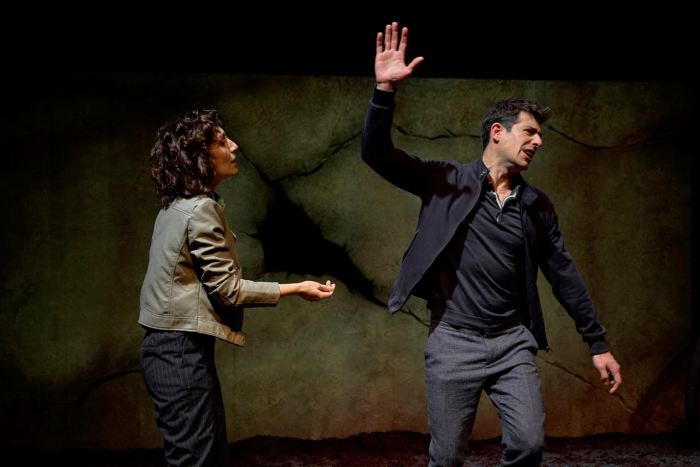
translated from the Spanish by Michael Grundmann and Clara Ministral
☆ 2025 Eurodram English-Language Committee Selection
Bios
Alberto Conejero is a playwright and poet. Born in 1978 in Vilches, in the province of Jaén in Southern Spain, he holds a degree in Stage Direction and Playwriting from Real Escuela Superior de Arte Dramático and a PhD from Universidad Complutense. His plays include En mitad de tanto fuego, El mar: visión de unos niños que no lo han visto nunca, La geometría del trigo (The Geometry of Wheat), Los días de la nieve, Todas las noches de un día, La piedra oscura (The Dark Stone), Ushuaia and ¿Cómo puedo no ser Montgomery Clift?. He has also written and provided dramaturgy for modern adaptations of several classic works, including Pineda (Ballet Flamenco de Andalucía), Medea (Teatre Lliure), Electra (National Ballet of Spain and Teatro de la Zarzuela), Fuenteovejuna (National Classical Theatre Company) and Troyanas (Mérida International Classical Theatre Festival).
Clara Ministral studied Translation and Comparative Literature in Spain and the UK and has been translating fiction and non-fiction from English to Spanish for 15 years. She divides her time between Madrid and Belfast and currently runs Wheeker Books, a project intended to introduce Northern Irish literary works to Spanish-speaking publishers and audiences. In 2024 she co-founded Entre Bambalíneas, a Madrid-based collective focused on exploring and promoting global theatre in Spanish translation.
Michael Grundmann is a qualified teacher with a background in philosophy and politics. He has travelled widely, lived in several Spanish-speaking countries and, aside from translation, works as an international tour guide. He lives in London.
Introductory note, The Geometry of Wheat
The playwright Alberto Conejero is the author of an extensive body of work characterized by strong academic foundations, a firm ethical commitment and an artistic sensibility which have helped cement his status both internationally and as one of Spain’s leading contemporary playwrights. His profoundly lyrical plays are noted for their probing explorations of identity, memory, desire and human relationships, as well as their connection to social and historical topics, and their focus on marginal or historically silenced characters.
The Geometry of Wheat (2018) is a deeply personal piece which also marked Conejero’s debut as a stage director. It met with widespread critical and popular acclaim in Spain and, in 2019, earned him a National Award in Playwriting. The story, with its clear Lorquian overtones, found its initial inspiration in an episode from his mother’s youth in their hometown of Vilches (Jaén). It explores family bonds in his native Andalusia and the way the past—historical, familial, political—ripples down through to the present day. It also examines the intersection of the rural and urban, offers a penetrating analysis of the changing nature of society between generations, and considers the complexities of identity in times of transformation and crisis.
From a translation perspective, maintaining the lyrical nature of Conejero’s writing was a testing proposition. The language spoken by the characters is sparse yet beautiful; highly economical yet full of meaning. We often compared it to translating poetry, whilst being aware of the need to maintain the unforced qualities of the original so that the dialogue remains as natural as it is in Spanish. Throughout the play, there is a continual thread between scenes—reflective of the ongoing dialogue across different timelines and places—which is skillfully expressed through repetition, echoes and resonances in the original script. Consequently, we had to undertake a thorough analysis of the Spanish text and make extremely precise word choices to ensure this aspect was successfully rendered.
One further challenge was the presence in the original script of two languages, Spanish and Catalan, the latter being sometimes used by the characters of Joan and Laia (with Spanish translations provided by the author as footnotes). In the original text, the playwright includes a note that these characters’ lines should partly be performed in Catalan; depending on the location of the performance, the number of lines spoken in Catalan may vary. Due to the significant linguistic similarities between the two languages, it can be considered that a typical Spanish-speaking audience is broadly able to follow these parts of the conversation, though most non-Catalan-speaking audience members would very likely not understand all the details.
The use of one language or another is not only an integral part of these characters’ identities—in a play where identity is an overarching theme—but this device also reflects a linguistic reality which is specific to Spain and not necessarily easily translatable to other contexts. Whilst we feel this linguistic difference could be incorporated into any potential English-language production through the use of a different accent or dialect, we have elected to leave this choice to the discretion and creativity of future actors and directors. Consequently, our translation is fully in English and, in the text that we present here, there are no linguistic indicators that set Laia and Joan’s English apart from that which is spoken by the other characters. Instead, the lines in the original script that are in Catalan are written here in bold, offered simply as a starting point from which we would encourage any future theatremakers to create a new linguistic reality within the universe of the play that works in the specific English-speaking context in which any performance might occur.
—Michael Grundmann and Clara Ministral
The Geometry of Wheat (La geometría del trigo) was translated into English with support from Fundación SGAE. This work is protected by copyright and may not be used for any public purpose, including but not limited to performance, publication, broadcast or adaptation without the permission of both the playwright and the translators.
The Geometry of Wheat
When I remember you on my bed, when I think of you through the watches of the night.
—Psalm 63
Si un adéu d’amor fos encara amor.
—Lluis Llach
Tu suffoques, tu blêmis à présent qu’a sonné l’heure
Des adieux à jamais (ouais)
Je suis au regret de te dire que je m’en vais
Je t’aimais, oui, mais.
—Serge Gainsbourg
Characters
JOAN, 35
LAIA, around 30
ANTONIO, 35
BEATRIZ, around 30 / and around 60
EMILIA, around 60
SAMUEL, around 30 / and around 60
Notes
Although BEATRIZ, SAMUEL and ANTONIO appear in different times and at different ages, each character is to be played by only one actor. What the audience should experience is a single voice that unfolds in two time streams and not a performer portraying a body at two different stages in life.
The sign (/) in the dialogue indicates that the next line overlaps or that the character does not finish the sentence.
Even though different settings occur throughout the play, these locations will appear on stage as an unbroken, continuous whole. Thus, a room in Barcelona may look out onto a rocky headland in Southern Spain, or a motel room may lead to a headframe above a mine shaft. The characters will move across time and space as they observe, as they dream, as they reflect.
1
The letter
A bedroom in a flat on the outskirts of Barcelona. Through the open window glides the gentle hum of the city on a summer’s night; voices ebbing and flowing, the sound of car horns and the nearby sea. JOAN is sitting on the unmade bed, an open suitcase by his feet and a crumpled piece of paper in his hand. From somewhere, BEATRIZ watches him read. JOAN folds up the piece of paper nervously and tucks it away. A few seconds later, he suddenly gets up; opens and closes drawers, puts some clothes in the suitcase, shuts it. He is unaware that LAIA has entered a few seconds earlier.
LAIA: What are you doing?
JOAN: I decided to go in the end.
LAIA: And when were you planning on telling me this?
JOAN: I changed my mind.
LAIA: You changed your mind. None of this makes any sense.
JOAN: Probably not. (Short pause.) I was going to call you.
LAIA: I brought us some dinner. Chinese, thought you’d like that. They’d run out of / Joan, did you manage to get hold of your mother?
JOAN: She hasn’t picked up the phone since last night.
LAIA: Did you try going to the house?
JOAN: Her shutters are down. She’s not there.
LAIA: Of all the times to leave.
JOAN: Of all the times to leave. Do you think I understand what goes through her head? (Pause.) I can’t find my black trousers.
LAIA: You don’t have any black trousers. Why don’t we just take a moment and think this through calmly?
JOAN: What do I need to think through?
LAIA: We discussed this, Joan. We were going to wait to find out more, for your mother to give you some kind of explanation.
JOAN: They’re going to bury my father. I don’t have the time to /
LAIA: They’re going to bury a man who happens to be your father. (Extremely short pause.) I’m sorry.[1]
JOAN: It’s OK.
LAIA: What I meant was /
JOAN: Really, it’s OK.
LAIA: Does this have anything to do with us?
JOAN: Why would it have anything to do with us?
LAIA: Don’t you think we should talk about it? You know, a decision like this /
JOAN: It’s only a short trip. I didn’t want to bother you.
LAIA: Bother me?
JOAN: You’ve got a lot of work on.
LAIA: You never even met him.
JOAN: You’ve always got too much work on.
LAIA: I’ll make some calls.
JOAN: What?
LAIA: I’ll let them know /
JOAN: But Laia, sweetheart, there’s really no need. You can save yourself the long journey.
LAIA: They owe me a few favours.
JOAN: I can honestly do this by myself.
LAIA: It’ll only be a couple of days, right?
JOAN: Yes, but really there’s no /
LAIA: I’m not going to leave you on your own.
JOAN: I’ve told you there’s no need.
LAIA: No, but I’m coming with you.
LAIA exits. JOAN zips up the suitcase slowly. He sits down on the bed to wait. He takes out the piece of paper again. He reads it. Somehow BEATRIZ is already there. And /
2
The bond
BEATRIZ: Return to the place where you’ve never been, Joan. You will find the address at the end of these words. That place is where I was born, where your father was born, it’s where my parents were born, and my parents’ parents as well. And that land is where you too should have been born. In which case you would be someone else and I also would be someone else. I don’t know how that man found me. But last night he telephoned me to say that your father had died. I recognised the voice. Trembling. His voice was trembling. He begged me to do everything I could to get you to go to the funeral, he said your father had requested this before he died. I think I ended up saying that I would. His voice fell silent. I could hear him breathing at the other end of the line, it sounded like he was crying. I told him he had no right to cry. No right at all. I hung up. That’s not important now. You have to go. Maybe there you’ll be able to understand why I never told you about him, neither who he was nor why that was the last / Before tonight I couldn’t see, I wasn’t able to see… I’ll be away until this is all over. But you go with your father to his resting place. I wouldn’t be able to bear it. You look so much like him, it would be as if I was putting you in the ground. Forgive me, Joan. We’ve never known how to talk about things. Please, my son, make this journey. But you need to do it without me. I can’t go back to that place. I’ve survived long enough, just long enough, to remember from a distance. Go there. Don’t blame him, don’t blame me. We didn’t know how to do any better.
BEATRIZ walks. We now see SAMUEL. Maybe he was already there before. Maybe he has heard the last of BEATRIZ’s words. He walks as well. They walk back through the years, the hours, the nights. It is SAMUEL who is the first to arrive at /
3
The South
The living room in an old house in Southern Spain, three decades before the previous scene. The last of the afternoon light slips through the half-open door and the gaps in the windows. There is a knock at the door. Nothing. Another knock. More silence. SAMUEL enters and closes the door behind him. He fumbles around for the switch on the walls and turns the lights on. Now we see he is carrying a large piece of luggage. He approaches a shelf bearing family photographs and mementos. He runs his fingertips over some of them. The door opens again. BEATRIZ enters. She is six months pregnant. She takes off her shoes and casually tosses them to one side. She sits down on a chair and removes, one by one, the hairpins from her bun, letting her hair fall down. She doesn’t seem to have noticed SAMUEL.
BEATRIZ: Mum. (Very short silence.) For a moment there I thought I was going to faint. All those people in the square, shouting the whole time. I don’t know why the union people keep at it. They should just shut them down and be done with it. (Very short pause.) And the heat! It’s too hot for this time of day.
SAMUEL: Excuse me.
BEATRIZ: (Hearing his voice.) Who’s there?
SAMUEL: I didn’t mean to frighten you.
BEATRIZ: Who are you?
SAMUEL: The door was open and /
BEATRIZ: And you say you don’t want to frighten me?
SAMUEL: It’s OK, I’m a friend of Antonio’s.
BEATRIZ: Which friend?
SAMUEL: This is his house, isn’t it? I’m sorry I just came in like that. (He indicates the luggage he’s carrying.) I thought there would be someone inside. (Very short pause.) Samuel.
BEATRIZ: Sorry?
SAMUEL: My name is Samuel.
BEATRIZ: Samuel?
SAMUEL: Samuel.
BEATRIZ: Is it really you?
SAMUEL: Yes, I think so.
BEATRIZ: No, it can’t be. Let me have a look at you. Samuel! I’m Beatriz, Antonio’s wife. (She gives him a hug.) When did you arrive?
SAMUEL: Last night.
BEATRIZ: How long since you last saw each other?
SAMUEL: Fifteen years, if I’m not mistaken.
BEATRIZ: Fifteen… Will he recognise you?
SAMUEL: Sorry?
BEATRIZ: Antonio, will he recognise you?
SAMUEL: I hope so.
BEATRIZ: And where are you staying?
SAMUEL: I’ll find somewhere. / So where is Antonio?
BEATRIZ: I won’t even hear of it. You’re staying here.
SAMUEL: How am I going to stay here?
BEATRIZ: Of course you will, we’ve plenty of room, Antonio spends all day in the mine and /
SAMUEL: In the mine?
BEATRIZ: You’ll see how happy he’s going to /
SAMUEL: Antonio works in the mine?
BEATRIZ: Yes, and he doesn’t want to quit because that’s what he’s used to. Habit is a terrible thing, if you think about it.
SAMUEL: Is he there now?
BEATRIZ: Sorry?
SAMUEL: Antonio.
BEATRIZ: There was an accident last week. Two miners in hospital. That’s why he’s locked in there with the union. I don’t know what he thinks he’s going to achieve. He doesn’t listen to me. He can’t see it. I don’t understand why he can’t see it. The other day he punched the wall to stop himself from hitting / And all for what? They’re not going to invest any more money. They’ll squeeze whatever they can out of them and then they’ll close them down. And what will he be left with? A joke of a pay-off and a pair of ruined lungs.
Long silence.
SAMUEL: Your first one?
BEATRIZ: Yes, first one.
SAMUEL: Have you been married a long time? Sorry, now I’m the one asking questions that /
BEATRIZ: It’s fine. Five years. And you?
SAMUEL: What about me?
BEATRIZ: Did you get married over there? Where was it again?
SAMUEL: In France, in /
BEATRIZ: Did you get married? To a French woman?
SAMUEL: No, I haven’t found the right person.
(Pause.)
BEATRIZ: So how long are you going to stay?
SAMUEL: Actually… I’ve got this idea for a small business. You know the old olive mill?
BEATRIZ: Yes, of course, the one that’s all run-down. The rich people bought it and just recently they’ve /
SAMUEL: I wouldn’t say they bought it. I’d say they stole it from us. I’ve had to fight tooth and nail to get it back. Paperwork, lawyers, a lot of time spent on it. I’m going to restore it, get it going again. That’s why I’m here.
During the previous speech, EMILIA enters.
EMILIA: I almost didn’t recognise you.
SAMUEL: I’m sorry?
EMILIA: It’s been a very long time. But I knew I had seen your face somewhere.
SAMUEL: My face?
EMILIA: In your father.
SAMUEL: I don’t understand.
EMILIA: Now, with the beard, you’re the spitting image of your father.
SAMUEL: Do you know my family?
BEATRIZ: Mum, this is Samuel, a friend of /
EMILIA: I know who he is… Samuel. When did your family return?
SAMUEL: No, my parents are still in France, I came here by myself.
EMILIA: Are they doing well there?
SAMUEL: Yes, thank you, they are.
EMILIA: I imagine it hasn’t been easy for them. So far away from everything. I’ve often thought about how life would be over there, not speaking the language, starting again from scratch. The sun’s unbearable here, that’s true, but whenever I see on the TV how much it rains over there… Does it rain as much as they say?
SAMUEL: Not really.
EMILIA: But that’s why you’ve got those forests, proper forests, with proper trees. A real forest, in the middle of the mountains, with lakes and bears and everything. An actual forest!
BEATRIZ: Mum.
EMILIA: And not this endless boredom of endless olive trees and yet more olive trees, always the same whichever way you look. (Pause.) So your parents are doing well then?
SAMUEL: Yes.
EMILIA: Where is it that they are again? In France /
SAMUEL: In France, yes, in /
EMILIA: I think they came to visit a few years ago, didn’t they?
SAMUEL: No, they’ve never wanted to come back here.
EMILIA: I was very sorry they had to leave like that. (Long pause.) And what about you?
SAMUEL: Me?
EMILIA: How come you’re here?
SAMUEL: I bought the old mill.
EMILIA: So that was you? The owners didn’t want to say who they’d sold it to.
SAMUEL: Well, mystery solved. It was me. I’m going to fix it up and open a hotel, with a little shop there and /
EMILIA: You’ll need a lot of money for that.
BEATRIZ: Mum, please.
SAMUEL: Money’s not a problem. For those of us who had to leave, at least that worked out in our favour.
EMILIA: Things just happened as they happened /
SAMUEL: Things?
EMILIA: We all had to accept the hand we were dealt and try to look ahead, each of us as best he could or knew how. I was left on my own with Beatriz very early, far too early. They have been very difficult years for Spain.
BEATRIZ: But it’s all over now. Good riddance to bad rubbish. Now it’s time to look to the future, open our doors and windows and go out into the street with our voices raised, because we’ve spent too long quietly whispering. (Short pause.) And when did you come up with the idea of opening a hotel here? Because /
SAMUEL: I’ve been thinking about it for years and now the moment has arrived. My parents don’t want me to, they don’t get it at all. They think I’ve gone crazy, that I should invest my money back there, stay there. They want nothing to do with this place. But that’s impossible, I tell them. I saw the opportunity here and made up my mind. Why not? It is crazy, isn’t it? But I’m going to do it. I’m going to give it a try. At least I’ve got back the house they took from us.
EMILIA: So you came by yourself?
BEATRIZ: Mum, can we stop with the questions? What are we, the police?
SAMUEL: I’m sorry, I can wait for Antonio somewhere else if /
BEATRIZ: Absolutely not. Would you like a drink? I’m not sure what we have but /
ANTONIO enters. Silence.
BEATRIZ: Antonio, look who’s here.
SAMUEL gets up from his chair. He doesn’t speak. ANTONIO approaches. He doesn’t speak. They hug. A hug for all the years apart. They do not speak. ANTONIO laughs as if crying with laughter. SAMUEL cries as if crying with laughter. Dark.
4
Après l’amour
A viewpoint in front of a ghostly headland that seems to plunge into the void from the stone scar above. The roar of a barely visible waterfall can be heard as it falls away into the night. JOAN is sitting at one of the wooden picnic tables. A car door slams shut and moments later LAIA appears. She sits by his side and strokes the back of his neck. Silence. LAIA lights a cigarette, gets up and moves towards the edge of the cliff.
LAIA: (After a few seconds) I don’t remember the last time we spent this much time by ourselves.
JOAN: No.
LAIA: What?
JOAN: No, I don’t remember either.
LAIA: As soon as I can get that loft conversion signed off, I’ll ask for a few days’ holiday and we’ll go away. You and me. Alone. Somewhere. (Very short pause.) It wasn’t bad, was it?
JOAN: No.
LAIA: How long has it been since we last had sex other than at home? (Pause.) What are you thinking about?
JOAN: We shouldn’t have driven so far without stopping. (Pause.) Can you take over for a bit?
LAIA: Do you like the sound of that?
JOAN: What?
LAIA: Getting away from Barcelona for a few days.
JOAN: Let’s talk about that when we get back.
LAIA: You should get some sleep.
JOAN: I want to get there as soon as possible.
LAIA: We should stop at the first hotel we find.
JOAN: It’s not that far now.
LAIA: We both need to get some sleep. (JOAN is checking something on his phone.) Did you manage to get hold of her?
JOAN: Nothing.
LAIA: Try her again.
JOAN: It’s not worth it. We’re already here.
LAIA: Yes, we’re here now. (Pause.) So, shall we carry on?
JOAN: You don’t mind driving?
LAIA: And you’ll tell me what’s going on?
JOAN: Not now. (Extremely short pause.)
LAIA: What does that letter say?
JOAN: It’s about my father.
LAIA: What happened?
JOAN: Can we just keep going?
LAIA: Whatever you want. Whatever you say.
JOAN: We’re tired. / It’s better if we don’t talk.
LAIA: I’m not tired. I’m trying to understand some of what’s going on. I’m trying to help you. You were going to come without telling me.
JOAN: Let’s just get back to the car. And stop doing my head in, will you?
Silence.
LAIA: You’re not happy with me.
JOAN: Are you happy with me?
LAIA: I asked you /
JOAN: Are you happy with me?
LAIA: I am happy with you. But that’s not enough. Not for you. That much is obvious.
JOAN: You didn’t want to /
LAIA: I told you it was too soon. That we should think it over.
JOAN: You asked me why.
LAIA: I did.
JOAN: Like there has to be a reason.
LAIA: There’s always a reason.
JOAN: That’s the problem with you.
LAIA: Right, that’s the problem with me?
JOAN: Why are you still with me?
LAIA: All I said was that I wasn’t ready to have a child.
JOAN: You don’t want one.
LAIA: No, I didn’t want one, because I thought that you were looking to fill a hole in your life or /
JOAN: Is that what you think? That I asked you to have a child out of boredom? I know, I know. You don’t hold me responsible. It’s not my fault. It’s just how things are right now. There are no jobs for anyone. This country doesn’t need so many architects. This country doesn’t need half of the country full stop. That’s what it looks like. But don’t you worry, I’m keeping my chin up. “You have to fight, you have to try, something will always turn up, be positive about the future.” Isn’t that how it goes? Easy for you to say when every day you have somewhere to go and then somewhere to come back to. And I’m happy for you, Laia. Honestly, I’m happy that you have a job, that at least one of us has some luck.
LAIA: Have you quite finished?
JOAN: I’m sorry. I need some sleep.
LAIA: Can’t you see it?
JOAN: What should I be seeing?
LAIA: Forget about it. (She kisses him.) I’m going to give the windscreen a wipe and then we’ll head off. There are little spots of blood all over it. I don’t know where all these mosquitoes come from.
JOAN: Laia, why is this happening to us?
LAIA: Why is what happening to us?
JOAN: This.
Short pause.
LAIA: What’s happening to us is that nothing is happening to us.
JOAN: And you don’t think that’s bad enough?
LAIA smiles, gives him a kiss and exits. Suddenly the sky becomes a translucent canvas. Hundreds of swallows wheel across it. JOAN glances at them and takes out the letter once again. The birds seem to cover the entire sky. The car horn blares insistently. Dark.
5
Galena
The surface of the mine shaft. A metal headframe, an engine house and a ramshackle building that serves as both chapel and overspill for the changing room. Inside, only a couple of benches and the blackened carving of a saint; on the floor, lined up in rows, miners’ boots cracked by earth and time. Hanging on the walls are clothes and work tools, as well as photographs and small votive offerings.
SAMUEL: They said I’d find you here.
ANTONIO: Samuel!
SAMUEL: What a place, eh?
ANTONIO: Did we never come here as kids?
SAMUEL: I don’t think so, no.
ANTONIO: You’re going to end up filthy here, you know that? Hadn’t we arranged to meet later on in /
SAMUEL: Listen, I’ve been speaking to the surveyor and /
ANTONIO: Look, the other miner on shift with me is about to arrive. We’re behind schedule and /
SAMUEL: I’ve got the final plans now.
ANTONIO: I have to get back down.
SAMUEL: Look here.
ANTONIO: We have to do a double shift today.
SAMUEL: Look here. This is where the old mill is, you see? And here is where the hotel will be.
ANTONIO: This thing here?
SAMUEL: If we get permission and close the road, we can take people around and show them the animals. Do you have any idea how much money that will make us?
ANTONIO: You’re crazy.
SAMUEL: Just for taking them on horses through the olive groves. Look, the stables will go here, they’ll hardly take up any space.
ANTONIO: But how many men will it take to build that?
SAMUEL: I’ve asked around and there are plenty of people who’d love to work somewhere other than the fields or the factory, you know?
ANTONIO: Do you think people will come here for that? When those of us from here are desperate to /
SAMUEL: Of course they’ll come. Think about it. A small country hotel, a few animals, horses, a chicken, some hens. You know. For city types, seeing a goat is like seeing a dinosaur. And then they stay the night here, buy a bottle of olive oil for three times the price. Because we’re also going to set up a shop with local products, some chorizo, a few cheeses /
ANTONIO: You’re just as crazy as ever.
SAMUEL: Crazy? In a few months we’ll be seeing some profit.
ANTONIO: Profit?
SAMUEL: You’ll see. And then you’ll be able to sell that old wreck you drive around in, or travel a bit if that’s what you /
ANTONIO: It’s not like I haven’t travelled.
SAMUEL: I mean real travel, somewhere foreign.
ANTONIO: Like where?
SAMUEL: Paris!
ANTONIO: What do you mean Paris?
SAMUEL: You could come with your family.
ANTONIO: What am I going to do in Paris if I can’t speak French?
SAMUEL: “What am I going to do in Paris if I can’t speak French?”
ANTONIO: Right, enough of this Paris nonsense. Off you go, you can show me the / What are you laughing at?
SAMUEL: I’m not laughing.
ANTONIO: Yeah, right, you’re crying.
SAMUEL: At you, I’m laughing at you.
ANTONIO: At me?
SAMUEL: At the two of us.
ANTONIO: At the two of us.
SAMUEL: What?
ANTONIO: What?
SAMUEL: It’s strange, isn’t it?
ANTONIO: What’s strange?
SAMUEL: Back here… the two of us.
ANTONIO: The two of us?
SAMUEL: What’s happened to us?
ANTONIO: Time is what happened.
SAMUEL: In your case, not very kindly.
ANTONIO: Have I changed that much?
SAMUEL: Well…
ANTONIO: Charming. (Short pause.) So things are OK? (SAMUEL nods his head.) With your accommodation? Beatriz is still insisting you /
SAMUEL: Really, I’m fine. They charge me a fair rent and it’s got everything I need. It’ll be another story come winter, but for now it’s good enough.
ANTONIO: She keeps saying you’d be better off with us.
SAMUEL: And once again I ask you to pass on my thanks, but it’s better that I start finding my own place here.
ANTONIO: Will it work out for us?
SAMUEL: What?
ANTONIO: This.
SAMUEL: I’ve invested all my savings in this, so yes, it’s going to work out well, it’s going to work out great… Well, I hope so.
ANTONIO: You hope so?
SAMUEL: Yes.
ANTONIO: I’m going to be a father.
SAMUEL: Do you think I would have told you to get involved in this if I wasn’t sure? (Pause.) Look at you, I didn’t expect to come back and find you like this.
ANTONIO: Like what?
SAMUEL: I was living there in France, and things weren’t going badly for me, but it’s not enough that things just don’t go badly. They have to go well, they have to go well for us, mon ami. Here they teach us to live in fear, to stay quiet out of fear, to not do anything out of fear. The time has come for us to be happy, don’t you think?
The siren sounds again.
SAMUEL: Come on, off you go, the other miner will be waiting.
ANTONIO: Samuel…
SAMUEL: Yes?
ANTONIO: I’m glad you’ve come back.
The siren sounds a further time. They do not move.
BEATRIZ: Maybe love takes this or that form. Maybe one just needs to stop and try to understand. Without thinking, without writing, without talking. But I couldn’t understand it then, I wasn’t able to understand it. And I lived my life like a stranger – without him, and yet by his side. I imagine you now on your way there. I only went back once after that. Your grandmother was already very ill. And then never again. Never again that place, never again the South. Too many years with just one question. Since last night I feel the saddest relief. Now that your father is no longer, I finally have the answer.
Darkness.
6
The wrinkles in the olive trees
The same house in the South as in the third scene. Bedroom. ANTONIO is getting dressed to go out.
ANTONIO: How come you’re awake?
BEATRIZ: It’s the heat.
ANTONIO: Try and sleep a little /
BEATRIZ: Are you going to tell the foreman?
ANTONIO: No, not yet /
BEATRIZ: You told me you would speak with him today.
ANTONIO: Yes, but it’s not the right time.
BEATRIZ: I don’t want to pick up the phone one day and be told that you’re the one who’s /
ANTONIO: It’s better if you keep out of this, Beatriz. (Short silence.) Look, I’m sorry, it’s just that /
BEATRIZ: How long do you think the mine’s got left?
ANTONIO: The union won’t allow them to /
BEATRIZ: They are letting them die out. They’re not going to make any improvements, they’re not going to do anything. Stop fighting this, Antonio. It’s not worth it. It’s better they shut them down, mines make for sad men. I don’t want you like that. I don’t want my son to have a sad father, you know?
ANTONIO: But what am I doing getting involved in this hotel thing?
BEATRIZ: Stop worrying about it. Trust Samuel. He’s studied for this, right? We were waiting for an opportunity and suddenly one has dropped right into our lap.
ANTONIO: And what if it doesn’t work out?
BEATRIZ: If it doesn’t work out, no problem. We’ll start again. I’ve also got a pair of hands, I can pitch in.
ANTONIO: But I want you to keep studying. I want you to go to university. I promised you that, and that’s how it’s going to be. As soon as I have some time and we can /
BEATRIZ: And what about you? Look at me. Is this the life you deserve? Is this the life you want for yourself and for me?
ANTONIO: We are going to have a child.
BEATRIZ: We are going to have a child. And that’s precisely my point. You weren’t like this when I met you. Look at your eyes. Too many hours inside the earth. They’re fading away. (She strokes her fingertips across his eyelids.) What colour do you think they are now?
ANTONIO: Green?
BEATRIZ: No. They were green when I met you.
ANTONIO: I’ve grown old all of a sudden, haven’t I?
BEATRIZ: You have. (She caresses his hair, then unbuttons her nightdress and places ANTONIO’s hands on her breasts). You are an old man. (She bites him on the lips.) A most enchanting old man.
ANTONIO: Knock it off. What sort of a word is ‘enchanting’?
BEATRIZ: And my eyes? What colour are they?
ANTONIO: Black. Blue. A little bit of orange.
BEATRIZ: (She kisses him.) I miss it.
ANTONIO: Beatriz.
BEATRIZ: Let’s lie down.
ANTONIO: I’m late for my shift.
BEATRIZ: How long has it been since the last time?
ANTONIO: Tonight.
BEATRIZ: But you’ll be tired then.
ANTONIO: Tonight, I promise. I don’t want to keep the other miners waiting.
He kisses her and exits. BEATRIZ seems to fall asleep. Suddenly, through the open window, dust and dry leaves start to drift in, more and more, ever increasing, followed by ash and clay dust. It rapidly covers everything, the floor, the furniture, etc. At some point ANTONIO has returned. He is close to BEATRIZ. She screams, he doesn’t react. The ash gradually covers his thighs, his face, his arms. ANTONIO is almost entirely buried beneath dust. He smiles. She looks like one of those figures from Pompeii, totally embraced by ash. Until abruptly she awakens and…
BEATRIZ: Your father is sitting in that chair, watching me sleep. He’s smiling. The windows are open and the wind pushes the summer night into the room. I see your father as if he were behind my eyelids. He says something to me but I don’t understand. I talk to him about us, about the three of us. How we’ll tell you tales about the world, my son. We’ll tell you where the wrinkles in the olive trees come from; why men and women embrace one another in spite of everything, in spite of everything; we’ll tell you about cities that no longer exist and why animals weep as they die. Your father is still there, standing now, but just then something like ash suddenly starts to rain down, and he doesn’t move, he doesn’t move, and then suddenly /
EMILIA: (Entering.) Beatriz.
BEATRIZ: What is it?
EMILIA: You’re crying.
BEATRIZ: No. I don’t know.
EMILIA: Nightmares again?
BEATRIZ: Where’s Antonio?
EMILIA: It’s already been two hours since he left for work. What’s wrong?
BEATRIZ: Antonio can’t make up his mind about leaving the mine…
EMILIA: That’s because it’s not the right time for him to leave the mine.
BEATRIZ: Mum, I’ve already explained this. Samuel’s idea is a very good one. But Antonio won’t take that step.
EMILIA: Samuel shouldn’t be /
BEATRIZ: I’m the one who told him to do it. I don’t want him spending his days inside the earth, swallowing dust /
EMILIA: Why would tourists want to come here?
BEATRIZ: As soon as the motorway opens /
EMILIA: Why would anyone want to see how olive oil is made?
BEATRIZ: People who aren’t from here. Samuel has thought it through. Do you know what he told me? That they’re going to buy horses and mules so they can take people out on rides.
EMILIA: Horse rides? What kind of nonsense is that?
BEATRIZ: There’s no reason why it shouldn’t work.
EMILIA: You two are going to have a child. And I’m not always going to be around to help you.
BEATRIZ: It’s our decision.
EMILIA: There are other jobs. In the fields, in the factories. They’re selling more cars these days. They need men there, over at the Japanese place. (Pause.) If he wants to quit the mine, fine, but at least /
BEATRIZ: What I want is /
EMILIA: It’s not about what anyone wants or doesn’t want, Beatriz. It’s about what we do because we have to. (Pause.) I’m just saying that maybe now is not the right time, that it’s better to wait a little, and then we’ll see if /
BEATRIZ: He’s tired.
EMILIA: He’s a man. And he’s still young.
BEATRIZ: He’s spent ten years working in that mine. Come on, Mum, stop being so negative. Why can’t you show a little trust?
EMILIA: It’s not a question of having trust or not.
BEATRIZ: Why do we always have to expect the worst? I don’t want to be like that, I don’t want to wake up every day thinking that someone’s going to come and ruin my life. And neither do you. I want to see you happy, Mum.
EMILIA: It’s easy to turn up and fill people’s heads with /
BEATRIZ: No, not that again, Mum.
EMILIA: What does he know about this place?
BEATRIZ: Who?
EMILIA: Samuel. Don’t you think that if it was such a good idea, someone from here would already have done it? Things can’t just change overnight. Maybe they shouldn’t change… and that’s fine.
BEATRIZ: Mum, what’s wrong?
EMILIA: Nothing. (Pause.) I hope I’m mistaken, but something isn’t /
BEATRIZ: Mum /
EMILIA: A woman on her own is a very sad thing.
BEATRIZ: You’re not on your own.
EMILIA: I’m not talking about me, Beatriz.
Dark.
7
Pompeii
A room in a roadside hotel. JOAN lies on the bed. LAIA switches on the battered old TV – a black-and-white film is on, blurred by the foggy screen, playing without sound. She sits on the bed, next to JOAN.
LAIA: You should take a shower. I don’t know how that smell doesn’t bother you. The first time I noticed it – just as we came out of the tunnel, after the mountains – I had to fight the urge to throw up and I closed the car window. I was trying to get my thoughts in order, putting my focus somewhere else, but that smell had found its way into the car and I was finding it hard to breathe. I looked at you, you were concentrating on the road. I stroked the back of your neck. I don’t know if you even realised. I wondered why you didn’t seem to notice it, considering you’ve never been here before. This smell of damp earth, of animals and olive oil and all these other things which I haven’t yet found a name for. Perhaps something about this land belongs to you, or maybe you really do belong to it in some way. What a lot of nonsense. Now even the smell is familiar to me and I could swear that sometimes, lying next to you after we’ve made love, I’ve breathed in something like that in your sweat.
Silence. She seems to fall asleep. JOAN gets up from the bed. He presses down hard on the remote control, trying to turn the volume up, but the television remains silent. He shuts the window.
LAIA: What time is it?
JOAN: We nodded off. You were talking in your sleep.
LAIA: What?
JOAN: The bar will still be open, won’t it? We can go down.
LAIA: Joan /
JOAN: We could use a drink.
LAIA: Why don’t you tell me now?
JOAN: I don’t know what you’re talking about.
Suddenly the sound starts working on the old television: “It’s on this spot that they found a hollow space. When the men find hollow ground, they make a number of holes, and through these they pour plaster. The plaster fills out the hollow space left in the ground by the body, which has disintegrated. The shapes of bodies or objects, buried for over two thousand years, are reconstructed this way.”
LAIA: Turn it off.
JOAN: I don’t know what’s wrong with it. (He hits the TV a couple of times and the sound disappears again.)
LAIA: It isn’t just about your father.
JOAN: What do you mean?
LAIA: This trip. It isn’t just about your father.
JOAN: What’s it about then?
LAIA: What’s it about then?
JOAN: I think I’m going to go and have that drink.
LAIA: Have you stopped to think about it? The reason why you’re driving across the whole country just so /
JOAN: Nobody forced you to come.
LAIA: What does your mother tell you in that letter?
JOAN: They’re burying my father tomorrow. After that you’ll have plenty of time to tell me how stupid this has all been.
Pause.
LAIA: You’ve grown tired.
JOAN: What?
LAIA: Of me. Just like you grow tired of everything. Is it because I didn’t want a child? Because if that’s the reason /
JOAN: Why are we still together? Why are we still together? (Silence.) Do you still enjoy having sex with me, being with me, sleeping with me? Why do we keep trying? (Silence.) You like coming back home and finding me in the exact same place every day, same confused state every day, same wanting to cry every day, without the slightest idea how I’m supposed to change it all. Stop asking me questions, I don’t have any answers. I haven’t got the faintest idea. I don’t know why I asked you to have a child with me in the first place. I don’t know who the man they’re going to bury tomorrow is. I have no fucking idea who I am. That makes you the strong one, right?
LAIA: Does what make me the strong one?
JOAN: Being with someone more miserable than you are.
LAIA: Can you hear yourself?
JOAN: I told you it was best if we didn’t talk.
LAIA: Ever since we met I’ve only tried to make you happy. That’s what you’re terrified of.
JOAN: When we get back /
LAIA: The idea of being happy terrifies you.
JOAN: Laia, enough.
Silence.
LAIA: Tomorrow, after the funeral, you are taking me to the station.
JOAN: What are you talking about?
LAIA: There must be a train back to Barcelona.
JOAN. Laia, that’s not necessary.
LAIA: You didn’t need all those words to leave me. But I did need you to tell me.
JOAN: Tell you what?
LAIA: That you don’t love me anymore.
JOAN: When did you start feeling pity for me?
LAIA: Maybe the bar is still open.
LAIA exits. For a few seconds, it looks like JOAN is going to follow her. Eventually, he opens the window and takes a deep breath. The image on the screen becomes clear and the sound returns, now clearly audible: “Look, you can begin to see something. What is it? Let’s see. Looks like a leg. Yes. There’s an arm! And there are two more legs. Well! It must be a group. In the House of Menandro they found the remains of nine people. There’s the head. You can see the skull with the plaster clinging to it. And now the skull bones and the teeth, both remarkably well-preserved. Two people, just as they were at the moment they died. A man and a woman. Perhaps husband and wife, who knows? They may have found death like this together. What’s happened to Mrs Joyce?” Dark.
8
The bandage
The same old house in the South. Through a half-open window arrives the noise of the village fiesta outside. The sounds of music, games and voices intermingle until they become a strange language, dense and opaque, full of whispers and broken sentences. SAMUEL is waiting.
SAMUEL: Where’s Beatriz?
ANTONIO: She’s gone in the car.
SAMUEL: Is she there by herself?
ANTONIO: She enjoys all that stuff, the lights, the rides, the prizes. The noise and everything is a bit much for me, but she insists that we go along and then go to the dance. I can’t put this on.
SAMUEL: Come here, let me do it. (Short pause.) You look good in those trousers.
ANTONIO: Samuel… (Uncomfortable. SAMUEL has almost finished applying the bandage.) OK, I think that’s probably /
SAMUEL: You’re still as clumsy as ever. You just need to cross it here and then /
There is a long silence. SAMUEL is holding ANTONIO’s hand. It seems as though ANTONIO is moving away yet doesn’t. It seems as though SAMUEL is going to come closer yet doesn’t. He smiles, however.
ANTONIO: Well, that’s done.
SAMUEL: What’s the matter with you?
Pause.
ANTONIO: It isn’t a good idea.
SAMUEL: What’s not a good idea?
ANTONIO: I don’t want to go any further. You turn up here and fill my head with all these stories about the future, and I’ve let myself be dragged along but /
SAMUEL: Dragged along?
ANTONIO: I’m not going to go ahead with it, the hotel and everything. I need to look out for me and my family. Do you know the things I have to do? The things I have to put up with? The number of hours I’ve spent deep in that mine?
SAMUEL: That’s all going to change. You won’t have to /
ANTONIO: The hours I’ve spent pounding away at the seam?
SAMUEL: You’ll be able to take it easier now. Opening a business can be tricky at first but when /
ANTONIO: Have you seen my hands?
SAMUEL: You’re asking me if I’ve seen your hands?
ANTONIO: And do you know why I do it? Do you know why I put up with this?
SAMUEL: Yes, I’ve seen your hands. Is it worth it? This job, this life you have.
ANTONIO: You show up here and fill my head with ideas, with plans for the future, you make me believe that I can /
SAMUEL: It’s a good opportunity. For you and for your family. They pay you a pittance in the mine, don’t they? You haven’t stopped moaning about it since I’ve come back. That’s why I asked you to do this with me.
ANTONIO: You’ve got no idea. You’ve got no idea at all what it’s like to raise a family, how heavy that weighs.
SAMUEL: I’m sorry, I only made the suggestion that we work together, I don’t think /
ANTONIO: I’m not quitting the mine. And I’m not going back to…
SAMUEL: Going back to what?
ANTONIO: Why have you come back? Why have you come back now?
Short silence.
SAMUEL: You have a think about it and decide what you want.
ANTONIO: I’m going to be a father. Maybe it’s for the best.
SAMUEL: What are you talking about?
ANTONIO: Staying there. Spending my time alone with the earth. Tracing the seam with my fingertips.
SAMUEL: Do what you want, Antonio.
ANTONIO: I like coming back home all tired and her being there, smiling; her lying on top of me in bed, her hair brushing my neck.
SAMUEL: Have I asked you to give any of that up?
ANTONIO: And I like to think about our son, to imagine him in a few years’ time, how he’ll have a better life than I do, an easier life than mine.
SAMUEL: Fine. Stick with the mine, do what you want with your life, but don’t /
ANTONIO: How he’ll have parents who will explain this world to him, as best they can. That gives meaning to my life.
SAMUEL: Meaning.
ANTONIO: Yes, a meaning. I’m not quitting the mine.
EMILIA enters. There is another silence. A little longer. Voices nearby.
SAMUEL: Well, enjoy yourselves at the fair. I think I’m going to head home. The surveyor will be here early tomorrow and I want to have everything ready. See you around. (He exits.)
Pause.
ANTONIO: Beatriz is waiting for me, she wants to see the fireworks.
EMILIA: You’ve done the right thing.
ANTONIO: Excuse me?
EMILIA: The hotel idea. That’s not for you.
ANTONIO: I need to go.
EMILIA: The work in the mine is tough, but it’s work. You two are going to have a child. Now is not the time to get involved in such affairs.
ANTONIO: I’m not getting involved in anything.
EMILIA: There are certain things that can perhaps be forgiven when you’re young. (ANTONIO stops in his tracks.)
ANTONIO: I don’t know what you’re talking about.
EMILIA: I can just about understand how people might feel things that they shouldn’t, and really those things should not and must not be felt. And you are going to make a good father.
ANTONIO: What are you talking about? I’m not quitting the mine.
EMILIA: This isn’t about the mine.
ANTONIO: That’s enough. Beatriz is waiting for me.
EMILIA: We all accept things as they are and we all stay silent. Think about Beatriz. I don’t want her to end up on her own, like I did.
ANTONIO: I do nothing but think about her. And about our child. You can’t imagine how much.
Silence. ANTONIO exits. After a few seconds, EMILIA goes to the window and opens it once more. Again the noise of the festivities. She weeps. The music continues to play and reaches /
9
Laia and Beatriz
LAIA in the bar. She is alone, even though there might just be someone else there. She dances, full of tiredness, with all the words left unsaid and also the ones that were said, along with the crumbling images of the future and of the past. She lights a cigarette. Tosses it aside before taking a single puff because she remembers that she can’t now, she mustn’t smoke anymore. She keeps dancing. She seems a little dizzy. She leans against the wall for support, and the walls seem to tremble and crack, before sagging and giving way until they turn into the horizon. BEATRIZ has appeared. She places her hand on her belly. LAIA places her hand on her belly. Although they cannot see one another, the two women can’t stop looking at each other. Something of the future ripples within BEATRIZ’s flesh. Something of the past ripples within LAIA’s flesh. BEATRIZ whispers some words that we cannot make out. It seems that LAIA can’t hear them either. BEATRIZ is no longer there. The music continues to play, it’s a song that LAIA has never heard before but she thinks she remembers it. It’s a song that BEATRIZ will try to forget yet will always remember. The music plays on and on, and from that bar by the roadside it seems to move through space and time until it reaches a night on which the sky is full of /
10
Fireworks
Folding chairs and tables in a clearing amid an olive grove. Visible in the background are the huge chimneys of the mine. The noise of the funfair arrives from the distance – sparkles, flashes, sounds from shooting games as well as music played by a small band. BEATRIZ and ANTONIO can be heard over the music.
BEATRIZ: We could give it a try.
ANTONIO: What?
BEATRIZ: Dancing.
ANTONIO: Didn’t you want to head home?
BEATRIZ: (She places ANTONIO’s arms on her shoulders.) Slowly does it. I’m tired of feeling this way.
ANTONIO: What do you mean?
BEATRIZ: So useless.
ANTONIO: You need to be patient, you’re being silly. We just have to grin and bear it.
BEATRIZ: What do you mean?
ANTONIO: This. (Pause.) We should make a decision now.
BEATRIZ: About what?
ANTONIO: Our son’s name. I’d like to be able to say it out loud. It will help me.
BEATRIZ: Help you? Help you do what?
ANTONIO: It will help me.
BEATRIZ: What’s going on?
ANTONIO: I’m not quitting the mine.
BEATRIZ: What are you going on about now?
ANTONIO: Your mother’s right.
BEATRIZ: What?
ANTONIO: I can’t quit the mine.
BEATRIZ: Why are you saying this now?
ANTONIO: This whole business with the hotel and the mill… it’s just crazy.
BEATRIZ: Have you told Samuel?
ANTONIO: Yes, and /
BEATRIZ: But you told me you were going to quit the mine, so why have you now /
ANTONIO: Because it’s what I know how to do. Men are born one way or another and we have to accept things as they are.
BEATRIZ: Accept things as they are?
ANTONIO: Yes, accept things as they are.
BEATRIZ: It’s me who doesn’t want to carry on like this. I don’t just accept things. I don’t want to live with a man who is getting sadder by the day, and growing further and further away from me. What’s the point of a home if I’m not happy in it?
ANTONIO: And what can I do in this place?
BEATRIZ: Don’t start again with /
ANTONIO: Fine. I’m not going back to the mine but the hotel stuff’s not for me either. I just don’t see it. I don’t want to be there. I don’t want to be here. Let’s get out of here, Beatriz.
BEATRIZ: What?
ANTONIO: You’re right. You are, you’re absolutely right. I’m not prepared to accept things either. Let’s get away from here. I don’t want to settle for this. I’m not going to allow myself to. So, if you really want a better life, and you want that with me, let’s leave tomorrow.
BEATRIZ: Are you joking?
ANTONIO: You’ve got family in Barcelona.
BEATRIZ: Antonio.
ANTONIO: What?
BEATRIZ: I have a cousin.
ANTONIO: Ask her if /
BEATRIZ: Are you being serious?
ANTONIO: There are opportunities there, there are jobs. You’ll be able to study. There are good universities there, right?
BEATRIZ: Yes. And the sea. There’s also the sea.
ANTONIO: I’ll find us a place to live. One with a room just for you. So you can study without being disturbed, surrounded by those books and dictionaries of yours. Let’s just do it. Tomorrow.
BEATRIZ: Tomorrow?
ANTONIO: Why wait? What do you think?
BEATRIZ: I think you’re crazy!
ANTONIO: Yes! (He hugs her.) Barcelona?
BEATRIZ: Barcelona.
An initial flash in the sky, then fireworks. They die out. They embrace.
ANTONIO: It’s not easy.
BEATRIZ: What isn’t?
ANTONIO: To imagine being alone.
BEATRIZ: No, it’s not easy. We should head home.
ANTONIO: I’m going to walk back. I need some time to think. There’s lots to organise. Lots to do.
BEATRIZ: Are you sure?
ANTONIO: Yes. (They part ways.) In Barcelona /
BEATRIZ: Go on.
ANTONIO: In the city, do you think we can be happy?
Dark.
11
The word left unsaid
The same hotel room as in previous scenes. Somehow BEATRIZ is still there.
BEATRIZ: I don’t know why but I just remembered the fireworks that night as I drove back to the house /
LAIA: (Entering.) Are you ready?
BEATRIZ: the night everything started and everything ended.
JOAN: Just give me a moment.
BEATRIZ: I’m ashamed to write the following words.
LAIA: I’ll wait for you in the car.
JOAN: Laia.
BEATRIZ: I have never been as happy as I was that night /
LAIA: Yes?
BEATRIZ: and never so despairing as well.
JOAN: This isn’t what I wanted.
BEATRIZ: So now you know. (BEATRIZ is no longer there.)
LAIA: What do you mean?
JOAN: For it to end like this. This isn’t what I came to do, Laia. There’s something that won’t let me move forward, something I need to understand in order to… I don’t know. That’s why I’m here.
LAIA: Can we stop talking about this?
JOAN: It’s important to me /
LAIA: Not now.
JOAN: that you know that.
LAIA: You can’t be late for the funeral.
JOAN: I really didn’t want it to happen like this.
LAIA: Who cares how it’s happened?
JOAN: No.
LAIA: You wanted it and that’s all that matters.
JOAN: Laia, I didn’t mean /
LAIA: I can’t really blame you, can I? I can’t blame you for not loving me. You can’t help that. But it pisses me off, it pisses me off that I’m not more annoyed about it. It pisses me off that I haven’t slept a wink because you were lying there next to me and I was wondering exactly when we missed our opportunity, at what point we didn’t say the word that needed to be said.
JOAN: No, it’s not fair that /
LAIA: That’s how it seems to me. How there’s always a sentence that ruins everything, a sentence that’s wrong or left unsaid, it doesn’t matter which, but a sentence that is planted there, like a rock left on the train line, and then everything goes to shit, sooner or later.
JOAN: We’ve been happy.
LAIA: So that’s what you have to say. “We’ve been happy”? What the hell is happiness anyway? We were together and for me that was enough.
JOAN: Please, I don’t want this to /
LAIA: What, Joan? What do you want? Because if you yourself don’t know, what can I do? What can I possibly do? Tell me. What do you need so that you can be OK? That’s what I’ve been trying to understand ever since I met you, that’s what I’ve tried to take care of, as best I could, as best I knew how. You never met your father and you have a weird mother. I know it’s shit, but so what? Who doesn’t have a weird family round here? That’s no excuse for not trying to find your own way in life. Now you’re leaving me, and then what? When are you going to start facing up to things, Joan, you know, you yourself? I really hope this trip will help you with that and then I hope you can finally stop complaining and… Because I fucking love you, and you’re so great when you’re well and you’re smiling, and it does me good when you’re happy like that, it really does, I need you like that, I’ve needed that…
She closes her eyes. It seems as though she is going to faint. ANTONIO’s voice arrives from somewhere.
JOAN: Laia!
ANTONIO: You will think it’s silly, but when I’m inside the earth /
LAIA: I’m fine. It’s just the heat.
ANTONIO: with my eyes fixed on the rock /
LAIA: I’ll just have something to drink, it’ll pass.
ANTONIO: Pounding it over and over, again and again.
JOAN: You sure?
LAIA: I’ll wait for you in the car.
12
A buried stone
The surface of the mine shaft. The metal headframe is barely visible in the blue-black light of dawn. The building that serves as both chapel and overspill for the changing room is lit from the inside. When SAMUEL enters, ANTONIO is already there.
ANTONIO: / and then suddenly I pull the galena out from the rock, and I place it just so, here in the palm of my hand, and I gently caress its shape, all imperfect and shiny. I’m sure you will think it’s silly, but it strikes me then that God has to exist, or at least something similar to God.
SAMUEL: So you’re here.
ANTONIO: And if God, or something similar to what we call God, can create something so beautiful and then bury it under the earth, knowing that it may never see the light of day, then there has to be an order that we don’t know about and yet gives meaning to everything we are. (Pause.) Don’t you think that might be the case?
SAMUEL: No.
ANTONIO: You don’t think there could be an answer there?
SAMUEL: Why don’t you just speak plainly to me?
ANTONIO: How did you know I was here?
SAMUEL: Please, speak plainly once and for all.
ANTONIO: This is the last time we are going to see each other. (He hands him the stone he was caressing at the beginning. There is a silence.) You can’t accuse me of anything, you can’t blame me for not resigning myself to being alone, for having found a woman and decided to start a family. The sooner you know this, the better. I’m getting out of here. I’m moving to the city with Beatriz.
SAMUEL: What?
ANTONIO: Barcelona, I don’t know, maybe Madrid.
SAMUEL: What am I going to do here on my own?
ANTONIO: It’s your idea, your money. My life is somewhere else. I’m not accepting things anymore. I wish you the best.
SAMUEL: You wish me the best?
ANTONIO: Yes.
SAMUEL: You wish me the best?
ANTONIO: I’m leaving, Samuel.
SAMUEL: Why are you telling me this now? It was you who / You think this doesn’t hurt me? You think I came here looking for this? But you drew closer to me and I couldn’t… And now I know it was all true. Because it is true, it’s here, no matter how many years have passed. It’s here, how do you expect me to ignore it? You think I haven’t tried? It’s here. Truer, stronger with each passing day. Your name, your body, your mouth, everything that you are. All that together, more real than my life, my work, my friends; than that other language I learned and in which you were never meant to exist. But you do. In all things. And now you say you’re leaving? And what am I to do? How do I finish this inside me? How do I finish you inside me? All it took was one hug from you for everything that was, I don’t know, fantasy, or memory, all that stuff, to become true. You hugged me and I knew. And I’ve kept silent, I’ve waited, I’ve made do with whatever you were prepared to give me. Because I’ve thought about you, you know? All that time, do you realise that? About you, Antonio. I don’t want to keep talking, I don’t want all these words, but I don’t know what to do with them inside me, I don’t know, what do I do with them here inside me?
ANTONIO: The same as these past fifteen years. Life carries on in spite of these things.
SAMUEL: And what about these past weeks? You know perfectly well, because you’ve felt it yourself, that you and I /
ANTONIO: And what do you want? An apology? Fine. Forgive me. Is that what you want? If I’ve given you the wrong idea, forgive me. There you go, done. Nothing important has happened. Nothing I have to explain to anyone.
SAMUEL: Forgive you? What does this have to do with forgiveness?
ANTONIO: Leave me alone, Samuel.
SAMUEL: Do you think I would have gone through with all this if you hadn’t /
ANTONIO: You bought that mill because you wanted to. Don’t blame me. Stop asking for something I don’t owe you. Tomorrow I’m leaving with Beatriz. I love her, you know? I’m not lying to you. I’m not lying to myself. And I’m not going to lose her. Not for you, not for anyone. I’m not going to spend my life without her. I don’t know what’s going on between you and me, I don’t want to know, it’s there, I don’t know. Whatever it is, I don’t know, I don’t want to know, I’m not going to go any further. I thought that… I have no idea what I thought, I’m sorry you’ve come back, I’m sorry I’ve had you near me again, we were better off apart from each other. Of course it’s about forgiveness, Samuel. I just want to go back in time, I want it to be before you came back, when I knew who I was. That’s what I want, to go back. My home, my wife, my child. That’s what I want. Tomorrow I’ll leave this place and it’ll all be done with. It’s my last night here, in this darkness. That’s what I’m thinking about. About Beatriz and the sea. That’s all that matters to me.
Long silence.
SAMUEL: I’ll be the one to go.
ANTONIO: Samuel, what are you talking about?
SAMUEL: You’re right. I’ll leave. I didn’t come here looking for this. I just wanted to return to the place that my parents should never have left and, I don’t know, start again in a different way. And of course I was hoping I’d see you. But I thought the two of us could spend time together as if we had never, I don’t know / but you drew closer and I / It doesn’t matter now. You’re right, Antonio. The two of you are going to have a child. I’m the one who has to go. The hotel doesn’t matter. It doesn’t matter. Money comes and goes. Things come and go, right? But I did not come here to hurt you.
ANTONIO: Samuel.
SAMUEL: Come on, go home.
ANTONIO: And now what?
SAMUEL: I don’t know. (Smiles.) What a thing life is, eh? (He goes to leave.)
ANTONIO: And what happens now?
SAMUEL: Only you can answer that.
They remain motionless. There is a noise close by. BEATRIZ enters. The earth crunches under her feet. Dry branches, cracked stones, fallen leaves. She too remains silent. Motionless. Darkness.
13
The promise
It is not love that dies,
but we ourselves.
Luis Cernuda
BEATRIZ: Leave me alone.
EMILIA: You’re not seeing it. Right now, you can’t see it. Things aren’t always just as they seem. Don’t do anything you might regret later.
BEATRIZ: Mum, please, go away. I want to be by myself.
EMILIA: He will forget all about this. Give it time.
BEATRIZ: What are you talking about?
EMILIA: Have you looked Antonio in the eye? Do it, he loves you. Do it. He’ll regret all this, he’ll forget all about it. He’s confused.
BEATRIZ: Confused?
EMILIA: Months will pass and months will become years, and your child will grow up and then there’ll be another one, because life pushes through to the very end. The important thing now is that nobody finds out about this. People talk too much, people show no mercy.
BEATRIZ: Do you really think what hurts me is whether people find out about this or not? Do you think I could stay with a man who doesn’t love me?
EMILIA: How can you say he doesn’t love you?
BEATRIZ: Had you noticed?
EMILIA: Sorry?
BEATRIZ: All this, had you realised?
EMILIA: I didn’t /
BEATRIZ: Tell me you didn’t know about any of this.
EMILIA: What are you going to do when Antonio gets back?
BEATRIZ: I’m leaving.
EMILIA: What?
BEATRIZ: I can’t stay here. I don’t want to stay here.
EMILIA: Don’t be too hasty, think it through.
BEATRIZ: Are you thinking about me? About me, Beatriz, your daughter? Mum, have you ever thought about me? Has anyone ever thought about me? (She starts to pack her suitcase, practically with the same actions as JOAN in the first scene). Just go, didn’t you hear me?
EMILIA: You think I don’t understand because I’m old? You think I don’t know how hard it is to resign oneself to certain things?
BEATRIZ: No, not now /
EMILIA: There isn’t just one way, Beatriz. We can’t know everything. We will never know everything. But we have to stick together, as best we can. Because people cause so much pain to each other and then one day / That’s why we have to try. I only ask you to give it some thought. Because if you go away not understanding, if you go away without asking the question that needs to be asked, you’ll never be able to /
BEATRIZ: I don’t want to hear another word from you.
EMILIA: Darling, I’m only asking you to /
BEATRIZ: Mum, I’m drowning here. Just leave me in peace, I’m begging you.
BEATRIZ has noticed the arrival of ANTONIO, who has been there for a few seconds. EMILIA exits without saying anything.
ANTONIO: Beatriz.
Silence. The longest of them all.
BEATRIZ: Has it always been this way?
ANTONIO: No, I swear to you all these years I thought /
BEATRIZ: What was it that you thought?
ANTONIO: I don’t know. I don’t know. Why does there always have to be only one answer? I’ve been with you because I wanted you. I need you to believe this, Beatriz. The idea of seeing our son grow up, that gives meaning to the world.
BEATRIZ: And what about Samuel? Where does he fit into all this?
ANTONIO: I / We’ll leave, we’ll go tomorrow. I swear it didn’t happen like /
BEATRIZ: Say it. What didn’t happen?
ANTONIO: With him. Nothing happened.
BEATRIZ: Nothing?
ANTONIO: Beatriz, I’ve tried.
BEATRIZ: That’s not enough.
ANTONIO: Not enough?
BEATRIZ: How can you expect me to hug you again?
ANTONIO: Because I need you to.
BEATRIZ: Why didn’t you tell me?
ANTONIO: How could I tell you? With what words?
BEATRIZ: I want you to tell me the truth. Tell me the truth. Do you love him?
Silence.
BEATRIZ: You will never touch me again.
ANTONIO: What about our child?
BEATRIZ: Oh, so now you’re concerned about our child?
ANTONIO: I wasn’t able to, I couldn’t /
BEATRIZ: No, don’t come any nearer.
ANTONIO: Please, let me /
BEATRIZ: Don’t even think of touching me. You will not be a part of our lives. I won’t know who you’re living with, who that person is, or if you even remember any of this. Now get out of here, Antonio.
ANTONIO: Look at me.
BEATRIZ: I will not touch you again. I will not touch you again.
ANTONIO: Please.
BEATRIZ: I don’t know who you are.
ANTONIO: Don’t say that, please, Beatriz.
BEATRIZ: And you don’t know who you are either.
ANTONIO: Why is this happening to us?
BEATRIZ: If you’ve ever really loved me, let me go. (She moves away.) I’m going to do it. Yes, I will. I will go to Barcelona. Let me try life without you, that’s all I ask. That somehow, I don’t know how, I can simply forget this night. Yes, I will go to Barcelona, with my son. When he’s born I’ll cry and I’ll give him a name. A name that has nothing to do with this land nor with us. A name that will make me forget you.
ANTONIO: Beatriz.
BEATRIZ: And you… you must never try to find us. Promise me that. You will never try to find us.
ANTONIO cannot say anything in response. Suddenly everything seems to fill up with leaves, with mud, with dust. A whirling, changing ochre that rises up and seems to drown everything. Darkness.
14
Return
“The isosceles triangle produced the fourth elementary figure, which is compounded of four such triangles, joining their right angles in a centre, and forming one equilateral quadrangle. Six of these united form eight solid angles, each of which is made by the combination of three plane right angles; the figure of the body thus composed is a cube, having six plane quadrangular equilateral bases.”
Plato, Timaeus
EMILIA: People die and all that remains is their name. Love dies and all that remains is its name. That’s why I do nothing more than repeat words, repeat words like others cling to relics. From this place, from this light that never ends because it cannot end. (Pause.) Not all of death is painful. Don’t worry about that, Beatriz. It doesn’t hurt, you just feel a weight in the middle of your chest, right here, before you leave life behind. (Pause.) You returned a year later. As soon as you learned that I was sick, you came back. That gives me comfort. That continues to sustain me. You were crying. Leaning over me, in that hospital room, you were crying. You were saying “mother”, you were saying /
BEATRIZ: Mum /
EMILIA: you were saying your name, you were saying my name. And then we both became little children once more. You and me, together. As if death somehow returned us to birth. I wanted to push the words up into my mouth, to ask you to stop crying. You thought I could no longer hear you, that your words were not getting past my blank stare, which was… where was it? But I was still by your side. Just as I am by your side now. With you. You told me that you were happy, that you had a healthy and beautiful son, and that his name was…
BEATRIZ: Joan.
EMILIA: Joan. I wish you could know that I’d heard it, that at the sound of my grandson’s name the sky and the earth shook, they took a different form, and everything became filled with trees, very tall trees, and there, up high, thousands of birds were singing, so many birds! (SAMUEL has arrived, to a different place?) We were in the middle of that forest. You, Joan and me. We were happy. And I could also see my parents, and my parents’ parents as well. And I saw a man smiling at me from a distance. And my chest filled with the sweetest warmth. Because we were together. And so it remains, Beatriz. Because the bond never disappears. And there is always time for us to protect it.
***
At the gates of the cemetery. It is a grey autumnal afternoon. JOAN has stepped outside. He seems to be finding it hard to breathe.
SAMUEL: (Takes out a photograph and hands it to JOAN.) I really thought you were going to look more alike.
JOAN: How did you find the nerve to come here?
SAMUEL: Wait, don’t go.
JOAN: I have nothing to say to you.
SAMUEL: Your father asked me that if I ever saw you /
JOAN: Just tell me what happened to him.
SAMUEL: Sorry?
JOAN: My father, how did he die?
SAMUEL: Cancer. He was able to hang on for two years.
JOAN: And what do you expect from me? That I feel sad? That I comfort you?
SAMUEL: This is for you. Antonio asked me to give it to you. (JOAN takes the folder SAMUEL is offering him and tosses it to one side.) What is your name? Please. That’s all I ask. What’s your name?
JOAN: Joan.
SAMUEL: Joan.
JOAN: (Picks up the folder, gives it back to SAMUEL, looks like he’s going to leave…) I shouldn’t have stopped to talk to you.
SAMUEL: I wish your father had known it.
JOAN: What?
SAMUEL: Your name.
JOAN: Do you not feel any shame? Because I feel it, I felt it when my mother told me about the two of you. But I didn’t think you would dare come here, let alone look me in the eye. And you’re lucky.
SAMUEL: Joan.
JOAN: You’re lucky that I couldn’t care less what you are, but how does it feel to deprive someone of a father?
SAMUEL: The last few months your father kept repeating how it would help him, how being able to say your name out loud would help him.
JOAN: Help him do what? Die with a clear conscience?
SAMUEL: He had to do it.
JOAN: So that he could be with you.
SAMUEL: It’s not that simple.
JOAN: And he abandoned his pregnant wife.
SAMUEL: It’s not that simple.
JOAN: Do you want a round of applause? Do you want me to celebrate your big love story?
SAMUEL: It’s not like that.
JOAN: What do I care? What’s this got to do with me? How come he never tried to find me?
SAMUEL: He had to keep his promise to your mother. He never wanted to /
JOAN: Don’t you ever mention my mother again. What are you trying to do? Give yourself peace of mind?
SAMUEL: I’ve just buried the person I’ve loved more than anyone else in the world. How can I be at peace?
Silence.
JOAN: All these years… you were together?
SAMUEL: Thirty-two years. (Pause.) Please, this is for you. (JOAN takes the folder.) There are some photographs and notes inside. You’ll find the telephone number for the solicitor as well. Get in touch with him. There are some matters to deal with.
ANTONIO enters, barefoot, the same age as in the previous scenes. Sometimes he seems to be following what is happening, at other times he seems to be too far away.
JOAN: Didn’t he ever, during all that time, want to track me down? Didn’t it occur to him, I don’t know, to try and find his son?
SAMUEL: Not a single day went by, ever since that night when he came to my house, when he didn’t wonder about what you were like, what colour your eyes were, how your voice sounded, what football team you would support, if you had already fallen in love. And that was when I realised that I would never have him to myself, at least not completely. That actually I was only ever with a part of Antonio. And I felt like a terrible person. I’ve felt terrible, Joan, if that’s what you’d like to hear. It’s really tough, you know, to cause pain. To cause such pain without meaning to. Of course I’ve thought about it. Of course I’ve felt that regret. All through my life. To think that our love had been born out of pain. That some part of Antonio had remained somewhere else, with you, with your mother. That I had snatched away something that also belonged to him. Something that maybe belonged to him more than anything I could ever offer. Every twelfth of July – that’s the date your father estimated for your birthday – he’d leave the house in the morning and wouldn’t return until the next day.
JOAN: It was the eighth of July. I was born on the eighth.
SAMUEL: I never asked him where he went or what he did.
JOAN: Do you think he ever came to Barcelona?
SAMUEL: No. He told me he couldn’t break the promise he made to your mother, that he wanted to at least keep that. There is a place, here in the village. Go down the street where your mother used to live – you can ask anyone, they’ll tell you where it is – and then turn right. You’ll see how, all of a sudden, the sky opens up. And then there’s nothing there at all. Your father liked to sit there. I don’t know why I’m telling you this now. Forgive me. I’m tired and I’ve got a long journey ahead of me. It’s been a very difficult few months. At least I have done what he asked. (Leaving. But then something makes him pause.) It’s not easy to imagine being alone.
JOAN: Was he happy?
SAMUEL: What?
JOAN: Was my father happy with you?
SAMUEL: Yes, he was. We loved each other. As best we could, as best we knew how. And here I am. By his side. To the very end. That’s what it’s all about, isn’t it? (Pause.) The documents are important. A long time ago I bought an old mill. At the time we thought that it would be a good idea to renovate it and / It doesn’t matter. It’s there. It’s yours now. Your father asked me to leave it to you. It’s just a pile of rubble, but who knows, maybe you’ll think of something.
JOAN: What about you?
SAMUEL: Me?
JOAN: What will you do now?
SAMUEL: I don’t have an answer to that.
JOAN: Wait.
SAMUEL: In the folder is my address and telephone number. I have to go now. Oh, I almost forgot. (He takes a small stone out of his pocket and gives it to JOAN.)
JOAN: What’s this?
Pause. JOAN handles the stone just like ANTONIO did.
SAMUEL: You look too much like your father.
BEATRIZ: You look too much like your father.
SAMUEL exits.
BEATRIZ: This letter is for your father, Joan. Please leave it by the earth where he lies. (JOAN takes the letter, and in a way that only the birds and the wind can comprehend, he is able to leave it in the land where his father rests. This is also how these words find their way to ANTONIO. JOAN exits.) I have just found the answer. I couldn’t understand it then. That night I thought I was going to go crazy if I kept seeing you, hearing your voice, knowing that you were no longer mine. At least not completely. Not all of you. How badly we handled things, Antonio. I should never have demanded such a promise and you should never have kept it. But maybe in our silence we have cared for each other. Maybe at a distance, somehow, we have continued to love one another every day, through and for Joan. That’s why you kept your promise. (Pause.) And that’s why our son is with you.
ANTONIO: Not all of death is painful. It doesn’t hurt, but you do feel a weight in your chest, in the middle of your chest, before you leave life behind. When it happened I didn’t know what it was. Maybe the weight of all that absence, all piled up there. Your absence, Beatriz. The absence of our son. And I refer to him like that because I couldn’t even take his name with me. And I have imagined what it might be. So many nights when I would say names out loud, thinking that something would happen if I spoke his name. A revelation. Manuel, my son. Alberto, my son. Mateo, my son. A revelation…
BEATRIZ: Joan. When he was born, I picked out his name from the sea.
ANTONIO: Joan… All those times I imagined him playing football, engrossed in his books at home, his child’s body giving way to another body, perhaps one similar to mine. His body where love had been. His body like a scar of your body and of mine, the two entwined together, from a time when love knew just one way. His body like the last shipwrecked survivor of our nights together, which no longer were, could no longer be, because love is something else, it is not enough to love one another, it is not enough to give one’s entire life, it is not enough, it is not enough. (SAMUEL has returned.) The time has come… Have I been happy? If only man did not have to be simply one / But, yes, in a manner of speaking, I was happy. When I closed my eyes, with your hand in mine, Samuel, I also felt your hand, Beatriz, and then came the saddest relief. (JOAN walks the distance which separates him from the station. There, as the wind turns, in the street, he meets EMILIA, BEATRIZ, SAMUEL and also ANTONIO. Because the bond has not disappeared. And it always has something to teach us.) And I imagined myself with you, Joan, teaching you the names of different minerals, the secrets of the ice ages, about the seams of this world, about the geometry of wheat. The life I invented for you so that I might survive you. Return. Leave. The bond has never disappeared. But already the earth now trembles. Calling out my name. With mercy.
Now LAIA waits for the train at the station. Lightning breaks the grey sky. A few seconds later JOAN enters.
LAIA: Are you OK?
JOAN: It’s all done.
LAIA: There’s a train to Barcelona in a couple of hours. It’s fine.
JOAN: Laia.
LAIA: Let’s not talk any more, please.
JOAN: I don’t want you to go back alone.
LAIA: It doesn’t matter.
JOAN: There’s something I need to tell you. (JOAN shows her the photograph.) This is my father. Antonio. Well, he was my father.
LAIA: (Very affectionately.) You don’t look anything like him.
Silence.
JOAN: Laia, listen, I’ve been thinking that maybe here I, I don’t know, I could spend some time here and maybe that way, with the distance…
LAIA: Here?
JOAN: Far from the city, far away from all the noise. I’m not going to give up, I’m not going to just accept things. I have to start again in a different way, I want to start again in a different way. Now that I finally know where I come from, maybe I can also work out where I want to go.
LAIA: Do you honestly think you’ll be happy here by yourself?
JOAN: No, not by myself. Look.
LAIA: What is this?
JOAN: There’s this old mill. I’m just asking you to have a quick look and /
LAIA: Listen, Joan.
JOAN: We could give it a go. Build something with our own hands. Together, if you want /
LAIA: Let me /
JOAN: Only if you want to, if you still /
LAIA: There’s something I need to tell you.
JOAN: It’s crazy, I know, but we wouldn’t be the first to get out of the city. I need to leave Barcelona, even if it’s just for a while, and then /
LAIA: Haven’t you thought /
JOAN: You could work from here, you could /
LAIA: You haven’t even let me tell you that /
JOAN: I’m only asking you to /
LAIA: Let me speak, Joan. (Silence.) There’s a decision I haven’t made yet. Maybe because it’s not only mine to make, because it belongs to us. It belongs to the both of us. I don’t know. I can’t think, I can’t think right now. I need you to tell me whether there’s something that comes after us or that existed before us, just waiting for us so that it can come into existence, somewhere, somehow, and whether you and I met each other so that it could be. And if you don’t want it, it makes no difference now, it exists, it’s here /
JOAN: Laia, I’m not really following what you’re /
LAIA: I’m going to do it. With or without you, I am going to do this. That’s what I wanted to talk to you about. That’s why I’m here. That’s why I came with you.
JOAN: What’s going on, Laia?
LAIA: If you want, Joan, you can do it with me, because this also belongs to you, what’s going to happen also belongs to you. But if you do that, if you want to be by my side, I need you happy, I need you and me together, even if you and I no longer / I don’t know, I can’t find any other words right now, I don’t want any more words. This is what I ask of you, Joan. Because somehow we’ll always be together if /
JOAN: Laia.
LAIA: I need an answer. I need to know if there’s something that love delivers and that won’t die with us.
JOAN: Laia, are you /
LAIA: Is there anything that love delivers and that won’t die with us?
Suddenly a blaze of blue, the unexpected sky. And little birds, hundreds of them (where are they coming from?), feverishly crossing it back and forth. For the first time, and without realising it, they are all together because they all follow the flight of the birds attentively. At the station, JOAN and LAIA wait. They also smile. The light then perfectly embraces them all, releasing them from time and space, until they are all fused together in the same landscape. And everything begins and ends so that everything can be, just at the right moment. When nobody expected it.
Final darkness.
[1] Bold lines denote dialogue written in Catalan, rather than Castilian Spanish, in the original (please see Introductory Note for more on this.)

