by Marta Barceló
translated from the Catalan by H.J. Gardner
Bios
Marta Barceló is a playwright, artistic producer, and former trapeze artist from Mallorca. Her plays documenting issues in the lives of women have won numerous awards. Aging with Alzheimer’s is portrayed movingly in Abans que arribi l’alemany (Before the German’s Here); social isolation and adoption in Tocar mare (Mom®); and living with breast cancer in Anar a Saturn i tornar (To Get to Saturn and Back). She began her career studying physical theatre at the Institut del Teatre in Barcelona and The Circus Space in London. She is currently artistic co-director of the C.IN.E Sineu (Sineu Centre for Performing Arts Research) and the Festival Ciclop. Her works are available in Finnish, German, Greek, Italian, Polish, Romanian, and Spanish at: https://www.catalandrama.cat/en/autor/marta-barcelo-en/
H.J. Gardner translates contemporary Catalan theatre for Sala Beckett/Obrador Internacional de Dramatúrgia in Barcelona. She previously collaborated with Marta Barceló on Abans que arribi l’alemany (Before the German’s Here), winner of the 2021 Plays in Translation contest of the American Literary Translators Association and Scoundrel & Scamp Theatre. With Jaume Miró, she translated Into the Light, a profile of oral storyteller Rafela Servera Sureda, whose Mallorcan folktale “Na Filet d’Or” inspired new names for an exoplanet and its host star. Her translations of Esteve Soler’s Trilogy of Indignation and Revolution have been performed in Europe and New York (for the Prelude Festival in 2010 and Between the Seas Festival in 2014). She recently co-edited a Special Catalan Issue of the literary translation journal Metamorphoses (volume 31).
Introductory Note, Flood Zone
Flood Zone by Marta Barceló takes place in an imagined space, the fictional representation of a small town on the Balearic Island of Mallorca. Although based on the actual 2018 flash flood affecting Sant Llorenç des Cardassar, in Flood Zone, the town is renamed Sant Llis, and the multiple voices of the play explore the two opposing directions a tragedy can take us, either down into profound despair or uplifted in the solidarity of shared experience.
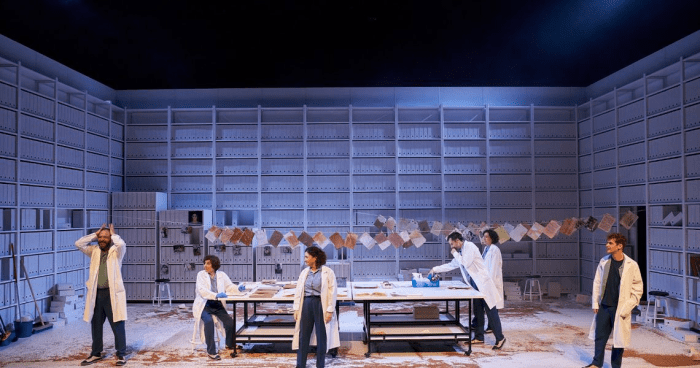
In the staging of the work for its premiere at the Teatre Nacional de Catalunya (TNC) in 2022, the imagined space of the town is portrayed as a wall of archives representing the Municipal Archives building, the place where the main character Magdalena goes to recover a sense of self and community following the disaster. All the events described by the characters in the play are acted out with moving tables or chairs and minimal props before a seemingly gigantic impersonal wall of civic history. But through the course of the play, the archives come to represent the heart of the town where Magdalena learns to face what has been in order to recover her hope to go on.
These days it is easy to imagine a Flood Zone localized in any community. Flooding arrived in mine immediately prior to beginning this translation, and just after completing it, unprecedented flooding devastated North Carolina and the País Valencià. In light of these disasters with colossal losses of human life, it was easy to feel swept away by wondering how a vision of a small flood event from afar could help us confront the new and much more extreme realities of climate chaos. At the same time, I am grateful to have had another opportunity to explore our current climate emergency in translation, since at times the task of translating can feel antithetical to taking necessary action.
This translation was made possible by a grant from the Institut Ramon Llull. In 2024, the British Centre for Literary Translation hosted a Multilingual Theatre workshop led by William Gregory, where I was able to experiment with rendering each character’s story in verse, attempting to find new rhythms in the text. Many thanks to my workshop colleagues who read versions of the official and intimate voices in early drafts and commented on how they were interwoven to either advance or derail the narrative.
For the Catalan sayings interspersed throughout Flood Zone, I researched sayings from around the world related to rain or water. Eventually, I returned to the idea of rendering each as close to their meaning with some sense of rhythm or rhyme to help the listener hear them as a repeated refrain in the context of their tradition. For the teenage character in the play whose life has run out, and for his lover who runs away on learning he will never be found alive, I wrote, “Water will run, it’s what water does.” It is a line I thought I could hear the performer in the role deliver to accentuate the theme of the work at that moment in the action, written with a deep respect for the valued traditions of an island already feeling the pressure of having its autochthonous culture erased by mass tourism and globalization.
—H.J. Gardner
Flood Zone (Zona inundable)
Characters
(3 men, 3 women)
OLDER WOMAN: 60-65 years old (also plays MAGDALENA)
MAN: 40-55 years old (also plays MANU)
WOMAN: 40-45 years old (also plays OLÍVIA)
YOUNG MAN: 16 years old (also plays TONI)
FEMALE CAST MEMBER: 30-50 years old
(also plays ANCHORWOMAN, ARCHIVIST, GEOLOGIST)
MALE CAST MEMBER: 30-50 years old
(also plays ANCHORMAN, PRESIDENT, MAYOR, SEBASTIÀ)
Setting
This play was inspired by the flash flooding that occurred on October 9, 2018 in the town of Sant Llorenç des Cardassar in Mallorca, and its devastating aftermath. It is set in the fictional town of Sant Llis.
MAGDALENA
MAGDALENA: I was home when the rain began. At first, I didn’t pay much attention to it. Then the downpour came. Before I knew it, brown water was streaming in under my front door. It’s going to flood again, I thought. The last big one was in 1985, but it wasn’t nearly as bad as this. When I went to open the door to the little courtyard where I keep the cleaning items, the force of the water ripped the bolt and the latch off the hinges. A wave of water rushed in and hurled me against the wall. I wasn’t knocked out, but I did get a bit dizzy from the blow. Then I realized the water was knee-deep already, and I went to stand in a corner of my kitchen, near the window. Everything started falling over— the fridge, the big clock, the dishwasher, the sideboard, even the stove. In a matter of seconds, the water was up to my waist and rising. Seemed like it was never going to stop. When my old brazier table floated past, the water was chest-high already, so I got on top, best I could. Like climbing onto a raft. And then…
MALE CAST MEMBER: And then.
MAGDALENA: I read once that words are like the surface layer of deep waters. That’s how it feels when I try to explain what happened that night. I’ve had to tell the story so many times. To my friends, the police, the TV crews, the journalists, my therapist, my doctor… And yet I’ve never really been able to come close to describing… Exactly what… Just can’t, you know? The words always fail me. They always fail me.
RADIO BROADCAST (off): That was the moving testimony shared to us by Magdalena, a resident of Sant Llis who came close to losing her life in the catastrophic flooding that struck the town two months ago today. Now, live from Town Hall Square, we join the memorial gathering for the eleven lives lost in the worst natural disaster to have hit the Islands in recent memory.
(The radio is switched off.)
THE BACKSTORY
FEMALE CAST MEMBER: Sant Llis is a small town of about two thousand residents in the north of Mallorca.
MALE CAST MEMBER: A regular town with the usual facilities: a school, a sports center, a medical clinic…
YOUNG MAN: A Municipal Archives. In the Magistrates’ Court.
MAN: For the most part, the town is built along a ravine called Torrent de les Dames, which channels three main tributaries.
WOMAN: All three tributaries run through town. One travels directly down Carrer Major, or Main Street.
MALE CAST MEMBER: Obviously, it’s a flood zone.
FEMALE CAST MEMBER: A flood zone. Meaning, flood-able. Prone to inundation, deluge, washout…
WOMAN: Some years ago, because of previous floods, the ravine was widened.
MALE CAST MEMBER: Our work here is done. Residents are safe. Yaw, yaw, yaw.
YOUNG MAN: October 14. Eighteen past three in the afternoon. It begins to drizzle. For the first few hours, there’s this low-key, normal rain, nothing unusual. Gradually, it starts raining harder, faster. At nine in the morning, the forecasters at AEMET, the State Meteorological Agency, issue a yellow alert.
FEMALE CAST MEMBER: “Yellow alert.” Meaning— Likely no risk, although care may be called for in certain weather-dependent activities. Recommendation: Be aware and stay informed.
WOMAN: Manu and Nick, his assistant, are at work, repairing a wall in Magdalena’s courtyard. Manu checks the sky.
MANU: Senyora, that’s it for us today. Nothing more we can do in the rain. Nick, you take Fortuna. Park her on the road down by the water.
MAGDALENA: Will you finish tomorrow?
MANU: We’ll finish tomorrow. I know I promised the job would take three days, not four, but with the rain…
MAGDALENA: That’s how it goes. Nick, have some cake. Freshly made. Coca dolça, your favorite
MANU: Don’t spoil the boy.
MAGDALENA: You have some, too, then.
MANU: I’m full, thanks. Had a big lunch.
MAGDALENA: Save room tomorrow, then.
MANU: If I know Nick, he’ll finish it off first. Got to get going.
MAGDALENA: What about an umbrella? Take mine.
MANU: No need. Just headed down the road to Olívia’s for a haircut.
MALE CAST MEMBER: Half past four in the afternoon. The sky has turned steel gray and the first bolts of lightning have begun to flash, but the weather alert stays yellow. The forecasters at AEMET never saw it coming either.
FEMALE CAST MEMBER: Here’s Olívia, on the phone with her son Toni.
OLÍVIA: What is it, Toni?
TONI: Are you still at the salon, Olívia?
OLÍVIA: Where else would I be?
TONI: Well, I’m in Manacor with my friend Kike, but it’s started to rain.
OLÍVIA: You’re where?
TONI: In Manacor.
OLÍVIA: Did you ride your motorbike there?
TONI: Yes. So could you come pick me up?
OLÍVIA: No, Toni, I can not. I’m working.
TONI: I know. I mean when you finish.
OLÍVIA: When I finish work, I’m lying on the sofa, having a beer and maybe some pizza. Not getting in my tin can of a car and driving through the pouring rain to pick up my son. My son, who I never hear from, except when he needs transportation.
TONI: Fine, Olívia. You don’t have to nag. I’ll figure out something.
OLÍVIA: Stay the night at Kike’s, why don’t you?
TONI: Can’t. I’m meeting a friend tonight in Sant Llis.
OLÍVIA: Which friend?
TONI: It doesn’t matter. I’ll figure out a way back.
OLÍVIA: But not on your bike. Toni! Do you hear me?
(Toni hangs up.)
OLÍVIA: (Still on the phone.) Toni! Toni! (She hangs up.) To hell with him.(To her customer.) Sorry. Just my son asking if I could come pick him up, but I don’t like driving in the rain.
MALE CAST MEMBER: Olívia and Toni have always had a stormy relationship.
OLÍVIA: You can’t just do nothing! If you don’t want to stay in school, then don’t. But get a job.
TONI: I can’t find one. It’s not my fault.
OLÍVIA: Then try looking for one!
TONI: What do you think I’ve been doing?
OLÍVIA: I think that when I get up at eight to go to work, you’re asleep. And when I come home to sleep, you’re out. And I have no idea where you go, what you do, or who you’re with!
TONI: Because it’s none of your business.
OLÍVIA: I’m your mother!
TONI: Since when did that mean anything to you?
OLÍVIA: That’s enough, you hear me? You know it hasn’t been easy for me raising a kid on my own.
TONI: You shouldn’t have had me then.
OLÍVIA: I didn’t realize how difficult it was going to be. I can’t say I wasn’t warned because everyone told me to think it through, think carefully. Everyone. My mother and my friends told me. The friends of my friends told me. The friends of my mother told me. Everyone told me the same thing. How are you going to support a kid if you can’t support yourself? No degree, no job, no father in the picture. I knew it wasn’t going to be easy, but I thought… I thought I could do it. I thought that if I managed to be the mother I’d always wanted, maybe my life would have purpose. All I had to do was improvise. But it didn’t turn out that way. I didn’t turn into the mother I always wanted. I just am the mother that I am. To be honest, sometimes I have regretted it, having a kid, but many more times, I’ve felt like it was the only good choice I’ve ever made in life. Well, not the only good choice. But the best choice, the very best.
A MAN: Quarter past five in the afternoon. The streets have begun to fill with water. Out at sea, the outline of a waterspout.
YOUNG MAN: Magdalena is talking to her daughter, Catalina. Talking to the memory of her daughter in a photograph, more like.
MAGDALENA (To a photograph): That new helper of Manu’s, who’s fixing my wall, he reminds me of you. He adores desserts. My, look at the rain come down. Once, before you were born, it rained like this. Rained and rained till the whole town flooded. Houses got damaged, and cars were swept away, and someone died. Perhaps this time, the floodwaters will come and take me out to sea. Perhaps they’ll come take me, Catalina, so I can be with you.
FEMALE CAST MEMBER: Twenty minutes past five. Now just a few people out in the streets. Not walking but at a dead run, getting drenched to the bone. Manu is in a chair in front of a mirror at Olívia’s salon.
MANU: It’s coming down hard now.
OLÍVIA: Sure is. Excuse me a second, I need to make a call. Toni? Toni! Listen. Dammit. I hate voicemail! (She pauses.) Toni, hello, this is your mother calling. It’s raining like mad here. So don’t ride your bike back, you hear me? I don’t care what you do, just don’t try to make it home on your bike. I’m finishing up with a customer, and then I’ll come get you, all right? Stay put and I’ll call when I’m on my way.
MANU: Should I come back tomorrow?
OLÍVIA: No. This’ll be quick. Short on the sides and longer here?
MANU: Yes.
OLÍVIA: Ten minutes is all I need.
MANU: I hear your kid has become friendly with mine.
OLÍVIA: I’m sorry, whose kid?
MANU: Well, “mine.” I mean the kid helping me out, Nick.
OLDER WOMAN: Nick is the son every mother wishes she had.
YOUNG MAN: Irresistibly appealing.
FEMALE CAST MEMBER: Charismatic, decent, kind, smart. Just eighteen, and his whole life ahead of him.
MALE CAST MEMBER: Everybody likes Nick. He comes from a good family, you can tell.
OLDER WOMAN: He has such a nice smile.
MALE CAST MEMBER: Always willing to lend a hand.
MANU: So listen, Nick. I need a helper. The other guy I hired didn’t work out, and I hear you’re looking for work. The job is yours, but this is how it’s going to be. I’ve been working since I was fourteen and I’ve never stopped. I have hands harder than concrete, and I don’t put up with nonsense. The job is tough, and sometimes dangerous. So no messing around. On the scaffolds, pay attention, is that clear? And don’t make me ask twice for things. If you can do that, we’ll get along. And you should know my van has got to be treated like a princess. It cost me a kidney and half to buy her. She has a name. She’s a Ford, so her name’s Fortuna, for good luck. Maybe she’ll bring us both some luck.
YOUNG MAN: Fortuna is Manu’s prize possession. A Ford Transit van, brand new, with a load capacity of almost 900 kilos. Steel rims and ergonomic lines. And a registration plate that reads “4544LGF.”
MALE CAST MEMBER: “LGF.” Lots of Good Fortune.
OLÍVIA: Who’s the kid you have working for you now?
MANU: The boy from Can Tomàs.
OLÍVIA: Oh, you mean Colau?
MANU: I guess. Now he goes by Nick.
OLÍVIA: Of course. Nicolau. We always called him Colau.
MANU: Well, now they call him Nick. Been working with me for about a month. A good kid. Real hard worker. Head on straight. Trustworthy.
OLÍVIA: He and Toni used to play together when they were kids, but he moved away.
MANU: Well, they’re good friends now.
OLÍVIA: They are? Toni barely talks to me these days.
TONI: I can’t really say it was love at first sight. I’d seen him hundreds of times. But then Nick went off to live in Barcelona, and every summer he’d come back because his dad’s family was here, and we’d hang out and play in the ravine or in the park, ride our bicycles together… you know, kid stuff. For some reason, for four or five years Nick’s family stopped coming to the island. But then this summer… Nick was back, for good. And when I saw him, I… I can’t explain it. Nothing else mattered. Not fighting with my mother, or finishing school, or being on my phone. Nothing mattered except for Nick. I couldn’t stop thinking about him. I didn’t even know I liked guys. I didn’t like guys. I never liked guys before. But I liked Nick.
OLÍVIA: Toni barely talks to me these days. We’re like two ships… Before, at least we’d watch movies together. Action films, disaster movies, zombie flicks, the stuff we both like. Now, nothing… Nothing at all.
MANU: How old is he?
OLÍVIA: Sixteen.
MANU: That’s a rough age.
OLÍVIA: Are you asking, or telling me? He doesn’t even call me mom anymore. He uses my name.
MANU: Probably a phase.
OLÍVIA: You think? Because it’s been a year already. At first I played dumb and didn’t answer, but he’s kept it up… It’s always Olívia this, Olívia that.
TONI: Nick, are you driving Fortuna? Come get me in Manacor? Olívia said she couldn’t, and I don’t want to stay the night here. (…) Well, fuck it then. (…) Is it raining that hard? (…) Yes, it’s raining here, nothing special. (…) Fine. I’ll find a ride back. Maybe Kike will take me.
OLÍVIA: Hold still. Almost finished.
MANU: I don’t like the look of this rain… My wall has to hold.
OLÍVIA: What wall?
MANU: The wall I’m fixing at Senyora Magdalena’s place up the street. I told her I’d finish tomorrow, but with the storm… Cement won’t dry in the rain.
OLÍVIA: How’s she doing?
MANU: We work, and she lets us work. The Senyora doesn’t seem to care. Nice for me, you know? Otherwise, they make life impossible. The cement’s too dark. The walk’s not level. The stones aren’t set far enough apart. But Senyora Magdalena keeps to herself. Wish I could copy her. Are you friends?
OLÍVIA: Not really. She comes by three or four times a year to get her hair done. She never talks much. About three years ago, her daughter died, and now she mostly keeps to herself. After it happened, she had to take a leave from work— you know, she got depressed— and then when her medical leave ran out, she decided to retire.
MANU: Where’d she work?
OLÍVIA: In the municipal archives, I think. As an archivist.
MANU: How old was her daughter?
OLÍVIA: Early thirties maybe.
MAGDALENA: We were going to have lunch together. I was waiting here at home for her. Instead, the phone rang. That was the last call I ever took because after hanging up, I removed the battery in the receiver and never replaced it. The landline’s long disconnected. She wanted baked fish, and I’d made her a cake, her favorite. She was supposed to come at two-thirty, but by two, everything was ready, so I took a nap in my chair. Till the phone woke me. The child who loses a parent is called an orphan. The woman who loses her husband is a widow. But the mother who loses her child is so… We don’t even have a word for it. What word would you use for the chasm inside that splits in you two from head to toe? When I was baptized, they sealed my fate. Magdalena I was born, and Magdalena I will die. Because it’s all I want now, to die. And soon, not eventually, because my life is meaningless to me now.
MALE CAST MEMBER: All right. I’ll refer you to a therapist, but keep in mind that it may take a few months to schedule an appointment. In the meantime, I can write you a prescription for antidepressants, and I’ve made a note in your chart. Start with one pill once a day, in the evenings. Try to distract yourself, get out of the house, eat well, and have a social life. All this will help. Be sure to close the door on the way out.
MANU: I know it’s not my place, but a person has to move on. Otherwise, what? To lose a child, all right, it’s the hardest grief. But if you don’t let it go, you’re next. Because the Senyora’s house is nothing but photographs of her dead daughter, and she’s got a painting of her covering an entire wall…. It’s hard to take. You go in, and it’s not like entering a home at all. It’s more like one of those places for dead people… A mausoleum! And that’s a house with nice light, with those big windows facing the wide open street. But she’s in there all day with the shutters closed.
OLÍVIA: I’ve noticed that.
MANU: She’s worried the sun will fade her daughter’s photographs. I call that a dance with death, don’t you think?
OLÍVIA: It’s wrong to judge.
MANU: Well, I’m not judging her. It’s her life to live. But that’s hardly living life, is it?
OLÍVIA: There. Does that look right?
MANU: Nice. Here’s my card. Raining like the devil now.
OLÍVIA: Yes. Here you go. (They wait.) The connection’s not going through.
MANU: Must be the storm. I’ll go get you cash. Shouldn’t take long.
OLÍVIA: You’ll get drenched. Just pay me tomorrow. I need to get going.
MANU: To get your son?
OLÍVIA: Do I have a choice?
FEMALE CAST MEMBER: When the rain began that afternoon, no one had any idea what was coming next. Yes, it’s a flood zone. Yes, it’s flooded before. But the last time was over thirty years ago.
MALE CAST MEMBER: The ravine was widened, they said. We’re ready. Yaw, yaw, yaw.
OLDER WOMAN: Believe it or not… Flood zones are called that because they have a tendency to flood. And every now and then, they do.
YOUNG MAN: The ravines exist for a reason. Water has to be free. It will find a way.
OLDER WOMAN: Maybe we’ve forgotten, or try not to remember, but there are times when nature is more powerful than we want to accept.
MANU: Maybe wait to go out until the rain quits?
OLÍVIA: If I go home first, I won’t want to go back out.
MANU: I’m going to move Fortuna. I sent Nick to park her in her usual spot, but she’ll be in the path of the water there.
OLÍVIA: Is it going to flood that much?
MANU: Probably not. But I’ll be calmer if I park her up by the church.
OLÍVIA: Good luck. Stay dry, if you can.
MANU: Likewise.
MALE CAST MEMBER: On the island, we have a lot of sayings about water. Our popular sayings record experiences repeatedly observed.
YOUNG MAN: “Don’t make your bed near a river bed.”
FEMALE CAST MEMBER: “Neighborhoods near ravines or nuns are best avoided.”
WOMAN: “Never build a nest where the water won’t rest.”
OLDER WOMAN: “Floods are nobody’s friend. They’ll take the best and leave a mess.”
MAN: “Rain in October, the ravines run over.”
WOMAN: “Water is as water does. The floods will come again.”
FEMALE CAST MEMBER: “Nothing for me or you if the water takes it, too.”
MALE CAST MEMBER: They are words of wisdom collected over centuries of shared history.
OLDER WOMAN: At what point did we stop listening to the voices from the past?
FEMALE CAST MEMBER: Six fifty-five that evening. The disaster commences.
THE FLOOD
ANCHORMAN: Good evening. Tonight, flash flooding in Sant Llis. Emergency Services is asking people to stay off the streets.
ANCHORWOMAN: The rain is falling at a colossal rate, 180 liters per square meter, and still coming. The situation is dire. We’ll try and go live to Sant Llis momentarily, but first, a reminder that drivers are asked to exercise extreme caution.
TONI: Hey, Nick. I’m still in Manacor. I can’t find a way back. What are you doing? (…) Hey, Nick, I can’t hear you. I can’t hear you! What? Hey… Are you ok? Nick!
MAN: Communication outages are extensive. Connecting with Sant Llis is a challenge.
OLÍVIA: (On the phone.) Toni! I’m on my way to get you. Toni? Toni! Toni. I don’t like this at all. I don’t know if I can control the car.
MALE CAST MEMBER: Eleven minutes past seven. A Level One emergency situation of the Civil Protection System is activated. Almost immediately, the 112 emergency call system is overrun. Two minutes later, the situation is escalated to Level Two, requiring the immediate activation of all intervention teams that serve the autonomous community.
OLDER WOMAN: AEMET issues an orange alert.
FEMALE CAST MEMBER: “Orange alert.” Meaning— A significant weather risk. Recommendation: Be vigilant. Take precautions and keep regularly informed.
ANCHORMAN: Good evening. Tonight, a special report. Severe flooding in Sant Llis, and the situation is catastrophic. Emergency Services is asking everyone to please stay away from the area. These floods are life-threatening, with fatalities a real concern. Tonight, on our special report, we’ll bring you the latest on the crisis, and hear firsthand from witnesses to the disaster. Our first report…
FEMALE CAST MEMBER: When I looked out my window, I saw cars being carried away in the floods. Here we go again, I thought. But this time, it’s so much worse.
WOMAN: Everything was getting caught in the current… Furniture, vehicles, even a tree. I saw a delivery van for the produce shop go by. Two of the cars had people inside.
MAN: I live just outside of town. Around five, I heard this deep roar like an airplane coming from up there on the mountainside.
ANCHORMAN: The Fire Brigade reports that nearly fifty incidents have been recorded due to water accumulation and flooding.
ANCHORWOMAN: Air traffic is also experiencing difficulties. The Islands remain under an orange weather alert for rain and storms through early tomorrow.
TONI: Olívia! Olívia!
WOMAN: The person you are calling is not accepting calls at this time.
TONI: Nick!
WOMAN: The person you are calling is not accepting calls at this time.
FEMALE CAST MEMBER: When the floodwaters start pouring into the streets, Olívia is in her car, driving to pick up her son. Manu is running down the road hoping to save his van. Magdalena is at home, preparing supper. And Toni is stuck in Manacor.
WOMAN: Once, when she was five, Olívia found a bottle of hydrochloric acid left open next to the washing machine and took a sip. At sixteen, driving drunk, she crashed her mother’s car into a wall and suffered a concussion. Those were Olívia’s only encounters with death. Until today.
MAN: Ten years ago, Manu fell off a scaffold. He spent twenty-four hours in a coma then came to without any repercussions. When asked if he had seen the light at the end of the tunnel, he said no. He had seen himself at work fixing the tunnel, though.
OLDER WOMAN: Magdalena has never had a close call, but she has been in an intimate relationship with death since her daughter passed.
YOUNG MAN: This one time, rock climbing, Toni fell and broke three toes, his shin, and his kneecap.
WOMAN: (Correcting him.) We’re talking about death.
YOUNG MAN: Oh. Toni doesn’t usually think about death. But sometimes, he has these dreams about his grandfather’s white face looking up from the coffin.
FEMALE CAST MEMBER: There won’t be time for them to remember this in the flood.
MALE CAST MEMBER: There won’t be time for anything but survival.
FEMALE CAST MEMBER: Seven twenty-one in the evening.
MALE CAST MEMBER: Experts have observed that in extreme conditions, adrenaline can give a person superhuman strength.
OLÍVIA: The wipers on my little Opel Corsa are going like mad but can’t keep up with the rain. My stupid car is fifteen years old, at least, and I’m driving through the middle of town annoyed that I have to pick up my son. I have this nagging feeling he’s going to try to make it back home on his motorbike. My intuition is telling me don’t be reckless, don’t drive in a storm like this, but I ignore my intuition because in the past, paying attention to it has been useful. I’m not thinking I’m going to die. Yes, there was this big flood a long time ago, and yes, a few little ones since. All the old folks talk about how it was, but that doesn’t mean it’ll happen to me. It’s raining. It’s pouring. End of story.
FEMALE CAST MEMBER: At what point did we stop listening?
MALE CAST MEMBER: “Rain in October, the ravines run over.”
YOUNG MAN: “Don’t make your bed near a riverbed.”
OLÍVIA: Right at the edge of town, I see the water starting to crest the bridge. I know I’m being stupid, but I just have to stop for a moment and watch. The water is rushing down the ravine with this brutal force, dragging everything with it. It’s an awesome sight, right out of a doomsday movie, like the kind I watched with Toni. Like Infinite Storm or Volcano. It’s absolutely mesmerizing to see the full force of nature on display. But these seconds I’m spending on the bridge might be ones I need to avoid getting caught in the current. Because as soon as I come back to reality, I realize I’m in big danger. I decide to head back the way I came, but I see this huge wave headed right for me. There’s no time to shout. The wave hits and lifts my car up into the air, at least a couple of meters high, because now I’m eye level with the roofs of the houses. My car hangs up in the air for a moment, just like in the movies, like when they put the most spectacular moments in slow motion. The car is in the air, almost like it’s on a platform made of water. But right after giving me this moment in the sky, the water surges forward faster and carries me with it downtown. That’s when I start to panic. Because that’s when I realize, maybe today I will die.
TONI: Hello? I don’t know if this is where to call. Olívia— My mother is in Sant Llis but I can’t get hold of her. I can’t reach my friend Nick either. (…) No, I’m in Manacor. My mother was driving to come find me. (…) I don’t know if she managed to get out. I told you, I can’t get through to her. (…) Olívia Fuster. (…) I don’t know about Nick. What do I do?
MANU: I’m running down the street, and all I can think about is Fortuna. She’s perfection, drives like a dream. Bigger than you’d expect, she’ll haul anything I need her to. I love that van. She’s a real beauty. The rain is pelting my face, and my feet are getting soaked, and I’m remembering all the walls I had to put up just so I could afford Fortuna. Oh, I held on to my old van as long as I could. I had the rearview mirror stuck in place with duct tape, and the back all banged up from hauling scaffolding. Then one day, she said I’m done, and quit on me. Bank gave me a loan to buy a new vehicle, and I’ve been living like royalty ever since. I had this idea that the new van would bring me luck, so I named her Fortuna. How dumb was that? Dumber than I realized at the time. Working stiffs like me aren’t meant to have luck. Especially not when they forget their keys and decide to go back for them. Because by the time I’m back out on the street, things have gotten worse. The water was knee-deep now. You tell yourself, don’t go, don’t, but at the same time, you see the invoices piled up and the lifetime of work it took to keep your business going… You start thinking about how hard you had to fight to start your company, how you began as a kid of fourteen, how you haven’t stopped working since. And now I’m fifty-two with a back bent from carrying sacks of tile and gravel and cement… So I convince myself that I’m not letting this flood take my Fortuna, or my mother didn’t name me Manu… And I run to find her like my life depends on it. But as I do, I realize this isn’t just something people say… This time, for me, it’s going to come true.
MAGDALENA: From the top of my table, I attempt to maneuver past the furniture and household items floating about. The water is rising, and on my improvised boat, I regret never having learned to swim. Never thought I would need to know. I don’t like the water, and I don’t go near it. Never bother with the beach or the pool. Just keep clear of places like that. But they say if you don’t go to the mountain, the mountain will come to you, and now the water’s in my home. Every possession of mine is floating, especially anything that’s made of wood. Chairs, stools, the chest of drawers… The chest is where I keep my important documents. The slices of bread that I’d prepared for supper not that long ago pass by. I want to grab the photographs of Catalina from the wall, but when I reach for them, the table almost capsizes, so I don’t dare try again. Everything is happening so quickly, I haven’t had time to adjust. It’s like being in a dream, it all seems so unreal. Perhaps it is a dream. Perhaps a couple of minutes ago when the water burst through my door and overran my home was just a dream. Or, if it’s not a dream, if it’s really happening, perhaps it’s my answer to these past three years I’ve spent asking for death. Catalina, perhaps finally I am going to see you again.
OLÍVIA: My little Corsa does a complete spin, smashes against a wall and bangs into other cars being carried away. All I can think about is Toni. And also, you can’t stay in here. You can’t die. I know he wouldn’t agree, but Toni needs me still. I’m scared to death with the car being pulled by the floodwaters down the center of town, but I reach inside myself to find some source of strength, a strength I never knew before, a strength from deep down inside, from my gut, from my liver, from my kidneys, from my very core. All I know is that if I stay in my car, the only option is death, so I grab onto the seat as tight as I can and kick till I bust the window open. Then the water rushes in. As best I can, I swim out, fighting the current, and swim in the direction of the houses to try to get out of the water’s flow. I grab onto a gutter, I think. It’s a downspout, and if I manage to climb it, it looks like I’ll be able to reach a small balcony sticking out just above the water. I wrap my hands and feet around the downspout. My leg aches, but I don’t care. It’s not far. I manage to climb and stretch my hand out so I can just reach the railing on the balcony. I grab onto one of the bars on the railing, and, no idea how, manage to pull myself up onto the balcony and lie there gasping for breath, spent. At that moment, I’m thinking I’ve cheated death— today’s version, at least. My leg is throbbing, and there’s blood from a cut that’s long but not deep. Must’ve been the glass. There’s nothing to stop the bleeding, so I hold the wound with my hands, putting pressure on it, and sit there watching the disaster unfold below me. The water is above the doorways now and carrying everything away with it— cars, trees, furniture, motorbikes… A big white van goes by, and I wonder if it’s Manu’s, and if it is, if he’s in it. There’s no time to see for certain.
MANU: It’s raining as if the sky has split open, as if the pipes in the sewers have burst. The water is up to my knees already, and then to my waist, to my chest. I realize I’ll never make it to Fortuna’s parking spot because I can already see cars spinning by, being swept downstream by the rushing water. I even see a car with people in it. I grab signs on the road and door handles, anything I can get my hands on. This is beyond anything I’ve ever seen. I start to pray like I did when I was a kid— me, who hasn’t set foot in a church since first communion. All I wanted was to save Fortuna. So many walls put up to pay for her. Why the hell are you putting your life at risk for a van, idiot. But what else could I do, I couldn’t afford to lose her. It would ruin me. Just then a huge piece of junk, a fridge I think, reams me on my head. It knocks me senseless for a few seconds, long enough for the water to drag me off with it. There’s nothing I can do because the force of the water is so strong I get sucked under. Then I can see the cars and dumpsters and trees all floating above me, the cars swirling above my head like beach rafts for tourists. I’m just about out of air, and can’t make it to the surface, can’t get my head above water. Then I’m slammed into a log, and I grab hold of it and climb on and manage to catch a breath. The log is actually an orange tree and I have no idea where I am. I can barely see, and I’m clinging to the tree like a new branch that’s been grafted onto it.
MAGDALENA: The cold and the fear convince me this is not a dream. My house has flooded. I am on a table. The water is rising. If I don’t take action, the water will be up to the ceiling soon, and I will drown. Be careful what you wish for, people say. Be careful what you wish for because one day it might come true.
WOMAN: What is it like to drown?
YOUNG MAN: Does drowning take a long time?
MALE CAST MEMBER: How many seconds do you need to be submerged?
FEMALE CAST MEMBER: Or is it only a matter of minutes?
WOMAN: Is there suffering involved?
MAGDALENA: I’m so lost in thought that when something hits my head, I’m startled and fall off the table. The light fixture, I think, as I go under, and the water enters my nose and mouth, and the panic sets in. I’ve been caught by surprise. Unawares. If I don’t do something now, Catalina, I’ll be with you in just a few minutes. A few seconds or a few minutes, I don’t know which, but we’ll be together again, my dear. My feet touch down. It’s the tile floor of my house. I open my eyes and see a ghostly underwater image of my home, filled with brown floodwater, and your picture, Catalina, your picture still hanging on the wall. We look into each other’s eyes through the particles of muck suspended in the gloom. We look into each other’s eyes, and I think, this is it. Don’t do anything and it’s over. Time for it to end. But then, I feel an unknown force. Without asking permission, my feet push against the floor. My feet push against the tile floor, and my body is propelled back up toward life. My mouth opens when it reaches the surface, hungry for air, and my lungs force the water out, coughing up what’s been clogging them, and my hands cling to the light fixture. My body has made the decision to live. But now this means I have a problem, because in a situation like this, dying is the most likely outcome.
OLÍVIA: From the balcony, I can look out and see how widespread the disaster is. All the houses in the lower part of town are flooded. The water continues to drag cars and trees and mud. I can’t stop shivering from the fear and the cold seeping into my bones. I’m soaked, and still the rain comes down. Next to the balcony, there are ledges on the wall that I could use to climb up to the roof of the house across the way, where there’s a skylight. I used to climb when I was young, but haven’t in a long time, and the years haven’t exactly been kind. But I go over to the wall and start to scale it like I’m this version of Spiderman, a Spiderwoman. Hand here, foot there. Don’t move a limb unless the position above is secured. As I climb, I think of Toni. Good thing he’s still in Manacor. I don’t even want to think about what could have happened if he was here.
TONI: Excuse me! Are you going to Sant Llis?
MALE CAST MEMBER: Yes. But the traffic circle is as far as we can go.
TONI: Can I come with you? I can do the last part on foot. I need to find my mother and my friend. They’re not answering their phones.
MALE CAST MEMBER: Get in.
TONI: Thanks. I heard somebody died. Maybe more than one person. They say people are missing. Is your family…?
MALE CAST MEMBER: My wife and kid. The baby’s eight months old. Haven’t gotten through to them.
TONI: Do you live up on the hill or…?
MALE CAST MEMBER: No.
TONI: I’m such a rat for telling Olívia to come get me. If anything happens to her, I’ll never forgive myself.
MALE CAST MEMBER: Is Olívia your mother?
TONI: Yes.
MALE CAST MEMBER: Look, the road’s impassable. That sinkhole must be twenty meters deep.
TONI: It’s like, apocalyptic.
MALE CAST MEMBER: This is as far as we can go. I’m pulling over and parking here. Good luck.
TONI: Same.
MANU: Holding onto the tree takes all my strength. The force of the rushing water strips me of my clothes and leaves me dangling there, exposed. It’s getting darker and darker the later it gets, but I can see the water level rising. It’s going to cover the orange tree soon. Then soon is now, and I have to let go. The current drags me down again, but this time I manage to grab onto a bed of reeds. This time I’m staying, I think. I wrap my hands and feet around the reedbed. Time passes, I have no idea how much. It’s pitch black, I can’t see anything at all, only hear the water roaring past. But then I see headlights on a car and start shouting like a madman. Louder than I’ve ever shouted at any football match. It looks to be the Civil Guard on patrol. There are two of them, from what I can tell by the outline of the flashlights. They shout something at me, but with the roar of the floodwaters, I can’t hear what they’re saying. They throw me a rope, but I can’t catch it. I can’t let go of the reedbed. My hands are stuck there, cemented to it. You’re in shock, I tell myself. I can’t do anything but hold onto the reeds like I’m a koala, shivering and freezing in the cold. I watch as one of the guys fastens a rope around his waist and jumps into the rushing current. That rope’s not long enough. That rope’s not long enough. That rope’s not long enough. But it is.
MALE CAST MEMBER: Stay calm. Take hold of me.
MANU: I let go of the reeds and grab the man rescuing me. I grab as hard as I can manage. Harder than I’ve ever grabbed a woman.
MALE CAST MEMBER: Not so tight, friend, or we’ll both go under.
MANU: Sorry, man. I close my eyes. Don’t watch. A thousand things can still happen crossing the current. Maybe we’ll both die, swept away by the water. We’ll be hit by a car, or a tree, or a tank of butane. My body aches. Think of something pleasant to distract you. Think of something that makes you forget that you are riding naked on the back of a Civil Guard. Think about Margarita Lloberas, your first girlfriend, when you were ten, no, eleven, you were both eleven years old. She was this smart girl, and you were a clueless kid. She’d have to take your hand and put it around her waist for you. Now is when the butane tank will come and we will both die, me and my Civil Guardsman, poor guy, now that’s a dangerous job. Margarita had long dark beautiful straight hair and a freckle on her nose. We’re going to die now, but don’t think about that. Think about Margarita Lloberas and that little freckle on her nose.
MALE CAST MEMBER: We made it.
MANU: I open my eyes. We’re out of the floodwaters, next to the vehicle.
MALE CAST MEMBER: You can let go now. You’re safe.
MANU: When I hear the word safe, I go limp. The man lets go of me, and I collapse. Curl up in the dirt and start to sob.
MALE CAST MEMBER: There’ll be time for that later, friend. Let’s get you in the car and to the hospital.
OLÍVIA: Hand here, foot there. The gash on my leg is throbbing, but I don’t care. The rain is pelting me in the face, and I have to make an effort not to get distracted by the bolts of lightning. I get to the roof and hobble over to the skylight. I pound desperately on the glass, screaming, please help me, help. A child’s face looks up at me in fear from the other side of the pane. She gets scared and runs out of the room. I keep banging on the glass— help me, please help— and a woman appears. When she opens the skylight, it’s like the gates of heaven open.
FEMALE CAST MEMBER: “Water will run, it’s what water does.”
MAGDALENA: That saying echoes in my head. My mother used to say that all the time.
FEMALE CAST MEMBER: “Water will run, it’s what water does.”
MAGDALENA: The water will not stop rising. I am holding onto the light, and in no time, I’ll be submerged. The doors are closed. The wave that opened the door must have closed it, too. I have to get the doors open but can’t. The doors and windows are all blocked. Then I remember the window in the bedroom. A little window up high, that opens out to the front. I must hurry. A coffee table comes by, and I grab it and start paddling to the bedroom. The light flashes once or twice, then leaves everything in semi-darkness. I’m so afraid, but I mustn’t stop. I must hurry. On the table, I paddle as fast as I can from the dining room to the hall, then to the bedroom. I have to stick my head under to get through the door because the water is up over the frame already. Once I reach the little window, I have to break the glass, but how. I try kicking it, but the water won’t let me gather strength. In the half-light, I see a log from the fireplace. I grab the log and begin hitting the glass with an unknown rage, with a massive, disproportionate show of strength, as if instead of hitting fragile glass, I’m pounding iron. The glass shatters. Done. I don’t know if the effort is of any use. I paddle over to my very tall wardrobe still in place because when the handymen installed it, they secured it to the wall, oh, bless the handymen. The water is almost to the top, but I manage to climb on top and curl up on one side. The stiff boards make my old bones hurt, and I close my eyes. I don’t know if today’s the day I’m going to die, but I’ve tried so hard not to, I must have stopped wanting to.
TONI: I’ve never been in a war zone, but as I walk along the road in the direction of town, I feel like I’m in one now. It’s not raining anymore, but there’s still lightning, and when it flashes, I see people clinging to the walls. And there’s people stumbling about in the mud. The mud’s so thick it’s like cement. I try calling my mom again and Nick. Then I hear this whining. I turn on the flashlight on my phone. There’s this dog lying on the ground, covered in mud. He’s not moving. Just whining, his tongue hanging out of his mouth, like he’s given up. I go up to him and see this stick stuck in his chest. Shit. He’s hurt. Poor thing. I know what I should do, what I will do, but crap. This is bullshit! I grab a big rock and go up to him, and the dog gives me this look. I look at the dog. Listen, dude, I’m sorry. It’s like he knows it, like he’s asking for it. Then the tag on his collar flashes. Probably got his name on it. I don’t want to know his name. Fucking hell. Sorry, big guy. I lift up the rock above my head and then… My phone rings. It’s from an unknown caller. (On the phone.) Hello?
OLÍVIA: Toni!
TONI: Olívia!
OLÍVIA: Are you all right?
TONI: Yes. Are you?
OLÍVIA: I’m fine.
TONI: Where are you?
OLÍVIA: They’re taking me to the sports center. Listen, stay in Manacor, okay? I’m perfectly fine.
TONI: Olívia… I’m in Sant Llis.
OLÍVIA: You’re what?
TONI: I’ll come find you.
OLÍVIA: Toni! (He’s hung up.) I will murder him!
ANCHORMAN: Joining us by phone is Margalida Planells, a geologist. Ms Planells, was the ravine ready for this?
GEOLOGIST: It would be impossible to prepare any ravine for such a magnitude of water. You can’t build infrastructures of these dimensions. They would have to be colossal.
ANCHORMAN: How would you categorize the floods we’ve seen?
GEOLOGIST: We know flooding is an endemic challenge of the islands. This time of year, it’s normal to have such heavy rains. It’s not new, not only here in the islands, but throughout the entire Mediterranean basin. If you do a Google search for “flooding in the Levant region,” every seven to eight years there are severe floods that sweep cars away. A flood is essentially a conflict of interests between a watercourse— the rightful owner of where the water needs to flow, let’s not forget— and humans, who want to use the land. When the water claims its right of way, because sooner or later it undoubtedly will, that’s when problems occur. These days it’s getting progressively worse because we are occupying more and more flood zones, and eliminating flood plains, quite recklessly. Perhaps we have forgotten that floods exist for a reason. But the water always remembers.
ANCHORMAN: Do you think climate change plays a role?
GEOLOGIST: I do, and I don’t. It’s true that higher surface temperatures can worsen the situation, but keep in mind that, if the loss of life and property has worsened, this is primarily due to an increase in human pressures on the land. We plan and measure structures with careful calculations, all the while forgetting that nature has her own rules and a tendency to undo our estimations.
WOMAN: In the first few hours, Emergency Services registers four hundred incidents. The firefighters, Civil Guards, local police, and Civil Protection teams can’t handle so many calls. More than two hundred people are saved. As soon as the water begins to recede, rescue workers can finally begin going house to house.
SEBASTIÀ: (On the walkie-talkie.) I’m at number nine. About to enter. Water up to my knees at this time. From the marks on the walls, it seems to have risen more than two meters. Senyora Magdalena? No response. It’s not looking great. Senyora Magdalena! It’s Sebastià, Marita’s son. From Civil Protection. Senyora Magdalena!
OLDER WOMAN: Magdalena has been on top of her wardrobe for over three hours now. She lies there motionless, her eyes closed. Maybe she’s unconscious. Maybe she’s asleep.
SEBASTIÀ: Senyora Magdalena!
OLDER WOMAN: Magdalena opens her eyes. She thinks she hears a voice calling her name. She thinks she might be dreaming. She’s not sure she is alive. She tries to respond but can barely manage a whisper.
SEBASTIÀ: Senyora Magdalena!
MAGDALENA: (Softly.) Up here!
SEBASTIÀ: Senyora Magdalena!
OLDER WOMAN: Magdalena takes a deep breath. She gathers the last of her strength and makes her final superhuman effort of the day.
SEBASTIÀ: Senyora Magdalena!
MAGDALENA: (Shouting and pounding.) I’m up here! Please! Up here!
SEBASTIÀ: (On the walkie-talkie.) I hear something.
MAGDALENA: In the bedroom.
SEBASTIÀ: Senyora Magdalena. Don’t move. We’re going to get help. (On the walkie-talkie.) Located. Trapped on top of a wardrobe. Paco, I’m going to need help getting her down. Who’s nearby who can assist? Have them come now. (To MAGDALENA.) Just stay calm, senyora. Don’t try to move. I’ve got someone coming, and we’ll get you out of here.
MAGDALENA: Don’t let me die.
YOUNG MAN: One minute past ten at night. AEMET finally activates the maximum state of alarm, a red alert.
FEMALE CAST MEMBER: “Red alert.” Meaning— A very high level of risk to the public. Meteorological phenomena of exceptional intensity. Recommendation: Take preventive measures and follow the instructions given by the authorities.
ANCHORMAN: This just in. The City Council has opened the sports center as an emergency shelter. Medical assistance, dry clothes, blankets, cots, and food are all available to those needing assistance.
OLÍVIA: Manu, are you all right?
MANU: They told me I am. I have no idea.
OLÍVIA: Did you see a doctor?
MANU: Yes. They held me for observation for a while, then brought me here. What happened to your leg?
OLÍVIA: They gave me a huge bandage. Really, it’s just a scratch. If you had told me this morning at the shop that…
MANU: Yeah.
OLÍVIA: When I was stuck on the roof, I saw this van go by that looked just like yours. I wondered if you were inside it.
MANU: No. I never made it to her.
OLÍVIA: What kind of sandwich did they give you?
MANU: Chorizo. Yours?
OLÍVIA: The same. I don’t really like chorizo.
MANU: Same. Although, to be honest, I can’t even taste it.
OLÍVIA: I think it’s that Revilla brand. Reminds me of the sandwiches my mother used to make for school.
MANU: (Speaking.) Chorizo Revilla, un sabor que maravilla. Wasn’t that the line?
OLÍVIA: That’s right. (Singing.) Un sabor que maravilla. [“The flavor of a lifetime.”]
(Both laugh and cry at the same time.)
MANU: Ask if there is anything else. Maybe they have fuet. Mortadella.
OLÍVIA: It doesn’t matter.
MANU: Salami, maybe.
OLÍVIA: Manu, what matters is, we almost died.
MANU: Yeah.
OLÍVIA: Do you think, given the circumstances, we could do away with formalities now?
MANU: I think we should. But Olívia…
OLÍVIA: What?
MANU: There’s a young man with a dog there. Isn’t he your son?
TONI: Is anyone here a veterinarian?
OLDER WOMAN: At the top of the news hour. A dire and difficult situation in Sant Llis.
ANCHORMAN: We’ve just learned that the first fatality has been confirmed. An elderly man of seventy-five has been discovered in his home. At this moment, over a hundred members of different agencies are working with the help of family members and friends to locate the missing. Emergency Services and the San Llis Civil Protection squad have opened emergency operation centers.
MAN: In the next hour, four more bodies will be recovered.
OLDER WOMAN: At eleven fifty-eight, a local police officer finds the motorbike of a missing man, Nicolau Riera.
TONI: Nick.
MAN: The motorbike was carried away by the floodwaters and found in a sidestreet.
OLDER WOMAN: But no sign of Nick.
TONI: Olívia… Nick’s father and his friends are organizing a search party. And I’m going to go out with them.
OLÍVIA: You are not! Toni, you can’t be serious!
TONI: I’m not asking your permission. I’m going out to search for Nick.
OLÍVIA: But it’s not safe!
TONI: It’s not raining, and the water’s gone down. There’s just mud on the streets.
OLÍVIA: Toni.
TONI: What?
OLÍVIA: Don’t go. Please.
TONI: It’s just mud! Nothing’s going to happen to me. I promise.
OLÍVIA: But be careful. Please.
MALE CAST MEMBER: At twelve-thirty in the morning, three local police officers, two members of Civil Protection, Nick’s father, and Toni slog through a river of mud, searching the length of the flood’s course by flashlight, exploring step by step the area where Nick’s motorbike was found.
FEMALE CAST MEMBER: Their search will last till five in the morning.
MAN: Nick!
WOMAN: Nick!
TONI: Nick!
OLDER WOMAN: Nick!
FEMALE CAST MEMBER: They won’t find him.
MALE CAST MEMBER: At five in the morning, they’ll take a break to wait for daylight.
YOUNG MAN: Heartbroken, Toni returns to the sports center. There are no free cots, so he stretches out next to Olívia, who has managed to fall asleep. He closes his eyes. There’s no way he’ll sleep. But lying beside Olívia as she takes long, slow breaths does him some measure of good.
MALE CAST MEMBER: Eighty-six people have sought shelter in the gym. By five o’clock in the morning, only four or five of them have slept. The rest are simply waiting for the daylight to come so they can determine the extent of the destruction. Eventually, the sun rises.
MAN: Facebook activates the “Mark yourself safe” option.
ANCHORWOMAN: Now, in the tragedy’s aftermath, a new day begins. People are beginning to assess the damage. The human toll, for the moment, remains at five confirmed fatalities, but that number could increase, as there are nine people still unaccounted for, as well as the possibility of missing tourists, whose safety has yet to be determined.
OLÍVIA: Good morning. Manu, I brought you some coffee.
MANU: Thanks, Olívia.
OLÍVIA: Did you sleep?
MANU: Not one wink. You?
OLÍVIA: A little. I’m worried about my shop. I need to go see how it’s doing.
MANU: And your house?
OLÍVIA: I’m not worried about my house. I live up near the church.
MANU: Lucky you. It won’t have flooded, then. My house is down by the water.
OLÍVIA: But that’s where… (She stops herself.)
MANU: It’s a house. It’s not even my house. I rent.
OLÍVIA: I’m sorry, Manu.
MANU: What time is it?
OLÍVIA: Seven.
MANU: Where’s your son?
OLÍVIA: He just went out again to look for his friend Nick.
MANU: Haven’t they found… Anything yet?
(Olívia shakes her head.)
MANU: What a fucking mess.
OLÍVIA: They’ll find him. Of course they will. He’s young. And strong. All you builders are.
MANU: Sure.
OLÍVIA: They’ll find him.
MANU: Let’s hope for the best.
TONI: Nick! Nick!
OLÍVIA: Toni never told me anything about Nick. Were they really close?
MANU: Very close.
TONI: In my mouth, mixed with the mud, I still have the taste of his tongue. And in my mind, the memory of our first time, my hand on his crotch, his intense gaze, then his hand on mine. And then doing it, without time to take our clothes off, urgently, like we’re afraid the other guy will stop, or, I don’t know, like we’re going to be walked in on. I had done it a couple of times before, but always with a girl. This was different. With Nick that time, and all the ones after that, it was… Special. Like, meaningful. It took me so long to find him. I can’t lose him now. Nick! Nick!
ANCHORMAN: Material losses are so extensive, the scene is Dantesque. Our team based in Sant Llis reports that it is a true ground zero. Cars, trees, trucks, furniture, and rocks lie piled in the streets, coated in an avalanche of mud.
WOMAN: Olívia’s salon is a total loss.
FEMALE CAST MEMBER: The shampoo stations, the styling chairs, the overhead dryers, the mirrors… all broken.
MAN: Manu’s house was swept away.
FEMALE CAST MEMBER: Fortuna’s missing, too, and Manu knows she’ll be a total loss.
OLDER WOMAN: At Magdalena’s house, everything is destroyed. Everything.
FEMALE CAST MEMBER: Even the photographs and the painting of her daughter. No image remains of her in the world other than the picture her mother holds in her mind’s eye.
MAGDALENA: First a car accident took her from me, and now a flood. Every photograph and image I had, all of her belongings that they gave back to me have been lost in the mud, and I have no idea where to find her. Oh, I know what people will say. Magdalena, your daughter isn’t in the material world, she isn’t in the photos, she’s in the memories you have inside of you. It’s a lie. Inside me all I have is a massive chasm so immensely dark and deep, there’s no room for anything else.
FEMALE CAST MEMBER: Town facilities like the stadium, the school, and the Magistrates’ Court, where the Municipal Archives are kept, have been decimated.
MALE CAST MEMBER: The Municipal Archives is what holds the memory of the town’s past.
YOUNG MAN: And Nick is still nowhere to be found.
FEMALE CAST MEMBER: Nick!
MAN: Nick!
WOMAN: Nick!
RECOVERY
MALE CAST MEMBER: While a search party for Nick and the others missing is assembled, help begins to arrive in Sant Llis.
ANCHORWOMAN: Good morning. Eighty team members of the Emergency Military Unit have left the port of Valencia to join search and recovery efforts. Additionally, a team of crisis counselors has been dispatched to the area to assist the victims and their families. Hundreds of volunteers have arrived to help.
MALE CAST MEMBER: Anyone volunteering needs to park at the gas station at the traffic circle and continue on foot from there. Head to the meeting point to be assigned a job.
YOUNG MAN: I live thirty kilometers from here, you know? It was crazy because in my town there was almost no rain at all. When I saw the news this morning, I called some friends and we decided to help. Man, it’s unbelievable what happened to this town. A total disaster. If we don’t lend a hand, these people won’t make it.
WOMAN: I don’t have relatives or friends in town, but it doesn’t matter. It could’ve just as easily been my village. If you can’t count on your neighbors to help, who will? Listen, go that way.
MAN: I’m from Menorca, just across the way. I’ve been glued to the TV and radio since last night. I sailed here this morning because I couldn’t just sit around doing nothing.
FEMALE CAST MEMBER: First there are tens, then hundreds, then suddenly, Sant Llis is flooded with volunteers.
OLDER WOMAN: First thing that morning, heavy equipment operators on the island turn up to begin clearing away the debris. Cranes, excavators, and a parade of construction vehicles appear. Their drivers have abandoned their regular job sites to help here.
ANCHORMAN: This just in. Search teams have confirmed the discovery of five more bodies bringing the number of fatalities to ten. The search continues for Nicolau Riera, known as Nick. Meanwhile, a team of five archivists has volunteered to…
YOUNG MAN: (Interrupting.) Archivists? What the hell? We need firefighters, carpenters, builders, electricians…
ANCHORMAN: A team of five archivists has volunteered to try to recover the documents in the Municipal Archives building which was devastated by the raging waters.
ARCHIVIST: When I read that the Municipal Archives building of Sant Llis had been flooded, I reached out to my colleagues, and we contacted the mayor to offer professional assistance. But when we saw the files, our hearts were broken. The documents are caked with mud, inside and out. It’s just devastating.
MALE CAST MEMBER: Thirty-two social workers go door to door to assess the needs of those affected.
FEMALE CAST MEMBER: A lunch room is organized for the volunteers.
MAN: The insurance companies receive more than five hundred claims in three days.
OLDER WOMAN: More than 1,500 people are at work on the reconstruction of Sant Llis. Six hundred operatives, nine hundred volunteers, thirteen social workers, sixty-three Nature Institute staff, and five archivists.
ARCHIVIST: All right, everybody. Let’s begin. If we want to save the documents, we can’t wait.
YOUNG MAN: We have to do a supply run. We have no supplies.
ARCHIVIST: (To YOUNG MAN.) Then make a list. Gowns, masks, gloves, boxes, blotting paper…
MALE CAST MEMBER: Listen, everyone! We need cleaning products. Brooms, shovels, mops, wipes, rags…
ARCHIVIST: …labels, pallets, hair dryers.
MALE CAST MEMBER … sponges, scourers, basins, dusters, cloths, scrapers, glass cleaner, brushes. Clothing of all sizes. Furniture.
ARCHIVIST: Let’s start with the Civil Registry books. Set up some tables and chairs. We need fans and dehumidifiers. Let’s also use the courtyard and dry some items in the sunlight.
YOUNG MAN: What do we do first?
ARCHIVIST: Let’s get the room organized and the documents off the floor and out of their boxes. It’s crucial we prevent mold.
YOUNG MAN: How?
ARCHIVIST: Air, air, and more air. And an alcohol spray. Add that to the list.
YOUNG MAN: (Taking note.) Alcohol.
MAN: T-shirts, jackets, coats, pajamas, robes, shoes, sheets, blankets, towels…
WOMAN: The governing party of Sant Llis works in tandem with the opposition, and a location is designated for receiving and organizing donations.
MALE CAST MEMBER: Mounds of clothing are sorted and distributed on demand. No time to inventory what comes in.
OLDER WOMAN: The car rental association offers thirty-five vehicles and two vans for shared use.
MALE CAST MEMBER: Forty-five animals need rehoming. At last count, one hundred and fifty-three pets or livestock died, among them, dogs, chickens, goats, sheep, pigs, and a horse. After a veterinarian operated on him that same evening, the stray that Toni brought in was reunited with his family. The tag said his name was Storm.
WOMAN: The politicians from Madrid arrive.
OLDER WOMAN: The leader of the opposition arrives first.
MAN: You can rest assured that we will move to have the town declared a yaw, yaw, yaw, because you matter. I’m here before the President, aren’t I?
OLDER WOMAN: The President.
MALE CAST MEMBER: How the hell did that imbecile upstage me? I have a team of morons, and you’re all fired!
YOUNG MAN: Sorry, Mr. President. I have no idea what happened.
PRESIDENT: Now what? That jerk has already played the “disaster zone” card.
YOUNG MAN: Just tell them what you usually do.
PRESIDENT: Goddamn it. Rest assured, friends, your Government is not going to turn its back on you. We are going to invest whatever is needed to promptly facilitate a yaw, yaw, yaw.
OLDER WOMAN: The king and the queen pay a visit.
MALE CAST MEMBER: The solidarity of our people makes us so proud.
WOMAN: So, so proud.
MALE CAST MEMBER: I just said that, dear.
YOUNG MAN: Here’s a broom, Your Majesty, if you want to help.
MALE CAST MEMBER: I wish we could, but we have more of the town to visit. Good luck with the clean-up effort.
YOUNG MAN: Keep it. In case you need it to clean house.
MALE CAST MEMBER: Let’s get to our plane.
OLDER WOMAN: The vloggers and influencers appear.
YOUNG MAN: (Videoing himself with his phone.) Hey, guys. Here I am in Sant Llis. Take a look at the mess the river made of this place…
MAN: Flash flood.
YOUNG MAN: What’s that, old man?
MAN: It was a flash flood. There are no rivers in Mallorca.
YOUNG MAN: Oh, yeah, right. (He deletes his video and starts over.) Hey, guys. Here I am in Sant Llis. Would you get a look at this. The town has turned out after a flash flood swept away cars, people, and pretty much everything. It’s so super-super sad. And right here next to me, there’s this old man who was telling me… Hey, hey! Guess he doesn’t want to talk about it. Can you blame him, guys?
OLDER WOMAN: The Civil Guard warns of attempted looting at the school and threatens to seize any drones flying over the affected area.
MALE CAST MEMBER: The youth association of Sant Llis decides to sell t-shirts to raise funds. Priced at ten euros each, they collect 48,000 euros.
FEMALE CAST MEMBER: That’s incredible!
MALE CAST MEMBER: They don’t realize yet that half the money raised will have to be paid back in taxes.
MAN: “Your government at work.”
FEMALE CAST MEMBER: A variety of public agencies will approve aid for the victims such as the Government of the Balearic Islands, the Council of Mallorca, the City Council, and the Spanish State. One year after the flood, there will be no sign of any relief funds from the Spanish State.
MALE CAST MEMBER: “Not to worry, the Government will not turn its back on its citizens. We are going to deliver all the necessary resources so that the people’s lives can be yaw, yaw, yaw.”
FEMALE CAST MEMBER: Around a dozen volunteers spend an entire day shoveling mud out of Olívia’s salon. The shop gets cleaned out, but nothing inside it can be saved. In the evening, as the sun is setting, Manu passes by and sees Olívia sitting on the floor.
MANU: Olívia.
OLÍVIA: Manu. Hi.
MANU: Hey. You’ll be all right. We’ll be all right.
OLÍVIA: No, it’s just… It’s just that.
MANU: What is it?
OLÍVIA: I mean… Look. There were fourteen of them. I didn’t know a single soul. These people just showed up and… Just look. I can’t remember the last time anyone helped me out like this.
MANU: Yeah.
OLÍVIA: Have you found Fortuna yet?
MANU: No.
OLÍVIA: How about your house?
MANU: I told you. It’s just a house.
OLÍVIA: Nothing could be saved?
MANU: I didn’t have anything worth saving.
OLÍVIA: Know what I’m thinking?
MANU: What?
OLÍVIA: That as long as I have to paint, the walls are going to be a different color.
OLDER WOMAN: Volunteers cleaned up Magdalena’s home as well. Not a single piece of furniture was salvageable. Now it has nothing in it but a bed donated from a hotel chain, one table and chair, and a battery-operated radio.
RADIO BROADCAST (off): The wave of solidarity continues. A team of archivists is currently at the Magistrates’ Court, working against the clock to recover items inside the Municipal Archives. With us now is the lead archivist, Bel Bestard, to tell us about the restoration efforts.
ARCHIVIST: We have to do a dry cleaning of each document, starting with the cover and using small improvised wooden spatulas, cellulose, and brushes. Then, sheet by sheet, we remove the thickest layers of mud, either drying soaked documents in the sun or using dehumidifiers. We have to unstick each page carefully, then add cellulose or blotting paper. It’s an extremely slow-going, painstaking process.
OLDER WOMAN: Magdalena turns off the radio, looks over the bare walls of her house, empty of photographs, and into the bare rooms, with no furniture, and knows what to do next.
ARCHIVIST: Hello. Can I help you?
MAGDALENA: Hello. I want to help you.
ARCHIVIST: I’m sorry. This kind of work requires a specialized team of experts.
MAGDALENA: I used to work in the municipal archives in Manacor for a time.
ARCHIVIST: In that case, welcome. Where are you from?
MAGDALENA: This is my town.
ARCHIVIST: You’re from here?
MAGDALENA: Yes.
ARCHIVIST: Didn’t your house flood, then?
MAGDALENA: Yes. My house was filled with water.
ARCHIVIST: Senyora… I don’t know your name?
MAGDALENA: Magdalena.
ARCHIVIST: Magdalena, thank you so much for the offer of assistance. But you must have so much to do at home.
MAGDALENA: I don’t. You see… (She hesitates.)
ARCHIVIST: Bel.
MAGDALENA: You see, Bel… At home I lost every document that held the memory of the person I loved more than life itself. I couldn’t bear to have the same thing happen to my town. Let me help here in the archives. Please. Let me be of assistance.
YOUNG MAN: The clean-up effort continues non-stop.
WOMAN: The owner of a food truck distributes three hundred rotisserie chickens to volunteers and flood victims.
MALE CAST MEMBER: I wanted to help. Six hundred people got fed today. And some even offered to pay, but I told them not to bother. I’m not here to make a profit.
YOUNG MAN: Marina and Elena, who run the town lottery, remove the mud from hundreds of tickets one by one, using a handheld hair dryer.
FEMALE CAST MEMBER: We sold out before we knew it. People are superstitious, I guess. They think after a tragedy, good luck has got to follow.
YOUNG MAN: Sports stars and celebrities show their solidarity with the victims.
MALE CAST MEMBER: They hold benefit concerts…
FEMALE CAST MEMBER: Sporting events…
WOMAN: Public performances…
OLDER WOMAN: All to support Sant Llis.
FEMALE CAST MEMBER: The number of vehicles damaged totals four-hundred fifteen, including eleven vans. But not one matches the registration plate of Fortuna.
OLÍVIA: Still no sign of her, Manu?
MANU: I don’t get it. I’ve checked every street that flooded. I’ve looked in all the piles of wrecked vehicles. I’ve followed the ravine all the way to the beach, and she’s nowhere. I mean, all that’s left to do is to look for her at the bottom of the sea. Not exactly in my wheelhouse.
OLÍVIA: What if you don’t find her?
MANU: She’s got to be somewhere. I mean, she’s a goddamn construction van, not a toy.
OLÍVIA: You’re right. Look, there’s Sebastià.
MANU: The guys from Civil Protection never stop. Any word, Sebastià?
SEBASTIÀ: I’m about to pass out if I don’t get something to eat. I’ve been on the job since seven.
OLÍVIA: We’re fortunate to have your help.
SEBASTIÀ: Without all the volunteers, this would be impossible.
MANU: You’re right.
SEBASTIÀ: What about you? How’s the shop?
OLÍVIA: Nothing could be saved.
SEBASTIÀ: And your place, Manu?
MANU: Same as her shop.
SEBASTIÀ: At least you’ve got Fortuna.
MANU: But I don’t. I can’t find her anywhere.
SEBASTIÀ: Listen, Manu… I just saw your van… Where was it? Oh, yeah. On Maria Moliner street.
MANU: What?
SEBASTIÀ: Good thing you parked up on the hill.
MANU: But, I didn’t. How in hell did she get up there?
SEBASTIÀ: What do you mean?
MANU: I told Nick to park her down by the water.
SEBASTIÀ: I don’t know about that. But I know your van is safe and sound at the top of the hill on Maria Moliner street.
OLÍVIA: Manu!
MANU: Must be a copycat.
MALE CAST MEMBER: Are you saying there are two vans with your name on the door?
FEMALE CAST MEMBER: Manu takes off like a man possessed for Maria Moliner street. And up there, he finds her, his majestic, imposing, invincible, flawless van… Unscratched.
MANU: Fortuna. You she-devil.
MALE CAST MEMBER: As Manu approaches the van, for the second time in as many days, his legs lose strength. He kneels in front of her and stretches his arms out either side, embracing the hood of Fortuna. What a sight, that of a grown man brought to his knees trying to hug a Ford Transit. But maybe it’s not so surreal. Because after a torrential flood, nothing is surreal.
MANU: I have no idea why Nick parked her here, instead of where I told him to. I don’t know if it was out of caution, or because he used Fortuna for something else, I don’t know. All I know is I almost died for this van. I almost died for her.
MALE CAST MEMBER: For the four days of the official search, Toni helps look for Nick, missing without a trace.
OLÍVIA: I watch Toni join the searches, spending the entire day slogging through mud till the shadows grow long. He doesn’t get home till late, and then he’ll shower and eat something, maybe just bread and cold cuts. I never learned to cook, and Toni didn’t either. My son still hasn’t said anything to me about the nature of his relationship with Nick. Maybe I’m not that smart, but I’m not blind either.
MANU: The boy is walking around like a lost soul in limbo. Toni, any news? Nothing yet?
(Toni shakes his head.)
TONI: We’ll find him. We’ll find him.
MANU: Maybe he believes it. More like he’s in denial because by the third day it was clear Nick wouldn’t be found alive.
TONI: We’ll find him. We’ll find him.
FEMALE CAST MEMBER: Everyone is waiting for them to find Nick.
MALE CAST MEMBER: A rescue team with members of the Civil Guard, the Emergency Military Unit, and the Fire Brigade of Mallorca works around the clock.
OLDER WOMAN: In addition, divers from the Special Group of Underwater Activities of the Civil Guard search the last stretch of the ravine, and up to seven miles out into the sea. More than 453 people participate in the rescue effort.
WOMAN: 453 people searching for one man, Nick.
MAN: But not calling his name anymore.
MALE CAST MEMBER: No. Not calling his name.
FEMALE CAST MEMBER: As they look for Nick, the argument about who is responsible begins.
MALE CAST MEMBER: It’s essential we improve the accuracy of weather forecasts in the Balearic Islands.
YOUNG MAN: Where the fuck is Nick?
WOMAN: Why did AEMET not issue an orange alert until a few minutes before seven in the evening? Then wait until ten at night to issue a red alert, when by that time, the flood was already almost over?
MAN: Emergency call services warned of the risk of staff shortages ten days before the torrential rain. There were more than two thousand calls to 112 coming in, and they couldn’t all be answered.
YOUNG MAN: So where the fuck is Nick?
WOMAN: 453 people searching for him.
OLDER WOMAN: AEMET claims protocols were followed, but that resources were lacking.
FEMALE CAST MEMBER: They say that current technology does not allow for the prediction of the exact location or the precise intensity of these types of events.
MALE CAST MEMBER: We need a Balearic emergency agency and a comprehensive risk map of the Islands.
YOUNG MAN: We need to find Nick! Where the fuck is Nick? Where is he?
FEMALE CAST MEMBER: Nick’s body remains missing until the fifth day…
ANCHORMAN: Emergency services has confirmed tragic news tonight. The body of Nicolau Riera, the eighteen-year-old who disappeared during the Sant Llis floods, has been located, bringing the number of fatalities attributed to the catastrophe to eleven.
TONI: No.
ANCHORMAN: Not the outcome that was hoped for. Family members of the young man have been notified, and crisis counselors made available in case relatives need assistance.
TONI: No.
ANCHORMAN: The young man’s body was found about five hundred meters from the last bridge at the edge of Sant Llis, hidden under mud and vegetation, in an area where a large amount of debris had accumulated…
TONI: (Interrupting the broadcast as he screams.) No! No! No!
OLÍVIA: I’m so sorry, Toni.
YOUNG MAN: Toni takes off at a run, running for his life, running like the devil’s chasing him, running so he doesn’t have to think, or listen, or feel.
OLIVA: Toni!
YOUNG MAN: Toni runs till his stomach turns, till he pukes. But still, he doesn’t stop running. He keeps on running and running toward the mountain, running to the mouth of the ravine. He runs until his legs can’t take it anymore. And then, halfway up the mountain, he collapses, more alone and more desperate than he’s ever felt in his life. He thinks of Nick’s body, which he has loved, and savored, and admired so completely. The image of it covered in muck in a black body bag sickens him. And in despair, he screams as loud as he can manage, the loudest scream in the universe, a scream he did not know was inside him. He pounds the earth with his fists and his feet and his entire body, and he screams until he is empty and played out. When the pain of being alive becomes too much, he passes out. Or sleeps. And when he comes to, it seems as if he’s been asleep for hours. Just minutes have gone by. He takes out his phone and makes a call.
OLÍVIA: Hello?
TONI: Mom…
WOMAN: Moments later, Olívia, in a car borrowed from a rental agency, heads out of town and up the hill to pick up her son. Toni doesn’t say a word in the car that day. Not that day on the way home, not any of the days that follow.
OLÍVIA: I’m so sorry, Toni.
TONI: …
OLÍVIA: There’s pizza in the oven.
TONI: …
OLÍVIA: If you need anything…
(OLÍVIA goes to give TONI a hug, but instead he exits. She watches him go, filled with sadness.)
MALE CAST MEMBER: In the archives, the task of putting order to chaos continues. Progress is slow, but the archivists work steadily, dedicated to the recovery of names and dates. Each word freed from the muck is a tiny victory meant to ensure that the people and events named there in the documents will never be lost to the mud of oblivion.
OLDER WOMAN: Every day at the archives, Magdalena is the first to arrive and the last to leave. And the group of archivists, with whom she spends so many hours each day, becomes a family of sorts.
ARCHIVIST: Anyone have the alcohol?
MALE CAST MEMBER: Here.
YOUNG MAN: There’s a splotch of mud I can’t get off here.
ARCHIVIST: I’ll help. The important thing is not to scrape it.
YOUNG MAN: I know that.
WOMAN: Could someone help me with this pallet? It needs to go out in the sun.
ARCHIVIST: Sorry. Bad back.
MAN: I’ll do it.
MALE CAST MEMBER: I’ll bring you some massage oil tomorrow. It helps.
ARCHIVIST: I’ve always had bad lumbago.
MALE CAST MEMBER: So have I. Swimming forty laps a day has cured me of it.
MAN: But I get swimmer’s ear.
WOMAN: Who has the marriage licenses from 1995?
YOUNG MAN: Here.
MALE CAST MEMBER: You should try pilates. They say it helps.
ARCHIVIST: I don’t have time.
WOMAN: All there is is time. Until there isn’t.
YOUNG MAN: Listen to the drama queen.
MAN: It’s true. You’re young still, but you’ll understand one day. If we don’t find the time to take care of ourselves, what kind of old age can we expect? Oh, sorry, Magdalena. You have nothing to worry about. You’re like an oak.
MAGDALENA: Because I’m so old, is that why?
ARCHIVIST: Pau, don’t be rude. Magdalena is still young. Hand me the alcohol.
MAGDALENA: Thank you, Bel, but I am old, and it’s fine with me. It’s fine to say it out loud.
WOMAN: To get old, you have to have lived. You don’t get old without living a long life. That’s how it works.
MAGDALENA: Yes. I’m alive.
YOUNG MAN: The marriage certificates from 1995 are completed.
MALE CAST MEMBER / ALL: Yes! Let’s celebrate! Another year!
MAN: Conga line anyone?
ARCHIVIST: What is it with you and the conga?
OLÍVIA: Manu, I’m so worried. Toni hasn’t said anything for weeks. He almost never eats. He barely moves.
MANU: What did the therapist say?
OLÍVIA: To leave him be. That he just needs time to grieve. I know I haven’t been a perfect mother. I’m sure that when you’re not struggling to make ends meet every month, parenting is a whole lot easier. But not being able to help my son is killing me.
MANU: Maybe he needs to keep his hands busy.
OLÍVIA: How? If he doesn’t want to move?
MANU: If you’ll agree to it, Olívia, I have an idea.
OLÍVIA: What is it?
MANU: So listen, Toni. I need a new helper, and I think you could do it. Here’s the thing. I’ve been working since I was fourteen and I’ve never stopped. I have hands harder than concrete, and I don’t put up with nonsense. The job is tough, and sometimes dangerous. So no messing around. On the scaffolds, pay attention, is that clear? And don’t make me ask twice for things. If you can do that, we’ll get along. And another thing, this situation with Nick hurts, I’m not saying it doesn’t, but we have to put it behind us. Build a future, there’s no other choice. And this job… Putting up houses and plastering walls… It’s not too bad, you know? Later, when you pass by and see what you’ve done… It makes you happy, it helps. I think this job could do that for you. But another thing, the van has got to be treated like a princess. Fortuna didn’t bring me much luck. I’m hoping we’ll do better with Mercy.
FEMALE CAST MEMBER: Mercy is Manu’s name for the second-hand Mercedes Benz he put a down payment on. Only two years old and twenty-thousand kilometers.
MANU: Fortuna… She’s something, she really is, but… When I see her, all I can think about is that day, the day I almost died for her. So she’s for sale. I’m telling you, for this price, you won’t find anything better. If you want to test drive her first, we can do as many laps as you want. Just don’t try to bargain with me because it’s not happening.
OLDER WOMAN: Manu and Toni knock on Magdalena’s door. Senyora Magdalena has the blinds open, and a ray of sunlight floods her kitchen.
MANU: Senyora Magdalena, we’re here to see about the wall I left unfinished.
MAGDALENA: Oh, that collapsed. The insurance folks are supposed to come take a look at it, but they can’t tell me when.
MANU: I’d like to rebuild it myself, if you don’t mind. Free of charge. It’s just that… I want to be the one to work on it, with my new helper.
MAGDALENA: Then come in.
FEMALE CAST MEMBER: Magdalena’s wall will be Toni’s first job with Manu. It will take them three days to finish. On day three, Magdalena bakes in her new kitchen and takes a slice of cake to Toni.
MAGDALENA: Your friend Nick loved this cake. You should have some. It’s delicious. Coca dolça.
(MAGDALENA sits beside TONI.)
MAGDALENA: I know what it’s like to wish that you were the one to die instead of the someone you love.
TONI: I don’t know what you mean.
FEMALE CAST MEMBER: But Toni knows what Magdalena means. He knows that every night he slams his fist into the wall because it shouldn’t have been Nick who died. It’s not fair. Nick wasn’t even supposed to be in Sant Llis. He hadn’t even been back that long. Toni knows what he’s thought and felt so many times, that in that flood, it should have been him, not Nick, who died.
MAGDALENA: I’m old, but you’re young and have a whole life ahead of you. You only have this one life, you know. No one else can live it for you. And you don’t get to live someone else’s life. Not their life, and not their death.
(At first TONI doesn’t seem to react, but then he slowly gives in. He bows his head, begins to cry, and slowly lays his head on MAGDALENA’s chest. MAGDALENA puts an arm around his shoulders and draws him near.)
MAGDALENA: Oh, you poor thing.
RESILIENCE
MAYOR: My fellow citizens.
ANCHORWOMAN: Today, two months after the tragic floods, the Town of Sant Llis will pay tribute to the victims. The ceremony will take place near Town Hall Square and will begin with the lighting of eleven candles, one for each life lost in the disaster.
OLÍVIA: Want to go, Toni?
TONI: No.
OLÍVIA: Want to do something together? Watch a movie?
TONI: No. I’ll be in my room.
ANCHORWOMAN: Live now from Town Hall, where local authorities have gathered along with additional representatives and government officials. The number of people joining the event has exceeded expectations, and many of those here today will have to follow the ceremony from nearby sidestreets. The mayor has just started to speak.
FEMALE CAST MEMBER: Magdalena, no. Olívia, no. Toni, no. Manu, no. No, they don’t attend the memorial.
MAYOR: My fellow citizens.
OLDER WOMAN: At the exact moment the mayor starts to speak, Magdalena has just started cleaning the cover of a muddy tome. Isabel, the archivist, is at the other end of the room, working on a different set of records.
WOMAN: At this exact moment, Olívia is heating a frozen lasagna, and her microwave pings. She looks at the closed door of Toni’s room and is about to knock, but stops herself. Instead, she sits down to watch a movie on TV called Zombie Holocaust.
MAN: At this exact moment, the buyer of Fortuna arrives at the agreed-upon place to be handed the keys to the van from Manu.
MAYOR: Friends gathered here today. When a natural disaster with so much destructive power occurs, questions always arise in its aftermath. We ask ourselves— Why? What purpose does it serve?
OLDER WOMAN: In a room of the municipal archives, Magdalena’s brush falls from her hands as she lets slip a sharp cry of surprise.
ARCHIVIST: Magdalena, are you all right?
MAGDALENA: (To the ARCHIVIST.) Yes.
ARCHIVIST: Are you sure?
OLDER WOMAN: Magdalena is holding the tome with the town’s birth records from 1987.
MAYOR: I hope we will find an answer together to these questions.
WOMAN: Unexpectedly, a door opens. Toni comes out of his room and sits next to Olívia.
TONI: Is it any good?
WOMAN: Olívia’s heart skips a beat. She acts as if everything’s normal, as if it hasn’t been two months since she last heard Toni’s voice.
OLÍVIA: Want me to rewind it and watch it from the start?
TONI: Nah. Is that woman the star?
OLÍVIA: Yes.
TONI: So she’s at home now?
OLÍVIA: No. That’s her friend’s house. Her friend’s gone zombie. But she doesn’t know it yet.
TONI: Then the zombie’s hiding in the closet.
OLÍVIA: Or in the john. (They both jump.) Oh, crap! She was behind the sofa this entire time!
TONI: Dang. The zombie got her good.
OLÍVIA: She sure did.
TONI: So much for being the star.
OLÍVIA: She’s done now. Grab a fork and have some lasagna.
MAN: Naturally, we can expect this disaster to happen again. After all, it’s a flood zone.
FEMALE CAST MEMBER: And flood zones get flooded.
TONI: Olívia…
OLÍVIA: What?
TONI: Nick and I, we…
OLÍVIA: I know.
MANU: There’s a new bulb inside, so the light comes on now, see? But be careful with the brake at first or it’ll catch. Just a gentle tap. You’ll get used to it. And I left the water tank full and put the air in the tires, though her dash lights will come on if there are any problems. Fortuna is always on duty. I always called her Fortuna, you know. You’ll probably change her name. Or you won’t give a van a name, of course not. Most folks wouldn’t.
OLDER WOMAN: Magdalena picks up her brush. She opens the tome and works rapidly to clear it of mud. Her heart is galloping. She does a quick cleaning of the first page. Nothing. She cleans the second. Nothing. The third page, the fourth, and the fifth, still nothing.
MALE CAST MEMBER: “Floods are nobody’s friend.”
ARCHIVIST: Magdalena, are you sure you’re okay?
OLDER WOMAN: Magdalena cleans off the sixth page. And there, that’s where she finally finds the name she was searching for.
FEMALE CAST MEMBER: Magdalena…
MAGDALENA: Born February 17, 1987, Catalina Ramis Sureda. Daughter of Bartomeu Ramis Ramis and Magdalena Sureda Pasqual.
MALE CAST MEMBER: “Never build a nest where the water won’t rest.”
OLDER WOMAN: When Magdalena sees that name so neatly transcribed some thirty-five years ago, she freezes, held in place as if the slightest movement of hers could whisk away that page still bearing traces of the earth, that sheet of paper which is, for now, the only surviving piece of evidence she has to prove with any certainty her daughter’s existence. All images of her have been lost, but now her name has been recovered.
MAN: For a second and final time, Manu gives the hood of his old van a hug.
MAYOR: All of us here today have experienced loss. Some of us lost loved ones, family members and friends.
MANU: So long, sweetheart. Sorry this is the end of the road for us. You really were first-rate, Fortuna.
MAYOR: Some have lost their homes. But together today, we will persevere. There is something I once read, I can’t remember where, but the sentiment has stayed with me: “Even in a ravaged field, signs of life, stubborn and invincible, will always reappear.”
MAGDALENA: Catalina. Catalina.
(MAGDALENA hangs her daughter’s birth certificate up to dry next to the other documents.)
– End of Play –
Notes
The following Catalan sayings have been adapted for the purposes of this play.
- No hi ha veïnat més dolent, que terra arran de torrent. / “Don’t make your bed near a river bed.”
- Ni terra prop de torrent, ni casa prop de convent. / “Neighborhoods near ravines or nuns are best avoided.”
- A la vora del riu, no hi facis el niu. / “Never build a nest where the water won’t rest.”
- Mal veïnat és el torrent, se’n duu lo bo i deixa lo més dolent. / “Floods are nobody’s friend. They’ll take the best and leave a mess.”
- Si a l’octubre plou, els torrents fan renou. / “Rain in October, the ravines run over.”
- Prest o tard l’aigua retorna al seu pas. / “Water is as water does. The floods will come again.”
- Ni meu, ni teu: l’aigua reclama el que és seu. / “Nothing for me or you if the water takes it, too.”
- A l’aigua l’han de deixar córrer. / “Water will run, it’s what water does.”
Notes on approximate pronunciation of names:
Magdalena = mag-da-LEH-nah
Catalina = ka-ta-LEE-nah
Olívia = oh-LI-vee-ah
Toni = TOE-nee
Kike = KEE-keh
Manu = MAH-new
Nicolau = nik-kol-OW (known as Nick = nik, or Colau = kol-OW, as in “allow”)
Riera = ree-ER-ah
Sebastià = se-bas-tee-AH
Senyora = sen-YOR-ah
Fortuna = for-TOO-nah
Marita = mah-REE-tah
Bel = bell (short form of Isabel)
Pau = POW
Margalida = mar-ga-LEE-dah
Planells = plah-NEY-s
Margarita = mar-ga-REE-tah
Lloberas = yo-BER-ahs
Bartomeu = bar-toe-MEH-u
Ramis = rah-MEES
Sureda = sur-EH-da
Pasqual = pas-KWAL
Sant Llis = san YEES
Manacor = ma-nah-CO
Can Tomàs = kan toe-MAHS (“can” is a way of referring to a local place, similar to chez)
Torrent de les Dames = toe-REN deh lehs DAH-mehs
Maria Moliner = ma-REE-ah moh-lee-NEH
Coca dolça = koh-KAH dol-SAH (a kind of cake)
See also [balear]: https://nlp.lsi.upc.edu/freeling/demo/segre.php
– October 2024 –

