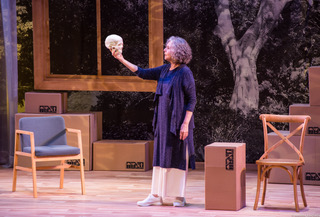
Photo by João Cladas
By Andréa Bassitt
Translated from Portuguese by Elton Uliana
Introductory Note
The Evicted Soul (Alma Despejada) begins with a fairly simple premise: a seventy-year-old woman has died, but she has not yet left her house. As movers prepare to empty the rooms where she lived her entire life, Teresa lingers between presence and disappearance, watching the domestic world she once inhabited slowly dismantled. From this unusual vantage point, somewhere between memory, confession, and afterlife, she begins to tell the story of the life that unfolded inside those walls.
Written by the Brazilian playwright Andréa Bassitt, the monologue premiered in Brazil in 2019 and quickly became one of the country’s most successful solo plays of recent years. Performed by the celebrated actress Irene Ravache, one of the great figures of the Brazilian stage and television, the production ran for extended seasons across the country and received the Bibi Ferreira Prize for Best Original Playtext and Best Actress, Brazil’s most prestigious theatre award. Ravache’s exceptionally charismatic and perceptive interpretation helped transform the text into a landmark performance piece, widely praised for its delicate balance of humour, intimacy, and emotional precision.
Teresa speaks from a liminal space, no longer among the living, but not entirely gone either. From this suspended perspective she reflects on family, marriage, class mobility, corruption, and the disquieting compromises of everyday life. What might initially appear to be a ghost story soon reveals itself as something more interesting and probing: a tender yet incisive moral excavation of Teresa’s life, her family’s trajectory, and the social conditions that insidiously shaped them. The “eviction” of the title refers not only to the sale of a house but to the gradual displacement of identity, certainty, and memory.
Bassitt structures the monologue through lyrical fragments of recollection, shifts in tone, wordplay, and sudden changes of register that move effortlessly between light humour and confession. Teresa’s voice is conversational, digressive, and often mischievous, yet it also carries the slow accumulation of a life reconsidered after death. The play’s humour, sometimes absurd, sometimes caustic, serves both as defence mechanism and subtle instrument of revelation. By the end of the monologue, the reader begins to realise that Teresa’s true haunting is not the house itself, but the moral landscape she inhabited without ever fully seeing it.
Although deeply rooted in Brazilian social life – the culture of domestic work, the language of corruption scandals, the rituals of middle-class aspiration – the play resonates far beyond its domestic setting, raising broader questions about responsibility, self-effacement, and deception. Teresa’s reflections reveal a silent continuum between the small everyday “shortcuts” people justify without much thought and the larger ethical failures that eventually engulf her family. What begins as a domestic narrative gradually unfolds into a compelling meditation on memory, mortality and moral complicity.
Translator’s Commentary
Translating The Evicted Soul involved negotiating the delicate balance between preserving the Brazilian social texture of the original and allowing Teresa’s voice to move naturally within English theatrical speech. The monologue depends heavily on rhythm, digression, and wordplay; its apparent informality is carefully constructed. Teresa speaks as if thinking aloud, often correcting herself mid-sentence, circling back to earlier ideas, or interrupting her reflections with jokes or linguistic observations.
An earlier English version of the translation leaned more toward a “domesticating” approach, smoothing certain cultural references, clarifying connections that remain implicit in Portuguese, and occasionally expanding short phrases into more explanatory sentences. Revisiting the text during the editorial review process for this publication made clear how easily such adjustments risk altering the tonal fabric of the monologue.
Portuguese, a language much more inflected than English, especially in conversational contexts, often relies on juxtaposition rather than explicit causal explanation, meaning emerges through proximity rather than elaboration. When these compressed structures are expanded in translation, the result can sound more essayistic than spoken. One of the central goals of this revision was therefore to restore the sharper, more elliptical rhythm of Bassitt’s phrasing.
The process also prompted a reconsideration of the frequently invoked notion of “speakability” in theatre translation. Translators sometimes assume that actors require language to be simplified, padded, or clarified in order to perform it effectively. In practice, the opposite often proves true. Actors are highly skilled interpreters of rhythm and intention; when the verbal texture of a text is preserved rather than softened, the resulting speech can feel more immediate and theatrically alive.
For this reason, the revised translation retains Brazilian references like names, forms of address, and cultural details that earlier drafts occasionally adapted. Terms such as “Dona” remain in place, as do local images that anchor the play in its specific landscape: the taste of a “jaboticaba”, the names of Brazilian trees like the “jacaranda” or the “quaresmeira”. Rather than smoothing these elements away, the translation allows them to remain as small points of encounter between languages and cultures.
Similarly, vital moments of wordplay were recreated in English wherever possible so that Teresa’s fascination with language, her habit of writing words, misspelling them as a child, or turning them into small philosophical reflections, remains central to the performance text.
Humour was another crucial element to preserve, or better still, to reinstate in English. Bassitt frequently places a light form of comedy beside grief or embarrassment, allowing laughter to emerge from uncomfortable recognitions. It became essential for me to maintain that tonal balance required, resisting the temptation to polish Teresa’s speech into a register that sound too elevated or elegant. Her voice is thoughtful but not literary; affectionate and reflective but never fully abstract.
Ultimately, translating The Evicted Soul meant following the complex, oscillating movement of Teresa’s thought rather than imposing a safe, more stable rhetorical order upon it. The monologue unfolds as a series of discoveries, many of which surprise the speaker herself. The task of the translation was therefore less to explain the text than to accompany it with minimal intervention, allowing Teresa’s wandering voice to find its absorbing, often emotional way through another language: unsentimental, wry and tenderly itself.
Andréa Bassitt (born 1966, São José do Rio Preto, São Paulo) is a Brazilian playwright and actress. She graduated from the School of Dramatic Arts at the University of São Paulo (USP). Bassitt gained national recognition through her work in television, notably for her role as Valdete in the series Sandy & Júnior and appearances in popular telenovelas such as Mulheres Apaixonadas. Her theatre work includes the plays As Turca and the children’s musical series Operilda, which received the APCA (São Paulo Association of Art Critics) Award for Best Children’s Musical in 2013 for Operilda na Orquestra Amazônica. She is also the author of Miguel Magno: O Pregador de Peças. Bassitt’s best-known play, the monologue Alma Despejada (The Evicted Soul), written for the renowned actress Irene Ravache, won the Bibi Ferreira Award for Best Original Playtext and Best Actress.
Social media:
Facebook: @andrea.bassitt
Instagram: @andreabassitt
Elton Uliana (born 1966, Porto Alegre) is a Brazilian literary critic and translator based in London. He is co-editor of the Brazilian Translation Club at University College London, where he also serves as a guest lecturer in Translation Theory. His translations and essays have appeared in publications including Daughters of Latin America (HarperCollins), Art in Translation (Routledge), Asymptote, The Massachusetts Review, West Branch, Latin American Literature Today,and The Oxford Anthology of Translation. He is a member of the Out of the Wings Theatre Translation Collective at King’s College London and, in 2023, served as a reader for the Royal Court Theatre’s International Plays in Translation project. Uliana received the 2026 English PEN Presents: Brazil award, a grant supporting his translation of Carla Bessa’s Jabuti Prize–winning Vultures. He is currently translating a collection of plays by Howard Barker for a Brazilian publisher.
Social media:
Twitter: @elton_uliana
Instagram: @eltonuliana
Facebook: @elton.uliana
The Evicted Soul
By Andréa Bassitt
Translated from Portuguese by Elton Uliana
(TERESA, a woman in her seventies, sits in the living room of her house. Only a few removal boxes, a chair, and an armchair remain. Upstage, the image of her garden.)
They’re taking everything away tomorrow. Everything. The armchair, the books, the colour of the walls, even the floor. They’re putting down porcelain tiles. They call it clean. Clean as in empty… as in almost nothing. A place that’s got only the basics is clean. Yeah. Basic is a good word for clean in this case.
(Writes: “BASIC”.)
I’ve always written down words, since I was a kid. When I learned a word I liked, I’d write it all over the walls, just to practise it. Then it turned into a family game. Everyone knew this habit of mine, so they’d find a way to make it very clear which word they wanted. Jabuticaba! An order. I’d grab the chalk and run to a wall to write it down. My parents didn’t care about the scribbles. The important thing was: their daughter could spell jabuticaba at four.
Auntie Lurdes was the generous one. Always easy words: house, cat, ball. Uncle José was brutal. He liked to challenge me just to provoke my father. (loud) “Vicissitude.” And when he realised I couldn’t, he’d wink at me and say to my dad: “See, João? Nothing clever about this girl. Four years old and she still can’t spell vicissitude! She’s illiterate! You’re the only one who can’t see it, João.” I knew he was joking. My father didn’t. He was easy to fool. João, the family joker.
Our house was always full. A house is the backdrop of a life: the family, the toys, the smell of food. I spent my whole life in this house.
(Stands and moves downstage.)
Now, I don’t live here anymore, but I come by often. If I weren’t dead, I’d say I live here. It’s normal, the dead take a little while to let go of their houses. My father stayed around here for a while too after he… (gesture indicating death.)
Sometimes the children said they saw Grandad around, but I never believed in spirits. Actually, I still don’t. I can’t quite work out what I am now. A ghost? A wandering soul? Nothing?
The first time I came back was when they cleared out my wardrobe. I spent quite a while here then. After that I’d come on Clarinha’s birthday, Eduardo’s, at Easter, on Mother’s Day… during the World Cup… Oh, the World Cup in Brazil… it was awful! My grandparents were German, but of course I supported Brazil! Nobody expected Brazil to score just one goal, let alone seven from Germany. Roberto suffered more from that match than from my death, I’m sure. Roberto is my husband. Even I, already detached from this world, was upset. My son was so traumatised he never ate sauerkraut again. And he used to love sauerkraut!
That was the day my grandson almost saw me. Children deal well with subtle things, they’re still soft and their spirit comes before reason, their imagination wanders into other planes, wherever the angels are. My grandson wanted water and no one would leave the game to get it. So I knocked over a pan in the kitchen; no one moved. And my wish for someone to bring that boy some water was so strong, so strong, that suddenly he called out: Grandma! He knew I’d drop everything for him. Everything. My grandson… Grandchildren are sweeter than our own children. They trust us when everyone else thinks we’re useless. One of the wonders of old age is grandchildren. The others don’t exist.
As time passed I came less and less, but I couldn’t say a final goodbye to the house. So it said goodbye to me. In the end, it was sold,. And my soul was evicted.
This isn’t sad, it’s liberating! The house does nothing for me now. And I’m already well into the detachment phase: from money, from cards, entering passwords!!!
How many things I didn’t need to live! I never thought I’d say this, but a shopping mall, for me now, is just a fair of useless things. Except for bookshops! Yeah, because books aren’t consumer goods, they’re necessities. Books have souls too, they exist between heaven and earth. Reading lightens the head, makes life weigh less. Borges, the Argentine writer, Jorge Luis Borges, said he imagined paradise as a kind of library. I can’t call my library paradise… but maybe an oasis. I love books, the covers, the paper, the smell… Many of mine stayed with family and friends… The ones no one wanted will be donated. It doesn’t matter, paper goes, stories stay. Memory doesn’t die; memory is the inheritance we leave ourselves. And now, with my eviction, I take only the essentials. My inventory, I invent myself. My share, I divide myself.
(INPERISHABLE)
“Imperishable” is spelled with an M for Maria, my daughter! And I’d correct it… (she adds an M the word imperishable).
After we die, memory improves. Did you know that?! The moment you open your eyes on the other side, you remember everything you did here. It’s like a final judgment, only there’s no court. Neither higher nor lower… Don’t think you’ll get there and hand your case to the Supreme to sort it out for you. No. There, it’s just you and yourself.
But you don’t need to be afraid. If you’ve been good, it’ll feel like heaven. Now, if you haven’t… you’ll have to watch it all over again. It’s like a movie: it starts the moment you’re born and ends when you die. Some people don’t believe it. “I didn’t do that!” “I don’t remember that!” “They must have mixed up my file. That’s not me!” Oh yes, it is. That’s you. You’ll have to face yourself. That’s why many people are afraid of death, afraid of knowing who they are and who they were. Afraid of waking up with a hangover and having someone beside you tell you everything you did the night before. Now, if you don’t drink, you don’t need to worry about that. If you’ve never killed, never stolen, never betrayed. If you’ve never slandered, never dodged tax, never fought with a sibling, never disrespected your father, mother, wife, employee, telemarketing operator… If you’ve never felt envy, never gossiped about a friend, never cheered at an enemy’s downfall, never lied or looked the other way, never hurt anyone… Then rest assured. You have nothing to fear. Right?
Nail. Swap the “n” to a “j”! Look… jail!
What a difference one letter makes.
The truth is, you take nothing from this life! Thank goodness! If even taking just your soul costs an arm and a leg. I had a friend who died when he received the bill for his wife’s funeral. Even in a public cemetery, to be buried in a plain grave, no plaque, just a hole in the ground, you have to pay a fee, the tax. Not to mention the wake, the coffin, flowers… Can you imagine if we had to take the whole house with us? I’d definitely be charged excess baggage! I was the type who kept everything. I kept my cousin’s wedding invitation, those baptism and first communion cards with saints in them, my children’s baby teeth, old clothes, new clothes, tight shoes, expired perfume… For forty-six years I kept a ticket to a Ray Conniff concert! For what? So someone else can throw it away when you die. And all those things we keep thinking we’ll give someone but nobody wants them?! I had a pair of trainers so ugly, so ugly not even a homeless person wanted them. They were trendy for a while, big thick soles, curved like a seesaw. They said they helped you lose weight. So I ate like crazy and then went walking in those shoes, thinking they worked like Xenical! (to someone in the audience) Xenical, remember that one? Then you must be dead already! Anyway, what happened? Instead of losing weight, I gained more! And on top of that, the rocking effect triggered my vertigo, I’d get terrible dizzy spells. And the seesaw trainers ended up shoved in the back room. They say if you don’t use something for two years, you’ll never use it again. Who knows. I kept my aunt’s swimsuit from the twenties – Lycra, black and white, with flowers and a little frill on the hip. I kept it because I thought it was beautiful. One day I went to show it to a friend, it disintegrated in my hands. You know when fabric just crumbles? I didn’t even have to throw it away. It turned to powder. I just blew. Like they did with my ashes. I blew.
Anthropophagy…
(Walks toward the skull resting on the shelf.)
I’ve always liked the skull. One day it was there on the shelf, smiling, and Neide, who worked for us, asked: Dona Teresa, when I die, will I look like that? You will, Neide! And so will I! She was shocked. She had never imagined that the lady of the house and the maid might be equal one day. Not even in death! Then she took the skull from my hand and said: “And I’ll look like this!” (Removes all the upper teeth.) “But I’ve already told my boys I want to be buried with my Corega!” We laughed and laughed. Humour in pain is wisdom. A sign you’ve evolved.
Neide worked in our house for more than thirty years – that’s a marriage! Three buses to get here, three to go back. She left her children alone so she could look after mine. She had a hard life, but she always kept that skull’s smiling humour. I think Neide came into my life to remind me of the purity of human beings.
Many times, after I took off (Gesture), I heard Neide praying for me. Once she was here all day thinking about me, missing our daily routine; she turned on the radio station I liked – the one she didn’t. Quietly, she cried from longing. Her sorrow reached me very gentle, like a breath of affection. A lament is like that, it touches us like light or shadow, depending on how it leaves the person. She used to make coffee after lunch saying it was for me, but she always drank it herself. That day she had to make the coffee just for her, since I couldn’t be with her anymore. Couldn’t I? Why not? I didn’t drink the coffee, but I sat beside her and stayed with her until she finished.
Then she went to dust the bookshelf… and came face to face with the skull! She remembered our conversation. She got scared, looked at the skull and then glanced around the room to see if there was a ghost. (Points to herself) “How must Dona Teresa be now? She didn’t even turn into a skull… She was toasted. Turned into peanut crumble. I have great sympathy for the skull. Besides always smiling, it makes everyone equal.
Anyway, I take Neide’s memory with me and leave the skull here. I’ve already got my own.
ANOREXIA
For someone who felt fat her whole life, death is wonderful. Such lightness! You don’t feel hungry anymore!
Now, vices are harder to get rid of. In fact, let me just warn you: smoking isn’t allowed up there.
Well… I’m not exactly waaaay up there. Not waaaay down there either. My “there” is somewhere… in the middle. Between paradise and purgatory. Even in death I ended up somewhere in between.
Next week the new owners arrive. New in both senses: young, and new to the house. A couple. Two men. It could just as well have been two women.
The boys are going to knock the house down! Just imagine: one’s an architect, the other’s an interior designer.
ARAUCÁRIA, CAMBUCÁ, QUARESMEIRA…
It’s been very windy around here these days. All my life, when it rained, I’d go to the window and just watch. It’s beautiful to see the rain fall. It clears your head, washes you inside. The other day, sitting in my armchair, I saw lightning strike a huge tree, a jacaranda I’d known for years. That tree was older than me, but you couldn’t tell, because the older it got, the stronger it became. Solid, lush! Completely anchored in its roots; unshakable. And then, suddenly, a flash of lightning, and my fortress was on the ground. Just like that, down went the giant Goliath. Nothing is permanent. Nothing.
(TRANSITION)
I wasn’t an overly sentimental mother. I was affectionate, but I didn’t spoil my children. If they asked for something and we could give it, we did. But if we couldn’t, or if it wasn’t the right time, we knew how to say “no”. My daughter doesn’t know how to say no. My son, on the other hand, that’s all he says. How is that possible? They had the same upbringing and they’re completely different. (pause) Did they have the same upbringing? Honestly, I don’t know. We change from one child to the next. Each new child finds a different mother.
(WRITES: SPOUSE – MARRIAGE)
Roberto and I met when I was twenty-five and he was thirty. Today that’s nothing, But back then, twenty-five, a bit plump, freckled, a schoolteacher and no boyfriend… I was a strong candidate for spinsterhood: “that one’s going to end up an aunt”. Roberto and I fell in love and married at the end of the school year. We spent our honeymoon at the seaside: São Vicente! The town was beautiful, it still is, but it was even more so then, like everything else. Roberto included.
“Do you love your husband?” my neighbour asked me once. I stuffed a piece of cake into my mouth so there’d be no room for words. But afterwards that sentence stayed in my head. “Do you love your husband?” Roberto was an interesting man, charming, energetic, who knew how to do business. In forty years of work he became a very successful businessman. Even after he became wealthy, Roberto never lost his simple manner. He never showed offwhat he had. He worked a lot, but I can’t say he was absent, busy, yes; but not absent. He was always there at the most important moments. Our relationship was built on trust and I admired him. We were good friends. Time went by quickly, a lot happened us, and before we knew it… The children had grown up and gone abroad to study, so they could have a better future. Brazil. An underdeveloped country. Miserable. When Clarice was little, if she saw someone sleeping rough in the street she couldn’t go to bed at night. She would lie down on the living-room floor… her father or I had to carry her to her room. Nowadays we almost trip over people lying in the street and don’t even notice. We’ve learned to ignore misery.
After our children got married, it was just Roberto and me in this house. Over time Roberto got fatter, more nervous, busier. And drank more. I pretended not to see it. I avoided the problem the same way we avoid a homeless man on the street. Things were going well. Why go looking for trouble? We were simply changing, I told myself. Some things change without us noticing, like a child growing up. Like putting on weight: you only realise when your trousers no longer fit. Better to just let it go.
Hipocrite.
“No, my dear, hypocrite is with a Y!”
Hypocrisy is a beautiful word, I think. Just listen to the sound of it: hypocrisy. Isn’t it lovely? It could be a musical term, hypocrisy… melody, symphony. Hypocrite also sounds elegant. It’s classy! Makes you think of hypodermic or hypnotic. Funny how the sound of a word doesn’t match its meaning. Pain is a sweet-sounding word, like “plain”, but not in meaning. Hypocrite.
This fascination with words never took me much beyond my own garden, where I loved to sit and write in the wind. Sowing. I always liked writing, but I was far too insecure to try a literary career. Unlike my jacaranda, I never blossomed. I kept teaching children, and I was more the lady of the house than the lady of my own life. But writing was a spiritual need, which back then was just a metaphor. I’d show my texts to Roberto; he’d fall asleep in the first few paragraphs. And to Dora, my best friend. Dora and I met at school. We studied in a public school, life was simple, everybody knew everybody.
“Carlos loved Dora who loved Pedro”… We used to say that was Dora’s song. She was dating a guy called Carlos until one day Dora met who? Pedro! Who was Roberto’s brother! And fate decided that, besides being friends, we’d also become sisters‑in‑law. The four of us dated, got engaged, and married together; I mean on the same day. We were always together. Dora was a journalist, and Pedro was crazy about politics. That’s what he wanted to be: a politician. First he was elected building manager. Then he became a bank clerk.
Oh, wait… let me say something: you can’t confuse a banker with a bank clerk, you see? Because people do confuse them! Just like lessor and lessee, lots of people confuse those two. The banker is the owner of the bank. The bank clerk works for the bank. In other words, the banker makes money. The bank clerk makes a salary!
Anyway… Pedro, my brother‑in‑law and Dora’s husband, was a bank clerk. So was Carlos! Carlos who loved Dora! Loved, imperfect tense. Gone, perfect tense. Carlos and Pedro worked at the same bank, studied law at the same university, and became very close friends. They had the same dream: to go into politics.
Even though he wanted to be a politician, Pedro was not dishonest. He wasn’t! He was upright and fair. He wasn’t handsome, but he seemed so because he was so charming. He stood up for whoever needed it, rich or poor: journalists, bricklayers, priests, artists… That sort of thing was not seen kindly in those leaden years, as we called them. A just soul is never welcome in an authoritarian environment. But Pedro thought he could change the world. And maybe he could have. He was a good brother, a good husband, and he was honest. Dora was lucky.
One day, actually, one night, the phone rang. It was Carlos. He could hardly speak, he was screaming. All I could understand was “they killed Pedro.” We were so stunnedwe ran out just as we were, in pyjamas, nightgowns. It was a car crash, a criminal accident, if you ask us. Pedro had stayed late at the office, working on the case of a missing journalist. He’d been on that case for months and already knew who was responsible. If there were people who loved him, there were also those who hated him, fewer in number, but they did exist. And even if his enemies were few, they were big and voracious. The wolves devoured Pedro. And Dora. She was with him. We both felt orphaned. Roberto lost Pedro, and I lost Dora. Roberto was devastated, he barely spoke, hardly ate.
Carlos helped a lot. He took care of everything and turned the loss of his friend into a mission: to devote himself to politics even more.
We didn’t. We started to despise politics. It wasn’t worth suffering for it, since it would never suffer for us. Politics is cruel; it kills its own children, it erases the very thing it writes. We never spoke of it again.
(Hums a tune.) “As if it were just a children’s circle game… Memory…”
I always thought Eduardo, my son, would become a musician. He loved music, carnival songs, he knew them all! Then he got a guitar and could play all sorts of things by ear. I was sure Eduardo was going to be a musician, at the very least a singer. (Proud.) Imagine, my son, a singer?! But his father wouldn’t allow it: “My son, a singer? No way!” He didn’t want the boy mixed up with artists. He was afraid, I understand. He wanted his son to work with him, to look after the business. Look after the business…
With our daughter things were different; she could follow whatever career she wanted. Funny, isn’t it? He never once thought of his daughter working with him.
So Eduardo didn’t become a musician, but he didn’t inherit the business either. He followed a completely different path. It was better that way.
The important thing was that everything was peaceful.
Pardon? Liberté!
When my children no longer needed me, I began to feel a bit useless. But then I thought: I’m going to make the most of my freedom! I went off to do all the things I’d always wanted to do but never had time for. I took French lessons, cooking classes, philosophy… I discovered so many interesting books; reading was no longer forbidden! I read and I ate! That’s when I bought the seesawshoes!
Going back to studying French gave me a pleasure I hadn’t felt in years. Learning is always good, especially when you think you’re past that stage. I’d studied a little French at school, so reading was easier. Speaking, though… I spoke an invented French. Je me vá ao toalet… Il toilet!
I did two years of French and then I decided: I have to see Paris! The hard part was convincing Roberto; business was going very well and he didn’t want to be away from the factory. Since our honeymoon, we’d never travelled alone again, always with the children. Just the two of us? Never!
“Jamais” in French is written like in Portuguese. The only difference is the pronunciation. (In Portuguese.) Jamais! (In French.) Jamais! Yeah.
Three months trying to convince Roberto and… finally, enfin! Voilà Paris!
It was our first trip abroad. The late eighties… The world was opening up for everyone. The Berlin Wall came down, AIDS was on the rise… Technology was spreading… So many new things: CDs, brick‑sized mobile phones, computers! Some things were very good, others not so much… In Brazil we had democratic elections, Fernando Collor de Mello was elected president. Ah, and Carlos was elected congressman! (Long silence. Dodges.) Where was I? Ah, on my way to Paris!
Arriving in Paris was worth all the hassle of the trip. The city was even more beautiful than I’d imagined. We stayed near the Champs‑Élysées. We saw the tower, the bridges, the Arc de Triomphe, the Louvre, Notre Dame, we took boat trips on the Seine, by day and by night! And I spoke French! Un peu. Merci. Ui! Je suis brésilienne. Roberto got all delighted to see me speaking another language. I loved it! Paris really was a dream.
After Paris we started travelling every year. Chile, Uruguay, Argentina… I loved Buenos Aires! And it was so close. I absolutely loved it! Roberto became more open. Open, Roberto! I’d go sightseeing and he’d go to work, visit factories, preferably plastic‑packaging factories, his line of business. In fact, it’s an excellent market, if there’s one thing that’s multiplied in life, it’s plastic. And plastic surgery.
Back in Brazil our life kept getting better. Roberto managed to set up his own factory and we started being called nouveau riche. Some people got offended at being called “new rich”. Not me! Much better to be newly rich than newly poor! One of the young men who are going to live here once said the entrance to the house looked very nouveau riche. I didn’t understand, but I couldn’t exactly ask, could I? He thought the little fountain I put by the steps was tacky. I liked the sound it made.
Another word that became fashionable when they talked about people like us was “emerging”. And people thought it was tacky to be “emerging”. Tacky to rise in life? Why? It would be wonderful if everyone could rise too, but the injustice of the world wasn’t our fault. Was it? We weren’t stealing. On the contrary, we were doing our part: paying taxes, creating jobs, fostering the economy. Another fashionable word back then: “fostering”. Roberto was very upright, he helped people, he was like Pedro. Neide used to say, “Seu Roberto is an angel!” He helped a lot of people. (Changes tone.) So why should I feel guilty for being newly rich, right? He helped a lot of people. A lot of people.
Franchising
The children got married and we reached that moment when my husband got fatter, more irritable… and I pretended not to see it. Soon the first grandchild arrived and brought a breath of fresh air into our lives. I helped my daughter‑in‑law with whatever she needed; I was exhausted, but my life felt full.
When my granddaughter was born, I was enchanted with having a little girl! But I didn’t want to look after her, no.
By then I was a senior citizen. Fifty‑percent discount on everything. Priority in queues. A lot of activities… gym, water aerobics, lambada! Can you imagine me giving up my freedom at this stage to look after a baby?! Just when I was in my “golden years”?
“This golden years thing is only for rich people, Dona Teresa, because for poor people… the older you get, the worse it gets!”
You know who said that, don’t you?
WRITES MARKETING…
Another word that came into fashion was marketeer.
WRITES OVERNIGHT
(TRANSITION)
One night like any other, Roberto came home for dinner… but that night he didn’t eat. He was anxious, trembling. He said he needed to talk to me. He asked me to stop everything. Of course I stopped right away. He looked straight at me, afraid. “Calm down, Roberto!” I thought he was going to tell me he had a lover, or a child out of wedlock…“Speak! Did something happen to the children?” He gripped my hands tightly and poured everything out in one long vomit of words, his eyes fixed on me. The news was harsh, but the determination he showed in telling me, and the trust he placed in me, strange as it sounds, gave me the clarity I needed to take the blow.
I listened to everything. When he finished, he was destroyed. I poured him a glass of water and one for myself. With a sigh, he pushed the glass away, laid his head on his arms, and cried. I had only ever seen my husband cry when his brother died. He cried and cried…He spilled all his anguish onto our table. I didn’t try to hold it back; I let it run over the edges, soak the floor, spread through the house. I stayed dry as a stone.
He wanted my help, wanted me to speak for him. Men do that a lot, when they don’t have the courage to say something, they send the woman…
(CUT)
Doctor, my name is Teresa So‑and‑so, I’m the wife of Roberto Such‑and‑such, owner of such‑and‑such a company. I’ve come to report my husband for involvement in corruption and money laundering.
He was receiving incentivesfrom public bodies, passing funds on to people connected to the government, political parties, election campaigns, all of that.
MODUS OPERANDI
The modus operandi doesn’t matter, the result is the same, and no end justifies those means, does it, Doctor?
Here are some of the accounting records, contacts, contracts, his passport. The only thing left to hand over is him. He’ll be doing that shortly himself, with a lawyer.
I only came first because he was scared and asked me to turn him in. And it’s better to help someone turn themselves in than to help them run away, isn’t it? So I came to make this outsourced confession. Sorry for my joke. I learned from a friend how to find humour in pain. It helps.
I left there and wandered around aimlessly for a while. When I got home, Roberto wasn’t there, he’d already gone to the police station. I turned on the radio. Suddenly I heard Roberto’s name in the news. “My God, it’s started!” I didn’t even hear the story properly. I turned it all off, went to my corner and stayed still, motionless, like a boa after swallowing an ox. I waited for the digestion. I waited for Roberto to come back, but he didn’t; he’d been arrested.
The next day, I went to visit him. When I saw him there, in jail, in those prison clothes, with that enormous shame pushing his head down, I thought of the children, of us… I felt angry, and very sorry for him. But the pity passed quickly. Mine did. His…not so much.
There are things you never imagine will happen to you, until they do. The father of my children, my companion… Why? For money? Power?
The corrupt always have a just cause. Did Roberto also have a “just cause” to justify the hell our lives had become?
Delight. Delete. Denounce.
Roberto’s “just cause” had a name: Carlos. At the start of his career, Carlos came to Roberto asking for help with his campaigns. After he was elected, he kept needing help to stay in power. Roberto felt a huge gratitude to him, and almost a brotherly bond. Pedro’s death had left the same scar on both of them; in relationships like that, the complicity grows so strong it can even justify a change in principles, if necessary.
Carlos was the head of a scheme that moved millions. Roberto benefited from it in public bids and was hired as a speaker and legal adviser for amounts far greater than the services he actually provided. When he provided them. In other words, they were laundering money. Interesting word: laundering. It can refer to both cleanliness… and filth.
“Teresa, transfers aren’t stealing! And the factory is a pioneer in its field!”
It was also a pioneer in forming a criminal gang. Forming a criminal gang. Carlos loved Dora who loved Pedro who loved… What would Pedro think of all this? If I run into him somewhere there, I’ll ask. His brother and his friend involved in corruption?
Friend… Friendship… That’s a word I like very much, for the sound and for the meaning. Friendship is something very particular, because friendship isn’t just one feeling, it’s many. How often we overlook a friend’s faults but not those of a brother, a husband, our children… No, forgive me, with our children we do overlook them. (Reflects). Yes, friendship has a bit of motherhood in it. Maybe Pedro would forgive his friend. His brother… maybe not.
Our children dealt with it in their own ways, as always. Clarice was pregnant, and even suffering a lot, she stayed by my side the whole time. She’s the one who ended up taking care of the business, and did it with a lot of dignity. Eduardo had been living abroad for years and there he stayed; he didn’t come to see his father, he was too angry. I thought it was for the best. One less person to feel ashamed.
They tore our lives apart. The press, the people…The police came into the house, turned everything upside down, took computers, papers, Roberto’s personal things, it was a huge stressful. But I’ll tell you, some things I was even glad they took, piles of Roberto’s old paperwork. One day I almost slipped the seesaw shoes into one of the police boxes.
If staying indoors was bad, going out was even worse. People hated us, attacked us on social media, hurled insults: “family of thieves!” One day, at my grandson’s school, a child asked the teacher if she was still allowed to be his friend. The little friends disappeared, and the big friends too.
We were isolated like monkeys with yellow fever.
Shame. Shame. Shame…The more you say that word, the uglier it becomes. Shame. Shame. Shame. Shame…Even Neide was ashamed to say she worked for us.
BRIBE. “Done Teresa, bribe means corruption, right?” Yes. “Oh, I thought it meant a present… ‘I’ll give you a little bribe!’” And she wasn’t wrong!
I like the word bribe, the sound of it, it’s funny. Bribe is another word that made it into the top‑ten list, but the term “bribe” doesn’t appear in the Brazilian Penal Code, because it’s considered slang. Slang… See how even the word itself is a kind of “deviation” in the language, a joke.
“But he can’t have meant any harm, Dona Teresa. Everybody makes mistakes. Forgive him!”
My God… so much misery, so much violence, so much disrespect, disregard, disgrace…So much disillusion. So many dis-words, and I never suspected a thing.
I never asked about Roberto’s financial life, and he never talked to me about it. I didn’t worry about those things. He paid for everything and I assumed the money the money came from our work. Yes, because what I earned as a teacher, I also gave to him. We were a couple! I never saw any tax return, any contract, nothing, I just signed. I had no reason to be suspect anything! Our life, despite everything, was normal. I never got a diamond necklace, or a house by the lake. All I had was my little fountain.
But human beings are unpredictable. You can’t really say anyone is totally immune to a slip‑up, can you? To a failure, some moment of opportunism. What’s our daily dose of corruption? Jumping the queue, getting a job through connections, grabbing a fake sick note, forging a signature, passing penalty points from one driver’s licence to another… “With or without receipt?” Giving a little “help” to a campaign, under the table… What’s the harm? Everyone does it! If you don’t, you fall behind! Dignity becomes a nuisance. Better to dodge it.
Spending a lifetime dodging reality, that was my greatest act of corruption.
“Family of thieves”…But isn’t that exactly what we were?
Ah, speaking of family, when you die, there’s none of that business of relatives coming to greet you. At least not in my case, no one came. Not my father, not my mother, not my grandmother; I’m an orphaned corpse. Maybe because they’re too ashamed to admit they’re related to me?
(Back to Roberto) When Roberto was released to serve his sentence at home, we were all locked up together. I didn’t recognise my husband anymore; something between us had broken forever. Many times I wanted to leave, eventually even that passed. All that remained was emptiness. Nothing. Neutral gear.
None of us died because of all this. Not even me.
(LOOKS DOWN AT THE FLOOR)
I’m not sure porcelain tiles will work here. People think Brazil is always hot, but that’s not true. It gets really cold in winter, the house turns into an icebox! With porcelain tiles it’ll become an igloo! Igloo was the name of a motel on the road to my grandfather’s house. Behind the Igloo there was a fortune teller everyone used to visit. I went there once too. She told me I would die on a day of great joy. I never trusted fortune tellers, but this one was good. I died during Carnival. From dengue. Of course it would have been more exotic if I’d been bitten by a snake, like Cleopatra supposedly was, but the end of my coil came from a tropical mosquito: Aedes aegypti, which has nothing to do with Egypt, the name comes from Greek. Very classy.
I wasn’t that old when I got sick, I was seventy. I could have died a bit later, from chikungunya or yellow fever! But you can’t choose, when your time comes, you die. To die, all you have to do is …be alive. My mother had a neighbour who choked to death on a kibbeh, Dona Zubaida. They called her Zica. What bad luck! Well… at least it wasn’t Zika!
And apparently death‑by‑mobile‑phone has gone way up too. Whether it’s in the “robbery”, “selfie” or “WhatsApp” category, all three are dangerous.
But without the slightest glamour, fate decided my death would be determined by a very Latin-American factor. It wasn’t hunger or misery, so I can’t complain. I received excellent care, comfort, and very little suffering. Life said goodbye to me gently. And my death brought Roberto and the children closer together. Together they cried the tears of the just and the unjust. Death relativises everything. In time they’ll find their way again. That’s what life is for, to help us make things right.
Around seven o’clock on a Carnival Monday, I made my transition. To the sound of A Voz do Brasil. If I had died a little earlier I might have caught the Ave Maria.
But my soul is truly Brazilian. That’s now proven. I said goodbye to this world to the sound of O Guarani.
They’ll take everything away tomorrow. And I, with my bags packed, say goodbye to this world. Since I can’t do anything more to change it, all that’s left for me is to rest in peace.(Puts the skull away.) From this house I take my leave without bitterness or sadness. They can take everything. It doesn’t matter. All I take with me is my soul. It was evicted, but after wandering for so long, it finally has somewhere to drop dead..
*** (Note: “A Voz do Brasil” was the long-running Brazilian government radio broadcast during the dictatorship whose theme music is the overture to O Guarani by Carlos Gomes.)
 The Mercurian