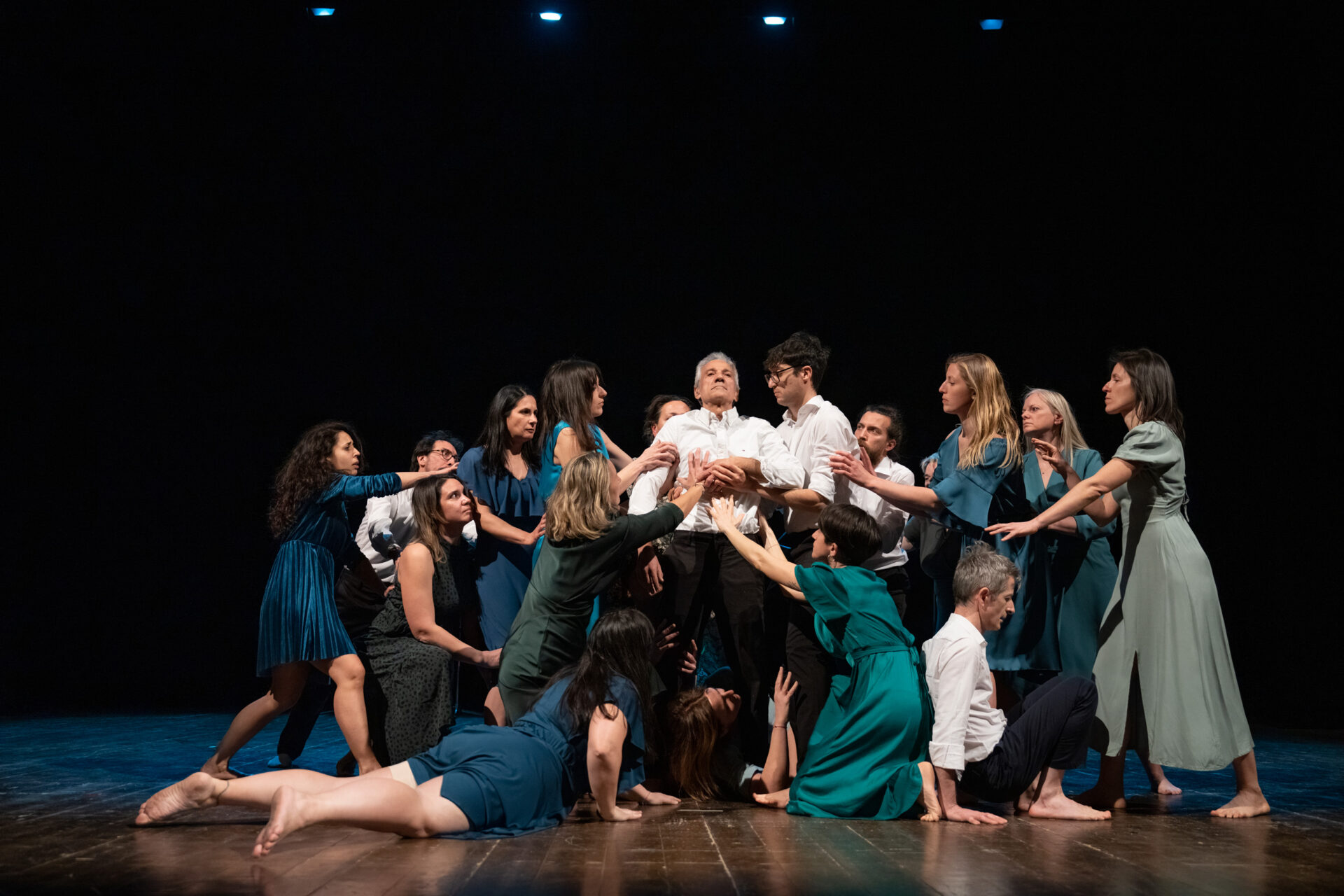
Photo by Andrea Franzetta
By Carmen Pellegrinelli
Translated from Italian by Carmen Pellegrinelli
Introductory Note
This text—originally written by me in Italian—was created during a theatre workshop organised by doctors and nurses from the emergency department of Bergamo’s largest hospital, Papa Giovanni XXIII, to process the traumatic memories of confronting the COVID crisis in March 2020. As is widely known, Bergamo, a medium-sized town in northern Italy, was one of the cities hardest hit by the virus, losing more than 6,000 people in just two months. The COVID crisis in Bergamo was especially devastating for the emergency department, which, within a few days, had to organise itself to deal with an overwhelming number of patients infected with the virus. The workshop and the resulting text led to the creation of a show featuring the doctors and nurses themselves on stage, which premiered in March 2023 at the Teatro Sociale in Bergamo.
Silent Days, Sleepless Nights is based on their testimonies, as well as improvisations that arose during the theatre workshop. My task as playwright was to weave together the material from the collective work to give it a dramatic form, creating unity while respecting the diversity of perspectives and voices. I have described elsewhere the choices made in composing the text, which blends stories from the ward, choruses from the community, and excerpts from classical texts on the plague. I invite readers to consult these publications for more details on how the text was crafted and its narrative paths (Pellegrinelli & Parolin, 2024a, 2024b, 2025).
Here I would like to share some reflections on the translation from Italian to English. The first English version of the text, created for an Italian edition (Pellegrinelli 2024), was translated by one of the doctors involved in the project and later revised by me. The initial plan was to publish it as a parallel text; however, due to editorial reasons, this did not occur, and only the original Italian version was published. Building on that translation, I have further revised the text for this publication, aiming to refine it and to unfold it from its theatrical context, making it more accessible and inclusive.
For this reason, I replaced the original names of doctors and nurses with other designations. I chose to characterise them through their social or professional roles, as well as with numbers (e.g., Nurse Number One, Nurse Number Two). This approach allowed me to highlight the collective nature of the Covid tragedy: in a context where patients, overwhelmed by the enormous number of cases and united by the same virus, ended up becoming numbers, doctors and nurses also shared the same fate, reduced to numbers while they all devoted themselves to treating a single disease. At the same time, this territory made by numbers was the ground on which very touching stories could emerge.
Silent Days, Sleepless Nights is divided into two acts, entitled “The Rise” and “The Fall”. Each act consists of 12 scenes, some of which are composed solely of collective stage movements without dialogues. As you will observe when reading, many stories are connected to what occurred in Bergamo and Italy before, during, and after the pandemic. In particular, the citizens’ choruses refer to local incidents that contributed to the outbreak of the crisis. For example, the text describes in the first chorus of citizens (scene 2) the failure of the Lombardy Region, the responsible institution, to close a critical hospital in the area (the Alzano hospital) after learning that the virus was spreading there. Furthermore, again through the citizens’ chorus, the text recounts the catchphrases (scene 14) related to the impossibility of citizens leaving their homes, the fear of not following government directives, and the practice of singing songs from balconies to combat loneliness (Lucio Battisti is a famous Italian singer; Bella Ciao is the most well-known left-wing song in Italy). And again, the text mentions, with a chorus of citizens, the denialism associated with the No Vax movements (scene 21), which was widespread in Italy at that time. Here, to translate the Italian word “negazionista”, I used the term “Covid sceptical” to refer to conspiracy theorists who believe that the pandemic was staged by governments. I have added notes in the text to explain all these references to recent Italian history and culture.
The scenes set in the hospital, based on the accounts of doctors and nurses, are less specific to particular socio-cultural contexts and could have taken place in healthcare facilities across many parts of the world. They mainly focus on relationships: between professionals and patients, and between patients and their families.
Generally, the translation from Italian to English aims to capture the immediacy of the original text, along with its poetic tension and musicality. It is through these formal elements that the thematic core of the work is conveyed, encompassing stories of life, compassion, and resilience among doctors and nurses at the hospital in Bergamo. For the final version below, I also consulted with my colleague and friend Fraser King, PhD, a former lecturer in Political Science in the UK and a professional proofreader.
References
Pellegrinelli, C. (2024). Giorni Muti, Notti Bianche. Altre Modernità, (32), 298-325.
Pellegrinelli, C., & Parolin, L. L. (2025). Changing Narrative Through Theatre. The Case of Bergamo ER Theatre Covid Play. In Historicity in Organization Studies: Describing Events and Actuality at the Borders of Our Present (pp. 225-253). Cham: Springer Nature Switzerland.
Pellegrinelli, C., & Parolin, L. L. (2024a). “Il tempo della cura”, un progetto di medicina narrativa attraverso il teatro di comunità. Altre Modernità, (32), 279-297.
Pellegrinelli, C., & Parolin, L. L. (2024b). The cathartic value of applied theatre: a case from ER professionals in Bergamo. Nordic Theatre Studies, 36(1), 76-105.
Carmen Pellegrinelli is an Italian academic working at the crossroads of social sciences and theatre. She has extensive experience as a dramaturg and director, with productions performed and recognised in Italy, France, Switzerland, and Austria. This experience has shaped her social science research, in which she advocates an innovative approach that combines art and activism for social change from a posthumanist perspective. In 2023, she earned her PhD from the University of Lapland for her work on collective organisational creativity. She has published several academic articles on theatre, performance, and organisational studies, providing an original theatrical perspective to social sciences. She collaborates on international research projects focusing on participatory design and social change. She is the author of “Performing Ensemble Practices, Theatre, and Social Change” (Brill, 2023), a sociological and theatrical study analysing the collective practices of the Italian theatre company ATIR and their contribution to social change processes. She is currently a postdoctoral researcher at the University of Trieste, where she studies participatory methods in healthcare AI research.
Silent Days, Sleepless Nights
Written and translated from Italian by Carmen Pellegrinelli
CAST OF CHARACTERS
The head physician or the storyteller
ER doctor No. 0
ER Doctor No. 1 to 10
ER Nurse No. 1 to 6
The infectious disease specialist
Patient No. 0
Patient No. 1 to 16
Citizen No. 1 to 10
COVID-19 sceptics No. 1 to 8
Some Voice-overs from Switzerland, Norway, France, Usa
A daughter
A lady
A singer
A musician
Act 1: The rise
Two musicians are on stage with a cello and a guitar. They start improvising.
SCENA 1 – The head physician becomes the storyteller
A head physician enters the scene wearing a lab coat
A MUSICIAN
The microphone is over there.
THE HEAD OF PHYSICIAN OR THE STORYTELLER
I hate theatre.
I fell asleep at the theatre.
Even if I’m well-rested.
Even if the seats are uncomfortable.
Even if the heating is not on, even if Toni Servillo[1] is on stage.
I hate theatre.
But most of all, I hate amateurs. Beginners.
Those who enter and exit through fake doors.
Those who watch the clock to show they’re waiting. I hate them.
Nonetheless, Tonight, I am here.
As an amateur.
As a beginner.
As a complete novice.
Because I admit,
I need it.
SCENA 2 – Chorus of citizens at the sauna
A group of people wearing bathrobes and towels on their heads enters the stage and lies down in a plastic position. They are relaxed, smiling and a little bored.
CITIZEN No. 1
No, but I mean… a flu slightly stronger than usual, you can’t really call it a mysterious pneumonia. Come on.
CITIZEN No. 2
Forget it. It’s something from China. It’ll never reach here.
CITIZEN No. 3
I hope I get it so that I can stay home from work.
———-
CITIZEN No. 4
Well, you won’t believe it – yesterday, I went to the supermarket and saw someone wearing a face mask.
ALL THE CITIZENS TOGETHER
Noooooooo
CITIZEN No. 5
Really? But look how people are overreacting.
CITIZEN No. 4
Yes, I mean, when you put on a facemask, you also scare others.
ALL THE CITIZENS TOGETHER
Ehhhhhhh
———–
CITIZEN No. 6
Yeah, they do it on purpose. It’s the strategy of terror. They want everyone at home to control us better.
CITIZEN No. 4
Right! Write it on Facebook, it is time to strike a blow to the system.
———–
CITIZEN No. 8
Excuse me, but how many kilometres from Codogno[2] to Bergamo?
CITIZEN No. 4
About 80, I think….
CITIZEN No. 8
Ah! Can you imagine how long it takes to get here?
ALL THE CITIZENS TOGETHER
Ohhhh
———–
CITIZEN No. 6
It’s one bit of fake news after another. They show these Chinese people all dressed up, but really, they were already wearing facemasks due to pollution.
———–
CITIZEN No. 10
Coughing
I’ve had this cough for a month. You have no idea how annoying it is. Next week, I had planned a trip to the mountains with my high school friends.
CITIZEN No. 6
Huh? You’re not staying home just because of a bit of cough, are you?
CITIZEN No. 10
Nah, of course, I’m going. What’s the worst that can happen? At most, if I don’t feel well, I’ll sit in a bar and have hot chocolate with the old folks.
———–
CITIZEN No. 7
Avoid Chinese restaurants and you’ll be fine.
———–
CITIZEN No. 11
Getting up to exit the stage and addressing the audience
And have a drink once in a while! You see, this thing is only dangerous if you’re old or have various illnesses. Finally, if you’re young, robust, vigorous, strong, moderately healthy, fit, and not suffering from heart disease: it’s a very mild virus.
Citizens 11, 3 and 6 exit the stage
———–
CITIZEN No. 1
No, I say, now, for this fucking flu, do we do Ramadan?
Shops, businesses, everything closed. We’re from Bergamo – we don’t even stop for Christmas; we won’t stop now for a slight fever. Bergamo is running! Keep going!
Citizens 1, 10, 8 and 6 exit the stage
———–
CITIZEN No. 7
Excuse me, but what are we talking about? We’ve all seen these Chinese people eating live rats dipped in soy sauce! It’s evident that they get sick afterwards, come on!
———–
CITIZEN No. 9
You know, you can easily kill this virus with hot soup. Yesterday, I got a WhatsApp message from my cousin, who heard from her friend, who knows a researcher who worked with a guy in China who knew a doctor… who knew how to treat it. So, it’s a piece of cake.
Citizens 10, 9 and 5 exit the stage
———–
CITIZEN No. 2
Is it true that they closed the Emergency Room in Alzano[3] because of the virus? My mom fell, and I want to bring her there.
CITIZEN No. 4
Yes, but they reopened it later.
CITIZEN No. 2
Ah… I see. Thanks.
Well then… I’ll take her right away.
Everybody, exit the stage. Live music plays.
Then, slowly, a group of thirty actors enter the stage.
SCENE 3 – The contagion
The actors’ bodies touch, mingle, dance, form figures, and then melt away. From the group, an Emergency Room doctor, referred to as ER doctor number Zero (0), advances to the proscenium.
She speaks, addressing the audience.
SCENA 4 – Nobody in the ER
ER DOCTOR No. 0
Just a few days after the first case in Codogno, there was a moment when, overnight, the triage was empty.
No trauma.
No colic pains.
No car or motorcycle accidents.
No kitchen cuts.
No wounds.
No infections, no strokes, no burns.
No food poisonings.
No chicken bones stuck in the throat.
No bruises.
No anaphylactic shocks, no heart attacks, no broken femurs.
No psychiatric cases.
Out of the two hundred or more daily admissions, there was no one left in the emergency room. We laughed.
We said, “Imagine if every day were like this.”
SCENA 5 – The fear
Live Music plays and arises.
After the ER doctor’s No. 0 speech, the actors around her start walking, looking at each other and smiling. The quality of their walk changes. Concern increases.
Actors look at each other as if searching for someone they cannot find. Their actions become increasingly frenetic until they suddenly stop.
The head physician, as storyteller, takes the floor. Slowly, everybody exits the scene.
SCENA 6 – The storm
THE HEAD OF PHYSICIAN OR THE STORYTELLER
Thus, it is before every storm. So, the Iliad tells us. When Apollo sent the plague into the Achaean camp, to avenge the daughter of his priest who had been taken from them, his priest prayed:
“Let the Achaeans pay for my tears with your arrows”.
Apollo came down from the peak of Mount Olympus with a heart full of anger.
He descended like the night.
Then, far from the ships,
he aimed and let loose furious arrows from a silver bow.
First, at the mules.
Then at swift-footed dogs.
And finally, at all humans.
The storyteller exits the stage. The ER doctor, number 1, and the first COVID-19 patient, referred to as Patient No. Zero (0), take the floor.
SCENE 7 – Patient No. Zero (0)
HEALTH WORKER VOICE-OVER
Hello, I’m calling from the operations centre.
I want to inform you that a 55-year-old man is on his way from Alzano Hospital in a simple ambulance with a fever and shortness of breath.
They report that his oxygen saturation is 82% in ambient air.
His father is hospitalised in Alzano and has tested positive for COVID-19.
ER DOCTOR No. 1
There he is!
Our first Covid case.
And we still don’t know where to examine him.
PATIENT No. 0
I called 911.
My father is in the intensive care unit. I’ve had a slight fever for three days.
ER DOCTOR No. 1
There he is!
Our first Covid case.
And we don’t know if we’ll be safe in our uniforms.
PATIENT No. 0
I have chills, especially in the evening. But I don’t feel that bad.
ER DOCTOR No. 1
There he is.
And we still don’t know if we’ll be ready.
PATIENT No. 0
Let me get over the fever, and everything will be fine.
ER DOCTOR No. 1
There he is.
The X-ray is shocking. Where have the lungs gone? It’s our first COVID case.
And we still don’t know exactly what treatment we’ll give him.
ER doctor number 1 and patient number 0 exit the stage.
SCENA 8 – One patient, two patients
ER doctor No. 2 enters. She has a wired microphone in her hand.
Epic music plays in the background, getting louder and louder.
ER DOCTOR No. 2
One patient, two patients
There is time to listen to them.
Five patients, six patients
frightened by the unknown,
more and more seriously ill.
Ten patients, fifteen patients,
there is a queue of ambulances.
The emergency room lobby is filled with people coughing.
Twenty patients, thirty patients.
To make it quicker: name, surname, and date of birth
hung on the beds.
They are all piled up.
There is no more space in the corridors.
They are side by side in makeshift beds.
And they don’t understand what is going on.
One hundred patients, two hundred patients.
They arrive en masse.
Late into the night
Supported by relatives
Ambulances are no longer there
They start dying in the emergency room
We can’t go on like this
If they don’t stop, we won’t make it.
We need more material.
We need more gloves.
We need more masks.
We need more oxygen tanks.
We need more oxygen helmets.
We need more beds.
We need more protective suits.
We need more doctors.
We need more time.
We need a cure.
If they increase any more, we’ll collapse.
Altogether.
SCENA 9 – Fall and Choreography
As the music continues, actors take turns running across the stage. As they run, many of them fall and get back up.
Finally, the group reassembles and builds a large human sculpture around the narrator. Then, the sculpture dissolves.
The music stops.
Each actor takes a bag out of their pocket and puts it on their head. They then take up a distributed position on the scene.
They begin to ask the audience questions.
They remove their faces from the bag for a while when they talk.
SCENA 10 – Chorus of citizens becoming patients
PATIENT No. 1
Why are you sending me to the intensive care unit?
PATIENT No. 2
Do I have to stay here much longer?
PATIENT No. 3
Are you sure about what you’re doing?
PATIENT No. 4
Why am I in the neurology ward if I have pneumonia?
PATIENT No. 5
I don’t have my pyjamas.
PATIENT No. 6
Who are you?
PATIENT No. 7
Why are we all sick?
PATIENT No. 8
Do you have a treatment for it?
PATIENT No. 2
Can I have some water?
PATIENT No. 9
Where is my son?
PATIENT No. 10
Is it day or night?
PATIENT No. 11
Why is no one helping me?
PATIENT No. 12
Can I have some lip balm? My lips are dry.
PATIENT No. 13
Do the lights ever, ever turn off?
PATIENT No. 14
The straps under my armpits are pulling.
PATIENT No. 10
Is it day or night?
PATIENT No. 15
I need to use the restroom.
PATIENT No. 11
Can you give me earplugs?
PATIENT No. 15
I no longer want this helmet. Take it off!
PATIENT No. 3
Could you give me some morphine? I don’t want to feel anything.
PATIENT No. 16
Can someone say a prayer for me?
PATIENT No. 5
Can I brush my teeth?
PATIENT No. 10
Is it day or night?
PATIENT No. 6
Where did my bed neighbour go?
PATIENT No. 7
What’s the oxygen saturation today?
PATIENT No. 8
How can I piss in front of everyone?
PATIENT No. 16
Who will feed my cats?
PATIENT No. 9
Don’t the lights ever turn off?
PATIENT No. 10
Is it day or night?
PATIENT No. 1
Can we video call my daughter?
PATIENT No. 12
But… What day is it today?
PATIENT No. 13
Let me go home.
PATIENT No. 14
Let me die.
PATIENT No. 17
I don’t want the tube.
PATIENT No. 11
Do you have candy?
PATIENT No. 10
Is it day or night?
PATIENT No. 15
Please tell my parents that I love them!
The patients exit the stage, and the plastic bags are on the floor. The ER Nurse No. 1 stays to pick them up.
In the background is the Storyteller.
SCENA 11 – The Rosary
ER NURSE No. 1
I change. I get dressed.
I arrive at work to start my shift.
THE HEAD OF PHYSICIAN OR THE STORYTELLER
I endure countless hardships.
ER NURSE No. 1
The emergency room corridor is full of stretchers.
THE HEAD OF PHYSICIAN OR THE STORYTELLER
My people are suffering.
ER NURSE No. 1
There are oxygen tanks everywhere.
THE HEAD OF PHYSICIAN OR THE STORYTELLER
And thoughts provide no weapon to create a shield.
ER NURSE No. 1
They are huge and make a noise that pierces the ears.
THE HEAD OF PHYSICIAN OR THE STORYTELLER
Fruits no longer grow on the earth.
ER NURSE No. 1
They pump air into the patients.
THE HEAD OF PHYSICIAN OR THE STORYTELLER
You can see, they are one on top of each other.
ER NURSE No. 1
Bodies lying on stretchers.
THE HEAD OF PHYSICIAN OR THE STORYTELLER
Daughters and sons falling on the shores of God, like birds with beautiful wings.
ER NURSE No. 1
Sweating. Trembling.
THE HEAD OF PHYSICIAN OR THE STORYTELLER
Struck by an untameable fire.
ER NURSE No. 1
Sheets hanging.
THE HEAD OF PHYSICIAN OR THE STORYTELLER
You can see them, daughters and sons, bearers of death.
ER NURSE No. 1
A man’s boot is left in a corner.
THE HEAD OF PHYSICIAN OR THE STORYTELLER
And without mercy.
ER NURSE No. 1
And water bottles. Open. Fallen. Empty.
THE HEAD OF PHYSICIAN OR THE STORYTELLER
The city perishes from countless deaths.
ER NURSE No. 1
In a chorus of laboured breathing.
THE HEAD OF PHYSICIAN OR THE STORYTELLER
They lie on the plain without lament.
ER NURSE No. 1
Goggles on their noses.
Masks.
Flow.
——–
ER NURSE No. 1
I look up and meet the gaze of a patient. He’s on a red stretcher.
There were no normal ones left. He calls me.
He’s not much older than me. I approach him.
He asks: “Will I ever see my children again?”. Yes, of course.
Then I go back and do my job.
I prepare IVs, antibiotic drips, and blood draws. I go back to the corridor. With a quick glance, I scan all the patients.
I don’t skip one.
I arrange pillows. Tuck in blankets. Wipe away sweat.
Then, my gaze falls on him again. He raises his hand.
I approach.
He struggles to speak.
He has a high-flow mask. I ask if I can do something. He says, “Find me a Rosario”
A rosary? Where? How? I go back to my spot.
I resume preparing IVs, antibiotic therapies, and blood draws. Then, without telling anyone,
instinctively, I remove my sweat-soaked gown. I rush out of the Emergency Room.
I run toward the Holy Mary statue in the central parking lot. I see a Rosario in her hands.
I grab it.
I’ve got it! I’ve got it!
I run back to the Emergency Room. And I bring it to him as if it were oxygen.
ER Nurse No.1 exits the stage, leaving the storyteller alone on the stage. The live music plays.
SCENA 12 – Oedipus Rex
THE HEAD OF PHYSICIAN OR THE STORYTELLER
There is no place untouched by ruin.
Every age and gender falls in the same way.
And this plague that brings death
takes young and old, fathers and daughters. The same fire burns newlyweds as well.
And the premature deaths receive neither tears nor lamentation.
In fact, as with all extreme evils, such a stubborn slaughter, such great misfortune, has dried the eyes, and there are no more tears.
The storyteller exits the stage.
Act 2: The Fall
SCENE 13 – Nonstop
Five ER nurses take the floor.
ER NURSE No. 2
I feel the uniform against my skin. It’s full of sweat.
I stink.
But it doesn’t matter; I’ll be home in a few minutes. I drive through the empty streets.
Home – work; work – home; home – work; work – home. As if I’m condemned to live the same day over and over. The last bit of energy slips away with the shower drain.
I eat with my head dropping into my plate.
Then, I reach the sofa. I’m tired, so tired, but I can’t sleep.
The pile of dirty laundry grows.
The dust on the furniture accumulates.
Before I realise it, it’s already time to go back to work.
ER NURSE No. 3
A coffee with my colleagues. We have 10 minutes left.
Then we’re all crowded in a room. Gowns, overgowns, facemasks.
We need a little laughter. We crack jokes.
We know it’s the only chance to talk.
Then, everyone out. Each to their station. We’re off!
I think. I want an adventurous life.
ER NURSE No. 4
And off we go.
Desperate faces, non-stop. Outstretched hands, non-stop. Wide-eyed, non-stop.
Stretchers, one, ten, a hundred, a thousand. A battlefield.
Am I dreaming?
ER NURSE No. 5
The ventilator alarm brings me back to reality. The infusion pump.
The monitor. Blood pressure. Shut one up.
Another starts. Let’s go!
You need to intubate, non-stop. Hurry, non-stop.
Check the parameters, non-stop. Take blood samples, non-stop. Monitor the therapies, non-stop. Bring a blanket, non-stop.
The nurses exit the stage, leaving Nurse No.6 alone.
ER NURSE No. 6
Don’t get distracted. Don’t make mistakes. The doctor is talking to you.
The phone rings.
The shift slips away in an instant. I undress. I wash.
I grab a pastry they gave us.
I eat it as I walk down the hallway, in my lovely, sweaty uniform.
Horrible hair stuck to my forehead.
My face, purple, with lines from the mask. Until next time.
Nurse No.6 exits the stage.
SCENE 14 – Chorus of citizens locked in their houses
A group of citizens dressed casually and holding phones enters. They walk in a circle around the scene.
CITIZEN No. 1
But what if I went out and got a couple of things at the mall? The store behind the house no longer has anything. Just a quick in-and-out, huh?
CITIZEN No. 2
It’s such a mess with all these directives. Oh, I’m taking a painkiller because this mess is giving me a headache.
CITIZEN No. 3
I bought an anti-COVID pendant. Look how cute it is…
CITIZEN No. 4
But instead, I say: why don’t just the scared ones stay at home? Let the rest go out…
CITIZEN No. 5
Girls, my neighbour has made some beautiful crocheted face masks. I always use them when I go shopping.
CITIZEN No. 6
Look there, at Mr Mangili. What is he doing outdoors? He’s retired!?! Oh, I’ll take a photo and send it to the police!
CITIZEN No. 7
Oh, I will get away with it: I’ve been wearing the same surgical mask for a month!
CITIZEN No. 8
Do you take the dog out like this? Look, even Barbara D’Urso said to clean its paws with bleach.
CITIZEN No. 9
Enough with all these virologists on TV. Objective data should be given once a week.
CITIZEN No. 10
Anyway, I don’t believe a single word of what the newspapers say: I’ve always been a contrarian and always will be.
CITIZEN No. 11
Oh, what shall we sing on the balcony today? Battisti or Bella Ciao[4]?
The musicians start playing Bella Ciao.
The citizens exit the stage, leaving only one of them on stage.
SCENA 15 – Brioches
She changes her clothes and becomes ER doctor No. 3.
ER DOCTOR No. 3
I remember… I am on the afternoon shift.
The hall is complete, but there are still a few CPAP machines.
It is still the early days.
It’s dinnertime.
My gaze falls on a patient, around fifty-five to sixty years old, who’s really struggling to breathe. Our eyes meet.
I can see that he’s in bad shape. I read fear in his eyes.
But he also reads fear in mine. Dinner arrives.
I approach.
I try to help him eat.
He says to me
“Doctor, I can’t do it. It’s either breathing or eating”.
Come on, you can do it.
“It’s either breathing or eating”.
Come on, at least try to have a sip: It can help you…
“It’s either breathing or eating”.
There is no way. He can’t.
“Now, I’ll leave you alone. But I promise I’ll come back tomorrow, I’ll bring you a croissant, and we’ll have breakfast together”.
In the evening, at home, I think about him. I can’t rest.
It is hard to fall asleep.
In the morning, my first thought is to find two croissants. I find them.
I rush to the Emergency Room. He’s not there.
Now it’s full, but all faces are different from the night before.
I look for him in the shock room. And there I find him.
He’s wearing a CPAP helmet.
He’s got the helmet on, so he can’t hear me.
I see, in his eyes, that he recognises me. I get closer, and I show him the croissants.
“Two: one for me and one for you… breakfast together”.
But we can’t do it now. I’ll be back later.
I put the croissants on the bedside table.
We say goodbye with a look.
I turn around.
I won’t see him again.
ER Doctor No 3. Exits the stage.
SCENE 16 – Dad
A girl runs to the middle and asks the doctor if she is worried about her father.
A DAUGHTER
I cannot find my daddy… Dad!?! Dad?!?
She moves between the microphones, searching and calling out to the point of desperation. Then, the young woman exits the stage.
In the background, the beep of a cardiac monitor machine starts.
SCENE 17 – Bad News
A lady, the wife of a patient, and ER doctor No.4 enter the stage.
A telephone call between the wife of a patient and an ER doctor.
A LADY
Good evening, doctor, tell me.
ER DOCTOR No. 4
Unfortunately, I have to give you some bad news, ma’am. Your husband has deteriorated this afternoon.
A LADY
But is he alive?
ER DOCTOR No. 4
He’s alive, but we had to sedate him. Do you remember that I called you yesterday?
A LADY
Yes.
ER DOCTOR No. 4
And he was improving a bit.
A LADY
Yes.
ER DOCTOR No. 4
However, today the intensivist arrived, and he has been intubated. So now he’s in intensive care.
A LADY
Can I see him?
ER DOCTOR No. 4
No, unfortunately not. You know that in these times…
A LADY
Please, just three minutes, one minute…
ER DOCTOR No. 4
Look, I realize the situation is critical, but it’s not possible to see him. We’ll keep you informed of any changes.
A LADY
But is he awake now?
ER DOCTOR No. 4
No, he’s sedated.
A LADY
Did he say something?
ER DOCTOR No. 4
He said goodbye… and that he loves you.
A LADY
Will I see him again?
ER DOCTOR No. 4
We’ll do everything we can to try to pull him out of this situation, even though it’s indeed very critical.
A LADY
But I don’t understand. When I brought him, he was fine. He had trouble breathing, but he was fine.
ER DOCTOR No. 4
Unfortunately, this illness has these complications.
A LADY
Can I call you from time to time? To know…
ER DOCTOR No. 4
Of course, I’ll call you. Is that okay?
A LADY
But when will you call me?
ER DOCTOR No. 4
I’ll call you every day, around this time, all right?
A LADY
So, nothing until tomorrow?
ER DOCTOR No. 4
No…
A LADY
I really can’t see him?
ER DOCTOR No. 4
No… you can’t see him. I’m very sorry.
A LADY
Okay, okay, I understand. Thank you. Good evening.
They look at each other, turn their backs, and exit in opposite directions. Live music plays.
SCENA 18 – La Bigi
A doctor takes the floor: the infectious disease specialist
THE INFECTIOUS DISEASE SPECIALIST
She answered on the first ring: you could tell she was waiting for the call. Her voice is calm, a bit hoarse.
I can imagine her standing in the dark hallway of an old house.
“Well, Mrs Rota, the situation isn’t much different from yesterday. I’ve already explained… Well, he’s not doing well, to put it mildly.
He’s an elderly man, and this disease is extremely dangerous for the elderly, you know.
He can’t eat anymore, and I really don’t think it would be good to push treatment beyond a certain point. So, I hope you can understand.”
And she says, “You see, doctor, it’s because I’m not there with him. My husband needs me. Doctor, we’ve been married for 55 years.
Ah, my nephew was right. He kept saying that.
When he brought us to the emergency room, he kept saying that once my husband was alone in the hospital, he would let himself go. He was right!”
“Do you have children, Mrs Rota?”
“No, doctor, it’s just the two of us.
We’ve lived together for almost our entire lives.
Listen, doctor, could you do me a favour? When you go to him, tell him this:
‘Giovanni, I have a message from your Bigi’. ‘Bigi’ is a nickname he gives me.
And tell him that I really can’t be there with him right now, but that I love him. Just say to him, doctor. Please remember: ‘Bigi.’
I’m sure it will help”.
At this point, I need to pause; I can’t go ahead. So, for a few seconds, Mrs Rota and I fall silent.
Each one is at the end of their rope.
Suddenly made dumb by the complete awkwardness of the situation.
A couple who have shared their entire existence, just before the end, are forever separated.
Oh God, I could tell Mrs Rota the truth: that her husband is no longer present, that he doesn’t even respond, that these are truly his last hours.
But I’d rather not.
I prefer to let her believe that he will receive her greeting with my voice and feel her close.
This daily round of phone calls to the relatives is a sad ritual for us doctors who have found ourselves performing it every single day.
Nonetheless, I realise that I do await this moment: I myself need to keep these unreal conversations with invisible strangers going, so together, we peer into the darkness of our fears.
In that motionless moment, that is the time of care.
At this moment, the music of Albinoni’s Adagio starts on the recording.
The group of actors enters the stage, creating a line-up at the front of the audience.
SCENA 19 – Dressing up
The actors, as medical professionals, slowly mimed dressing in PPE uniforms like a dance.
The scene reveals that they are the Emergency Room doctors and nurses preparing to enter a ward full of COVID patients every morning.
When they finish, the actors exit the stage.
SCENA 20 – Dad and son
The storyteller and ER doctor No.5 take the floor.
THE HEAD OF PHYSICIAN OR THE STORYTELLER
Dear father, don’t be afraid. Hold on to my neck. I’ll support you with my shoulders.
And you won’t be a burden to me.
However, in the face of common danger, we will save ourselves together.
ER DOCTOR No. 5
Outside, it’s quiet.
Only inside the hospital is there noise.
In the Emergency Room, there’s Luigi, an elderly man.
He’s been with us for four days now.
Four terrible days of bed, medications, and an oxygen mask.
We’re having trouble finding him a spot in a ward.
Yet, he asks for just one thing every day. “Doctor, I want to see my son”.
“Luigi, you know we can’t. We’d like to, but it’s not possible.”
“But I’m asking only one thing, then you can leave me to go (or leave me to die). Doctor, I want to see my son”.
“Luigi, we are taking care of you so you can return to your son and family soon.” But he insists.
“Doctor, I need to see my son”.
The time comes for the phone call home.
As we do for any patient, we call Luigi’s son Pietro. Pietro has been waiting for the call all day.
“Good morning, this is Dr Nanni.
We spoke yesterday as well. I am calling to inform you about your dad.
Unfortunately, his condition is still very critical.
However, today we’ve managed to find a place where he can be admitted.
No, no, no, unfortunately, you can’t see him.
Besides, he’s also asking all the time to see you.
The same rules apply in the ward as in the Emergency Room.
You can’t enter the Emergency Room, just as you can’t enter the ward. No, please, don’t insist.
It’s just not possible.”
Then, I think.
The hallway!
A tiny break from the rules. A small one.
The transition from the Emergency Room to the infectious diseases ward.
An instant.
But at least it’s time for a farewell.
Maybe. We can make it.
“Listen, Pietro. So, we do it like this. It couldn’t be done, huh?
In an hour, your dad goes up to the ward.
You come to the emergency room, and we’ll have you meet in the hallway.
It’ll be a very quick thing; I want to be honest with you.”
The time for this farewell is the brief moment it takes for a stretcher to be wheeled from the emergency room to the infectious diseases ward.
From one door to another door.
We prepare Luigi.
And Pietro is waiting on the other side of that door.
The door opens.
Luigi and Pietro meet each other:
“Pietro!”.
“Dad.”
“It’s so nice to see you, Pietro. Say hi to Mom. Kiss her”.
Kiss her. And the time is up.
Kiss her. And the doors close.
Kiss her. And Pietro and Luigi will never see each other again.
ER doctor number Five is chased off the scene by a group of angry citizens. They are COVID sceptics.
SCENE 21 – Chorus of citizens becoming Covid sceptical
COVID SCEPTICS No. 1
But take off that facemask.
We breathe carbon dioxide with the mask on! Come on and study how the lungs work.
COVID SCEPTICS No. 2
But do you still believe what they tell you?
How many people do you know who died of COVID-19? In Piacenza, Lodi, and Bergamo,[5]?
We want names and addresses!
COVID SCEPTICS No. 3
However, if you had a severe case of COVID without underlying conditions, it means you had something within you needing to be healed!
COVID SCEPTICS No. 4
The truth is that this virus is fortifying us.
COVID SCEPTICS No. 5
And they created it in a laboratory, the fantasy virus!
COVID SCEPTICS No. 6
But Covid doesn’t exist…!!
COVID SCEPTICS No. 7
And the swab punctures one’s membrane. Yes, you understood… I won’t let my child’s membrane be punctured!
COVID SCEPTICS No. 8
Am I free to say they moved the army trucks in front of the cameras to scare us all[6]?
COVID SCEPTICS No. 7
Is there still freedom of speech in this country, or are we in a dictatorship?
The sceptic COVID citizens exit the stage.
From the top of the stage, a headlight beam slowly descends.
Many white doctors’ coats hang there.
The actors slowly enter the stage, approach the beam, take off their gowns, and put them on. They all become ER doctors and nurses.
Messages are heard from a voice-over.
SCENE 22 – Messages from the world
VOICE-OVER FROM SWITZERLAND
Hello, my friend. Here in Switzerland, everything remains quiet, but the peculiar thing is that there are two factions: those who believe it’s all a setup and those who believe something terrible is about to happen. I decided to have my chief listen to your voicemail, and he sent it to the cantonal doctor. Now, our hospital in Locarno has become a COVID Centre, and today, we already have the first three patients on ventilators.
VOICE- OVER FROM FRANCE
Hello, my friend. Here in Paris, things are starting, but we managed to clear our hospital before the first patient arrived. This is thanks to you.
VOICE- OVER FROM NORWAY
I want to thank you for the podcasts and the interview with the doctors from Bergamo; they helped us prepare before the COVID wave reached Norway.
VOICE- OVER FROM USA
To the doctors, nurses, and all the hospital staff.
“In Japanese tradition, the crane is a sacred creature. Legend has it that anyone who folds a thousand paper cranes brings happiness and good fortune. On Easter Sunday, 2020, while reading The New York Times, I saw pictures of your faces. At that moment, I started folding paper cranes to honour all those faces. I’m sending you a part of these thousand cranes that will fly across the ocean. Accept them as an offering of hope, as a ray of happiness, as a way to tell you that your efforts are not going unnoticed.”
SCENE 23 – We are no heroes
ER DOCTOR No. 6
To those who…
To those who think they know more than we do.
To those who know what we should have done and failed to do in March 2020.
To those to whom no measure is good enough.
To those who believe they would have done it better.
To those who say, “What are you complaining about? You freely chose to care”.
To those who say, “So what if I catch it? Now everyone is asymptomatic.”
To those who say, “Only old people get sick.”
To those who say, “Wearing a facemask restricts my personal freedom.”
ER DOCTOR No. 7
And to those who like to call us heroes.
I mean, we are not heroes.
We are regular people.
Sometimes, we’re even jerks.
And we’ve been jerks even in the toughest moments.
ER NURSE No. 6
Sometimes, before our shift, we’d stand in a circle and chant together, “Shit, shit, shit!”
ER DOCTOR No. 8
And that time when someone found a bottle of red wine, and we toasted on empty stomachs?
ER NURSE No. 2
Yes, but say it was at the end of our shift, huh? The hospital management is sitting here in the theatre…
ER DOCTOR No. 1
And since we couldn’t even hug, we came up with the “bum-bum” greeting[7].
ER DOCTOR No. 5
Listen to this, listen to this! One night, I was driving home on the empty highway, and the police stopped me…
I pulled over, and a very stern officer got out and said, “You!!!”
Silence
“I made a bet with my colleague that you work at the hospital. Is it true?”
ER NURSE No. 2
But it’s not funny…
ER NURSE No. 4
And the lady who confused the CPAP helmet with the hairdryer one!?! Oh, she couldn’t stop apologizing because she didn’t have money for the hairstyling.
ER DOCTOR No. 6
Until someone told her that her daughter had already paid, and finally, she found peace in her heart…
THE INFECTIOUS DISEASE SPECIALIST
Speaking of hairstyle… let’s talk about our colleague Carmelo, who kept wearing a cap all the time, night and day, for two months… and only when he removed it, we finally figured out why: (he messes up his hair) Carmelo! What happened to your hair? and he, calm: “Even President Mattarella[8] no longer goes to the hairdresser!”.
ER DOCTOR No. 8
Masks, gowns, head coverings. “From Giovanni Rana’s factory[9]: Ladies and gentlemen, tortellini are on the menu today!”
ER NURSE No. 1
And what about how much we ate? They sent us food at all hours…
ER DOCTOR No. 9
Well, come on, they were gifts.
ER NURSE No. 1
… yes, but after kebabs, Neapolitan´s Pastiera and gorgonzola pizza… thank goodness we all had masks!
ER Doctor number Six puts her hand in her pocket, finds a paper crane, and looks at it.
Then everyone puts their hands in their pockets, takes their crane between their fingers, and exits the stage, almost carried away by the crane.
Then, everybody exits the scene.
SCENE 24 – And he sings
The music plays “Una furtiva lacrima”, an aria from “L’elisir d’amore” by Gaetano Donizetti. On stage, remain ER Doctor Number One and a singer.
ER DOCTOR No. 1
There was a boy who was 17, or maybe he was 19. I hope he’s still there.
Admitted to the ward for a few days with the CPAP helmet.
At some point, he has a sudden worsening of respiratory function.
So, he’s taken to the Shock Room.
I am there and welcome him.
He has Oxygen at very high flows. But saturated less than 90%.
And he sings.
A SINGER
Singing
Una furtiva lagrima
Negli occhi suoi spuntò
Quelle festose giovani
Invidiar sembrò
Che più cercando io vo?
Che più cercando io vo?
ER DOCTOR No. 1
It’s not a miracle and just brain hypoxia.
I’m looking for a pulmonary embolism.
But the embolism is not there.
I’m looking for the heart.
I can not see it.
I’m looking for the lungs.
I can’t even see those.
In their place, there is a wall.
A black wall of impenetrable air
Part of the chest is filled with air.
And it plays a dangerous game of pressure.
As a result, he could die of cardiac arrest.
But instead, he sings.
A SINGER
Singing
Che più cercando io vo?
Che più cercando io vo?
ER DOCTOR No. 1
We decide to intubate him and then attempt chest decompression manoeuvres.
The procedure must be speedy.
We remove the helmet. Put on a mask with a high percentage of oxygen.
We explain to him that we have to intubate him.
We explain to him that we will put him to sleep.
That when he’s better, we’ll wake him up.
He continues to sing.
A SINGER
Singing with vocalisation
ER DOCTOR No. 1
We are ready!
Medicines.
Pipe in hand.
Now you will be sleepy.
The music slowly fades away, and the lights go out.
[1] Toni Servillo is a renowned Italian actor and director, recognised internationally, who has worked in both cinema and theatre throughout his career.
[2] Codogno is an Italian municipality in the province of Lodi in Lombardy, where the first confirmed outbreak in Italy of COVID-19 was identified, dating back to February 2020.
[3] The Alzano Lombardo’s Hospital (Pesenti-Fenaroli) is a healthcare facility situated in Val Seriana, Bergamo Province, northern Italy. During the first phase of the COVID-19 pandemic (February 2020), the hospital became a hotspot, with positive cases and deaths reported. On this occasion, the hospital was closed and then reopened within a few hours on the orders of the Lombardy Region (the institution responsible), without adequate sanitisation or differentiated pathways. For this reason, the decisions that were taken are now the subject of a judicial investigation.
[4] Lucio Battisti was a renowned Italian singer in the 1960s, sometimes associated with the right-wing movement. Bella Ciao, a song written during the Second World War, is a famous left-wing piece. These two songs represent the perennial Italian conflict between right and left in civil society.
[5] These are all cities in the Bergamo area, in northern Italy.
[6] Here, the text refers to the famous image of the line of military vehicles carrying coffins away from the cemetery in Bergamo because there was not enough space to bury all the deceased.
[7] A doctor had invented a way of greeting his wife, also a doctor, by rubbing their backsides together, so as not to touch each other head-on and risk infecting each other.
[8] Sergio Mattarella is President of the Italian Republic.
[9] Giovanni Rana is a famous brand of tortellini and Italian pasta.
 The Mercurian