OH
By Putu Wijaya
Translated by from Indonesian Cobina Gillitt
Putu Wijaya (b. 1944), one of Indonesia’s most celebrated and prolific playwright-directors since the early 1970s, believes the objective of theatre is “mental terror.” For him, every performance is an opportunity to jostle spectators out of their comfort zones, shifting them from a feeling of stability to one of disequilibrium. He hopes to plant a seed (or ticking time bomb) that will grow (or explode) into a recognition of a new way of looking at how society functions on both the micro and macro levels, or at the very least prompt the onset of questioning the validity of long-held beliefs. His is not a prescriptive theater but a questioning one. It is up to the spectator to speculate on what has been presented. The work does not provide answers. Its ultimate meaning will be different for each spectator. It is important to note that Putu[1] is not out to crush souls through mental terror. Mental terror doesn’t always need to be explosive; the terror happens when something onstage suddenly appears unnatural, unexpected, or out of place, not unlike Bertolt Brecht’s concept of Verfremsdungeffkt. For Putu, a performance’s true significance lies in the effect it has on the audience long after it ends. His aim is not to simply entertain audiences, but to provoke thought and self-reflection.
In 2014, Putu suffered a stroke that left him in the hospital for several months followed by years of intense rehabilitation. His cognitive faculties were unaffected, but the mobility on his left side was severely impaired. He now requires a wheelchair. He is no longer able to type except with his right thumb on a Blackberry. However, his creative output didn’t diminish; in fact it grew because he could now write anywhere with his Blackberry.
In 2016, just two years after his stroke, he compiled the book One Hundred Monologues, published in conjunction with a national monologue competition he spearheaded. The contents of the book are monologues Putu adapted from his short stories that had been published in Matra, an Indonesian men’s lifestyle magazine (published in the years 1986-2007). Then, in 2018, in preparation for a national competition for the best performance of one of his drapen (a portmanteau for drama pendek, or short play), he further adapted his previously published short stories and monologues into short plays, including OH that had originally been published in short story form in Matra in 2003 with the title Peradilan Rakyat (The People’s Justice).
For both competitions, performers were judged on their ability to bring the work to life in the imagination of the spectators without all the trappings of theatrical naturalism. Each performer or group was provided the most basic elements of a set: one chair, one table, and a black backdrop with makeshift lighting. In part, this was necessitated by the constraints of the venue, Jakarta’s Galeri Indonesia Kaya (GIK) was not designed as a performance space. The narrow stage has no wings or backstage or flies. More importantly however, Putu embraced these constraints as a creative opportunity for the performers drawing on his credo bertolak dari yang ada (starting from what exists) that has characterized all of his work since forming his company, Teater Mandiri (Independent Theater), in the early 1970s.
The principle, bertolak dari yang ada informs OH as well, although the original performance of OH represents an aesthetic shift from Putu’s earlier works that were characterized by an energetic physical acting style, deafening music, huge puppets, proscenium-sized shadow screens, projections, and colorful lighting. Instead, OH does away with spectacle. Putu’s earlier works were often interpreted as absurd and criticized as imprecise and messy, overlooking the fact that they were actually grounded in life’s inherent complexities. Comedy, tragedy, and the seemingly absurd coexist in his all his plays, mirroring the unpredictable nature of reality. Stylistically, Putu had been inspired by the Balinese traditions he had grown up with, such as paintings where multiple life events—joy, grief, the spiritual—are depicted simultaneously.
The aesthetic shift of Putu’s post-stroke work in OH and other drapen (such as TRIK, JGERR, JRENG, JPRUTT etc.) using the barest of sets consisting of one table and one chair with a black backdrop and basic lighting, captured audiences’ attention and imagination. The performances of Putu’s drapen were tightly choreographed and focused, rather than appearing unfocused and ruly. Audiences and critics were enthusiastic about his change in style. Putu discovered that this “minimal realism,” where not everything is depicted on stage but filled in by the imagination of the spectators, was akin to ana tan ana, Balinese for “real but invisible.” Traditional Balinese belief conceives the world consisting of two realms rwa bhineda (two differences): the seen (sekala) and the unseen (niskala). Many traditional Balinese rituals are about achieving balance between the manifest and spirits that swirl unseen around us. In terms of theatre performance, in this new phase of his work, Putu believes that it’s the unseen that keeps the audience’s attention. Why watch something if everything is visible? Instead, Putu argues that theatre is a revelation of everything that is erased from view.
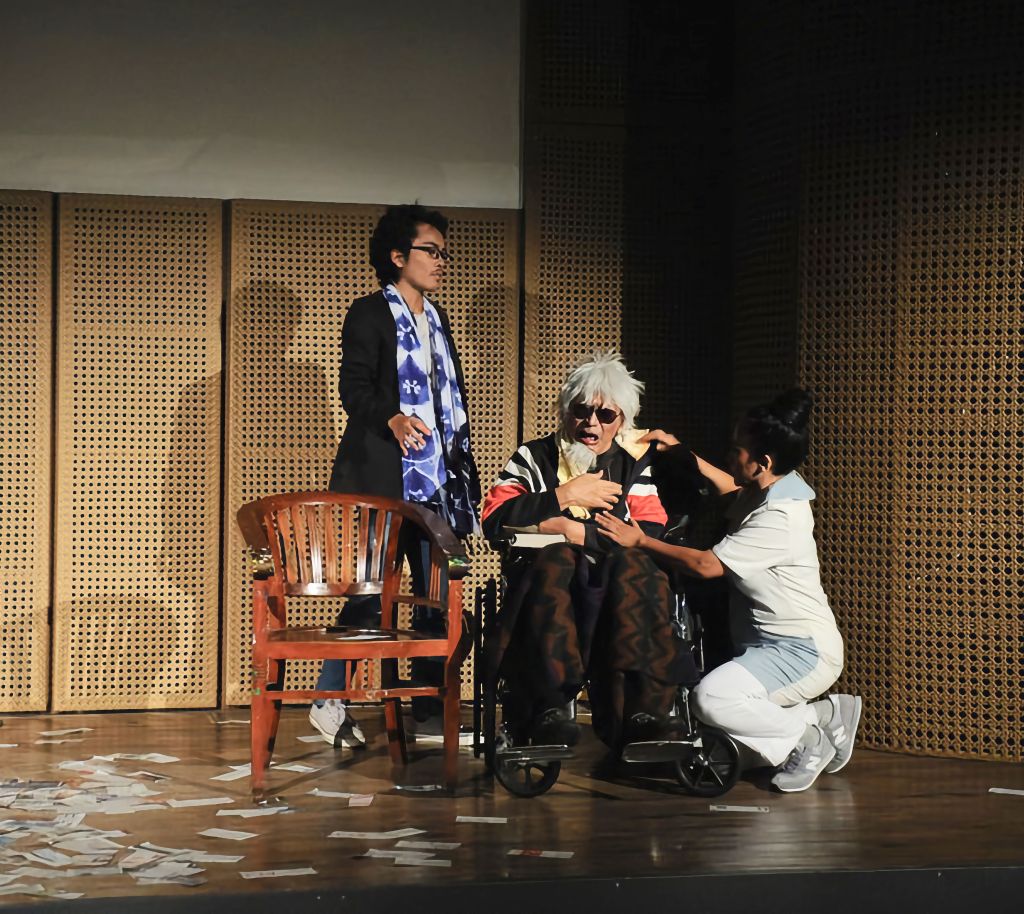
The drapen version of OH was first performed at GIK on February, 25, 2017. Theproduction was directed by Putu with the following cast, that included himself, his son, his wife, and a member of Teater Mandiri:
Taksu Wijaya YOUNG ATTORNEY, handsome, loquacious
Putu Wijaya SENIOR ATTORNEY, his dying father
Dewi Pramunawati NURSE
Ari Sumitro RIOTER, representing a crowd of rioters
OH was critically acclaimed and went on to be performed in thirteen different venues across Indonesia. Beginning with the premiere at GIK, it was precisely the emptiness of the stage that sparked the spectators’ imagination and kept them attentive. It showed that theater does not need to be a prepared, ready-to-eat meal or a spectacle to pamper guests, but something that needs to be worked out together. There is no divide between spectacle and spectators. Reality exists not merely in visual representation but in the imagination of both performers and audience. What exists is a common event: ana tan ana, “real but invisible.” The play doesn’t take place in front of the audience, but in the mind of the Senior Attorney. It is the inner voice of a Senior Attorney rendered speechless by a stroke, yearning to reunite with his only son, now a prominent lawyer in his own right. When the Young Attorney finally visits, he does so not as a son, but as a driven lawyer seeking his mentor’s advice on a case involving a drug dealer facing the death penalty. By the end, it is revealed that it is the ghost of the Young Attorney returning to apologize for not coming as a son during their last meeting. But it is too late—nothing can be undone.
The following is a translation of the 2021 monodrama version of OH, rather than the monologue or the drapen. Like a monologue, there is only one character that speaks, but in this monodrama version, there are other characters involved in the narrative, but who remain unseen. They must be invoked by the spectators’ or readers’ imagination. This English translation premiered on June 25, 2021 as an online live-streamed staged reading directed by translator Cobina Gillitt. The premiere was co-hosted by Beyond Home Borders: A Fundraising Festival for the Lontar Foundation, a Jakarta-based publisher of Indonesian literature in English, and the 2021 AIFIS-MSU Conference on Indonesian Studies: Paradigms and New Frontiers. Taksu Wijaya reprised his role as the Young Attorney (in English) while the Offstage Narrator was read by Cobina Gillitt.
Putu Wijaya is one of Indonesia’s most acclaimed and prolific playwrights and monologists. He is also a director of stage, screen, and television, an actor, a novelist, a short story writer, and cultural critic known for his innovations of post-1968 Indonesian theatre and literature. His plays mix Western and traditional Indonesian performance aesthetics and spirituality. In l972 he formed Teater Mandiri, and serves as the group’s artistic director and playwright. Mandiri is Javanese for “independent”—a guiding concept for the group whose motto is “to build from what is at hand.” By irreverently mixing fantasy and reality, Putu invokes “mental terror” in the hearts of his audiences. He attacks the monotonous rhythms of daily life and apathy toward the status quo. In order to create this sense of terror, Putu has often used dozens of actors, deafening music and sound effects, jarring images, colorful costumes, sets, and props, loud delivery, burning incense, and nonrealistic situations. Teater Mandiri has performed Putu Wijaya’s plays under his direction in Indonesia, the United States, Japan, Taiwan, Hong Kong, Singapore, Brunei, Egypt, Germany, the Czech Republic, Belgrade, and Slovakia. He has published more than forty plays, dozens of monologues, over thirty novels, and fifteen short story anthologies, and has written and directed close to two dozen screenplays and television series. He regularly performs his monologues and has conducted workshops around the world, including at the 2007 La Mama International Symposium for Directors in Umbria, Italy. His plays translated into English include Geez (Gerr, trans. Michael Bodden, 1986), Roar (Aum, trans. Michael Bodden, 1986), and Ought (Aduh, trans. Cobina Gillitt, 2010).
Cobina Gillitt (PhD) is a translator of Indonesian plays and a freelance new play and production dramaturg located in New York City. She has been a member of Putu Wijaya’s theatre company, Teater Mandiri, since 1988 and has performed and toured with the group in Indonesia, the US, and Germany. Her most recent collection of play translations is Era of the Bat: Six Political and Abstract Plays by Ikranagara (Lontar Foundation, 2024) for which she also wrote the introduction. She edited and wrote the introductions for the anthologies The Lontar Anthology of Drama, Vol 3: New Directions 1965-1998 (Lontar Foundation, 2011; University of Hawaii Press, 2017) and Islands of Imagination I: Modern Indonesian Plays (Hawaii University Press, 2015) both of which also include several of her translations. Other published translations can be found in New Indonesian Plays (Aurora Metro Books, 2019), Three Plays by Three Indonesian Playwrights (Jakarta Arts Council, 2006), and Playwriting Workshop: Three Selected Plays (Jakarta Arts Council, 2006). Her scholarship on contemporary Indonesian theatre includes “How the Fish Swims in Dirty Water: Antigone in Indonesia” in Antigones on the Contemporary World Stage (Oxford University Press, 2011) and “Indonesian Theatre and its Double: Putu Wijaya Paints a Theatre of Mental Terror” in Performance of the Senses (Routledge, 2006).
OH
A Monodrama
By Putu Wijaya
Translated by Cobina Gillitt
Cast:
YOUNG ATTORNEY, handsome, loquacious
NARRATOR, offstage voice
Empty stage, except for a single empty chair. Through the YOUNG ATTORNEY’s dialogue and gestures, it becomes apparent his father, the Senior Attorney, lies on a wheeled hospital bed or sits in a wheelchair, attended by his caregiver, the Nurse. The YOUNG ATTORNEY’s dialogue and gestures indicate the actions of the Senior Attorney and the Nurse throughout the play.
NARRATOR: (Offstage)A renowned Senior Attorney, who lost his ability to speak after suffering a stroke, is getting his morning sun accompanied by his nurse. Because he misses his son, who’s an up-and-coming attorney, he has asked that his son keep in touch by paying a visit. The Young Attorney, his son, does in fact arrive for a visit, but not in his role as a son, but as a lawyer. What follows takes place within the Senior Attorney’s mind.
YOUNG ATTORNEY: (Offstage) Nurse… Nurse…
(YOUNG ATTORNEY enters. He’s wearing a suit, carries a briefcase and a bouquet of flowers. Takes a seat.)
Professor, doctor, maestro, superstar, the greatest and most indubitable of all teaching gods, national asset, universal role model, unequalled legal expert, and my most beloved father, good morning.
(Gestures for the Nurse to move away from his father, the Senior Attorney. Moves closer.)
But I haven’t come here as your son. I’ve come here as an up-and-coming attorney dedicated to enforcing justice in this chaotic country.
I don’t know what the founding fathers would say about the current state of our nation if they were still alive today.
It used to be we didn’t have to decode things. Our enemies were obvious: the invaders, the colonial armies—Dutch and Japanese—and we knew what we wanted: independence. “We the people of Indonesia hereby declare the Independence of Indonesia. Matters concerning the transfer of power and other things will be executed by careful means and in the shortest possible time.”[2] But now, we don’t know who or what our enemies are: Ideology? Political parties? The community? A specific group of people? Just anyone? We are blanketed in a thick fog!
There’s no discussion about this at all. It’s thrown us into a vicious cycle, where for decades we’ve been running in place; in other words, stuck. Or moving backwards, even. We’re in decline. Abuse of power, corruption, manipulation, even betrayal of the Revolution and so on. All of it only enriches television executives and newspaper magnates with more subscriptions. (Outraged) Holy shit! Bullshit! It’s become absurd. Complicated. What?
Yeah, I know a lot of issues are obviously different and have to be different because their essential natures are fundamentally different. Impossible to reconcile. Like oil and water. Earth and sky. Heaven and hell. Love and hate.
What?
(Whispers softly) Yeah, what can we do? We have to accept the truth according to our Eastern mindset; we have to submit to the circumstances without reservation. I agree with that up to a point. I understand.
However, we can’t get rid of our habit of dreaming for something better because that’s also part of our reality. A basic fact of human existence is that it’s driven by a desire to live by blessings from on high. The most obvious thing of all is that reality is a dream because that’s what we mostly do. Dreams surround us every day; dreams surround everyone every second.
One person dreaming of unity makes him a hero in history. But what about a whole nation? If everyone in the nation has a dream, if everyone wants to lead, then we enter a black hole twisted up with all the crap we’re going through now. CHAOS. CRAZINESS.
But what can we do? That’s reality.
(Reflects.)
I don’t want to protest anything. Why do we have to resist? No, I am not a dreamer. I refuse to be infected with that malignant virus. I’ll stick with a single question, one I ask myself every second.
So what!?
I haven’t come here as your son. I’ve come only as a tiny cog in a giant mechanical machine we call country and nation. Sorry, this is no publicity stunt, but actual fact. This fact is: I am the hope now. And you, you’re the maestro. You are a wonder of the ages who has always taught me to accept reality. This is the result, this is the result, this is the result! I’m spearheading a quest for justice in this country torn apart by corruption, terrorism, anarchism, and radicalism.
We scoured Europe. We deconstructed the Ancient Greek philosophers, as well as those from Germany and France. To that we added Nietzsche, Karl Marx, Machiavelli, Freud, Jean-Paul Sartre, Albert Camus, Derrida, Foucault! But what we’ve forgotten is that we actually have an ambitious, but genius, young attorney who has the vision his country actually needs now.
You must understand what I mean. Who else is going to sing my praises, if not me, who truly understands what’s going on.
Everyone else is too busy playing politics and is so buried by knowledge stolen from elsewhere that they’ve forgotten our country’s basic ideal of unity in diversity.
Not me. I am the only one who has been awakened with a sane, unpolluted mind at the outset of this tempest destined to destroy our nation.
(Beat.)
(Heatedly) I won’t give up. I refuse to accept that 350 years of suffering, of sacrifices paid with lives, blood, and tears, will just go away with one protest rally by a bunch of radicals.
(Quietly whispers) Many things are different and will continue to be different, even contradictory, because their essential natures are the way they are. Impossible to reconcile.
This world is entirely new.
You were young once. Your reputation is beyond reproach. Surely you must understand what I mean. (Annoyed) This is not about some offensive dickhead trying to get publicity. (Panics) Okay, maybe it is offensive. But a reality so incredibly… (Quietly) …offensive needs to be wiped out using offensive methods.
(Slows down his breathing. Continues.)
Let’s you and me separate our family affairs and personal interests from the struggle for justice. Not like those other lawyers these days who are mostly about making deals, or those elites and intellectuals who shine when they are powerless, but who, from their new seats of power, become more…(Louder) violent, greedy, materialistic, merciless, and despicable once they get the opportunity to trample on justice and truth they once idolized.
(Stands on the chair.)
I’m not that different from you when you were young, professor. Maestro, have you read my biography, recently written by Professor Douglas, Ph.D. and Professor Rebecca, Ph.D., from a first-rate American university? They call me, Hungry Lion.
It’s true, I’m always ravenous, gluttonous, insatiable, wild and crazy on the hunt for the thieves of justice, nestled in our acclaimed institutions, multi-story buildings, and NGOs backed by foreign capital. They’re the ones who crafted this culture of evil in our country. You can learn a lot from that book.
(YOUNG ATTORNEY pulls out a cigar from his suit jacket pocket and begins to light it, but the nurse gestures that there’s no smoking allowed. YOUNG ATTORNEY nods.)
Oh, pardon me Nurse, I was only going to hold it, not smoke it.
(Hands the cigar to the nurse who takes it away.)
Thank you!
(He takes out another cigar and smells it.)
Where was I? Right. I’m stepping into the struggle for justice in this impotent toothless tiger of a country which, instead of using what’s left of its strength to fight, lazes around enjoying itself. Oh! This is insanely embarrassing. It just doesn’t make sense. But this is reality. Our reality! The older generation slacks off, the younger generation jacks off. People are racing to dig their own graves.
This is how it ends, our great historical legacy, passed down from the ancient Majapahit kingdom to form our great nation.
So what?! Oh my God! So whaaat!
Knock on wood.
(Throws the cigar. Picks it up again.)
Again, let me be clear. I didn’t come to challenge or to praise you, professor. Maestro, given your history, you are too much of a titan to defy, although you’re not free from criticism. I’m just suggesting a few corrections to your dispensed wisdom. (Humbly) Besides, I’m too insignificant to stand up to you. I’m not even worthy enough to compliment you. (Louder) You no longer require any reproach or praise because, not only are you an uncorrupted enforcer of justice, successful and impeccable, but you are: justice itself!
Let’s speak man to man, as equals, as true professionals, as fellow justice hunters, rather than as father and son, as family with all that time-wasting drama and meaningless small talk.
(Explosively) We’ve become 250 million resplendent rosebushes perishing on this Emerald Equator!
(Offstage, NURSE gestures for the cigar.)
(YOUNG ATTORNEY puts the cigar in his pocket and waves the NURSE away.)
Huh!? Oh, pardon me, Nurse. I’m almost done. Please, just five more minutes.
(The NURSE gestures to him to give up the cigar in his suit jacket.)
Fine, fine!
(He hands the cigar to the NURSE.)
(The YOUNG ATTORNEY follows the NURSE with his eyes as she walks away.)
Thank you, Nurse!
(He takes another cigar from his suit jacket. Laughs.)
This is just part and parcel of your training, your merciless training.
I’ve got to praise you; I can’t forget. I must shower you with praise! Your accomplishments have become… (Flatteringly) …historic monuments. And among them, there’s not one that needs improvement. You achieved it all flawlessly. Brilliantly. Fantastic. Over the top, Maestro. But that was then. Then is not now. It would be a fatal mistake to do it that way now. We need to find another way! Something totally different! (Speaks more forcefully) Because what we thought we knew is now false, false, false! F-A-L-S-E! False! Sorry, Maestro. It’s a fact. Don’t get all offended.
(Sounds of a riot coming closer.)
What!?
(Looks out at the audience.)
What? What is it!!?
(YOUNG ATTORNEY stands on the chair and points at the audience.)
No, I will not stand down. I will say what I need to say even if you don’t agree or don’t want me to say it. I’m not going to self-censor. I’m not interested in stifling myself! I can’t step back! But I’m also not someone who gets stuck in fixed narratives or doctrines. Like a mountain spring, I can only flow, gurgling along with the sounds of nature.
There’s a non-stop insistent voice deep in my heart that talks to me, even when I’m sleeping:
Young man, your country needs you!
Young man, your country needs you!
Young man, your country needs you!
Young man, your country needs you!
Young man, your country needs you!
I came here wanting to hear what you have to say, Maestro. I want to have a discussion. I’m now going to freely say what’s on my mind.
(YOUNG ATTORNEY returns his attention to his father.)
My apologies, but here I go.
(YOUNG ATTORNEY takes a deep breath. Speaks forcefully but not overly loudly.)
The State recently requested that I defend a major criminal facing two death penalties. Two! A faction of the criminal’s extended family even came to my house to express their joy at the State’s fairness in providing them with such a first-rate defense attorney as me. But I categorically turned it down! Why? Because I believe the State didn’t really want me to defend the criminal. The State only wanted to put on a spectacle to demonstrate that this deplorable country, devoid of the rule of law, is undergoing a new awakening.
Drug lords, treasonous financiers, and the most wicked, cruel, and barbaric criminals are all given mighty first-rate defense attorneys, like this Mike Tyson here. (Laughs) By the way, I didn’t come up with that. I borrowed it from what the so-called pundits call me on social media (quickly) because I always manage to win everything I’m handed.
Actually, I wanted to speak out and say NO. To tell the State no because it’s not acceptable for those who dispense justice to turn everything into a circus unless the justice they’re advocating is heartless and inflexible. The State kept trying different ways to convince me to take up this case. (Whispers) It made me suspicious. There must be a reason behind it all.
(To the audience) So I began a deep investigation and I discovered the facts. (Quickly) As a result, my conclusion is the State is already deep into choreographing this spectacle. The State wants to show the people and the world that criminals, no matter who defends them, will be found guilty and convicted. If the State can still throw a bastard like that under the bus at the last minute by giving him the death penalty, even if he’s being defended by a first-rate attorney like me, it’s a double victory for the State, decisive and spotless, because I, with my impeccable record, becomes their guarantee!
(Softly again) The State wants to make me a loser. And that’s what I want to challenge!
The State must instead advocate that justice can only be achieved transparently and without corruption, as you have always advocated, Maestro. You are still listening, right? I didn’t come here to ask for your judgement whether my decision to refuse the State’s request was right or not because I already refused it! I came here because, even after the State accepted my refusal, that shithead criminal came to my home and begged me, on his knees, to defend him!
(SENIOR ATTORNEY whispers something.)
(Startled) What? How did you know that I accepted in the end, professor? (Confused) What? Because you know who I truly am??! (Bursts out laughing.) Oh, Papa, Papa. Yes, it’s true, I did accept because I’m a professional. As a professional attorney, I can’t refuse anyone who asks me to represent them in their defense. As a defense attorney, I serve those who need my expertise to help the courts reach fair and just decisions.
(Sadly, without inflection) So, this is what I want to figure out. Was this decision the correct one? Was my decision the correct one? That, among other things. Not to second guess the reality of the situation, but as we discussed earlier, how do I remain professional?
(Loudly) I rejected the State’s request because it wasn’t really about the pursuit of truth and justice, as you’ve advocated as a legal expert, but because it was already tainted with politics. POLITICS! (Softly) However, why is it when I get the same offer from a mobster, I take it on without caring that this guy deserves to be executed twice over? Why? Why? Why?
(Loudly) Because as a professional, I can’t refuse those who request my help to defend them from corrupt courts that play dirty just to reach a quick verdict. I can’t refuse as long as the request is free of blackmail and bribes and coercion. Am I defending him out of fear? No way! Why be afraid? Absolutely not! And it has nothing to do with money. Nothing! I cannot be bought! I never have been and I never will be! This is precisely why I’m richer than all those gangster justice mafia lawyers. It has absolutely nothing to do with money. I already have too much money; I don’t need any more. It’s money that needs me! Nor is there some kind of psychological reason. So, why then? Why then? Why do I defend him? The media and the public are asking. I can answer this in just four little words.
(Beat.)
Because I…want to. Period! Because I decided to represent him.
So that he’d win? There are no winners in the hunt for justice. There’s only the attempt get as close as possible to the truth because genuine truth, the most truthful truth, is probably an unachievable dream. It belongs to Him, up there. Winning or losing isn’t the issue anymore. The most important thing is the pursuit and in order to glorify this process, I took on that son of a bitch as my client.
Was my decision wrong? Like I said already, right or wrong isn’t the issue. There’s only one possibility. If I defend him, I come out the winner. I don’t underestimate the state-appointed prosecutors. I’ve heard they’re supplying a very tough team. But I’ll win anyway. I will definitely win! How do I know I’ll win?
I’ve been an attorney for many years. I always know what the verdict will be even before the case begins. Not because of the content of the case, but because of the issues surrounding it. This time I’m too big to fail!
(Takes a deep breath. Continues sadly) It’s not arrogance but sadness. Honest. I will win. The criminal will be released because I will win the case… (Loudly) …because the State doesn’t have any solid evidence. The State only has passion, the desire for the death penalty, but no proof. (Sentimentally) That’s what makes me sad.
(Sounds of a rioting crowd becomes loud. YOUNG ATTORNEY tries to reason with the angry mob.)
It’s true! Oh, no. Absolutely not! No way! I swear! Oh, I am representing the son of a bitch, but not out of fear, okay? No! Why be afraid?! I’m not being threatened. Threatened with what? Large sums of money are indeed a kind of threat. But it’s not about the right figure. No way! I can’t be bought!
(Startled) What??? I swear on my life! There is absolutely no talk of payment! It’s all free! 100 percent professional! I don’t profit from other people’s misfortunes! I’m not in the medical insurance industry. There are no brokers involved! It’s not mafia justice! No bribes. This is clean justice. And I will win! Without a doubt, I will win!
(The crowd quiets.)
Huh? What will happen when that crook wins? The State will learn an important lesson. Don’t mess with the law! Crime is too dangerous for the State to gamble away its dignity. Leaders, don’t be idiotic!
(Sounds of riots again.)
Silence!
(Crowd falls silent.)
I will win this case. And I’m not defending him out of intimidation or bribery. He asked for help, without threats and without bribes. I am not being coerced. I took on this case with no expectation of payment or protection from any future consequences. I’m not looking for publicity and neither am I looking for awards from foreign humanitarian organizations that hate our country. No! Absolutely not! I swear. I will win because the State isn’t ready. It doesn’t have any strong evidence. Its team is behind the ball and the prosecutors aren’t on the same page. They’re dimwits. And the judges have been groomed.
(The Senior Attorney cries out. The nurse gestures for YOUNG ATTORNEY to leave.)
Okay, I’m done. Please, just give me two minutes to finish up. Thank you.
I won’t delay any longer. My decision to deliver this important lesson to the government is final. It’s because I love this country. So this wrongdoing isn’t repeated. Like you always said, the legal system is constantly undermined by allegations of ulterior motives other than truth and justice. In the end, when those accusations are shown to be false, you only win more acclaim as long as you follow your principals as a professional officer of the court.
(The nurse waves YOUNG ATTORNEY away.)
Okay, the nurse is sending me on my way. No more discussion. Got it. I’m done. Please, rest now because later, once all of this has become history, I would like you to wake up, smile, and we can talk at length, not as professionals, but as father and son. Have a good afternoon.
(YOUNG ATTORNEY exits. Blackout.)
[The following can be enacted onstage, shown as a video, represented abstractly with lights and sound, and/or spoken as a voice over by the NARRATOR.]
NARRATOR: The Young Attorney won the case and the Senior Attorney’s worst fears came to pass. Sounds of rioting fill the air. The riot abruptly ends with the sound of gunshots. Flag-bearing rioters attack the Young Attorney. They wrap him in a flag and beat him with a flagpole.
Lights Up. The YOUNG ATTORNEY is wearing a t-shirt covered in blood. His hair is disheveled. He carries a bouquet of flowers.
YOUNG ATTORNEY: Good evening, Papa. Sorry I couldn’t get here until now. Yes. Yes. Just like I told you, the State’s evidence was insufficient and weak. The trial was quick. I won the case, which means I set that bastard free, that cursed son of a bitch, feared by all. Once freed, he flew off like a bird into the sky. And with that, I hope our country advances.
The law cannot stand on its own because laws are merely inanimate tools. Human beings are what give them life. Laws come to life when living humans enforce them with established regulations. Courage is not enough; skill is also needed! It’s not enough to clench fists and make wild assertions. Strength and numbers don’t guarantee a case will be won. Ingenuity is required, and if needed, cunning as well! Justice can’t be dispensed arbitrarily because the highest form of justice in a lawful state rests in the hands of the law. Without laws, we would become a nation of savages and outlaws.
Everything I predicted has come true. In court, I brilliantly defeated the State with ease and freed the king of criminals. The shithead chortled with glee. He celebrated his victory with an all-night fireworks party, and then took off overseas with his whole family and all his ill-gotten gains stolen from the people! Out of reach for good.
(Sounds of people rioting.)
The masses are running amuck. They’re rioting! They’re burning with rage and flowing like hot lava into the streets! They’re stampeding, yelling, and carrying giant posters. The courthouse has been raided and set on fire! The judges are rushing out! And I, your one and only son, has been captured! Tortured! And in the end, I return as a corpse.
(The Senior Attorney begins to cry.)
Let him cry, nurse. When great men cry, it doesn’t mean they want to be comforted. Rather, it’s a sign they’ve noticed something ordinary people fail to see. Thank you, nurse.
Yes, correct Papa. You anticipated it would end like this. Your lifelong hope didn’t come to pass. My apologies. I’m sorry! I should have listened to your nurse. You asked for your son to visit, the fruit of your loins, not some ambitious, arrogant, foolish, and self-aggrandizing young lawyer claiming he was defending the mandate of a suffering population. In fact, it was nothing more than a few homegrown subversive cells whipped into a frenzy, incited by those who want to deny our existence and disregard the law.
FIN
[1] The majority of Indonesians do not have a family name at the end of their full name. Therefore, in Indonesian journalism and scholarship, the convention is to refer to a person by full name or chosen nickname rather than a “last” name. It is not a sign of familiarity or disrespect. In Bali, where he was born, “Putu” refers to his birth order among his siblings and “Wijaya” is part of his full given name—I Gusti Ngurah Putu Wijaya—but is not a family or last name. However, due to international convention, bibliographies will list him under Wijaya.
[2] Quoted from the Indonesian Proclamation of Independence read aloud by Soekarno, Indonesia’s first future president, on August 17, 1945.
 The Mercurian